

Table of Contents
So you need a car that’s great in snow and will actually work. Not just look tough in a photo. A good snow car has to do three things at once. Get moving on a slippery road. Stay in control on ice. And stop in a reasonable distance when the weather turns nasty. Sounds simple, right? It is not just about size, and it is not just about power either. You need the right tires, a drivetrain that sends power to the wheels that actually have grip, enough clearance so you do not end up plowing snow with your bumper, and safety systems that step in when a wheel starts to slip. This guide covers cars and SUVs together, by size and by need. Whether you drive mostly on plowed city roads or on unplowed rural roads, you should find a clear answer here.
What you need to know first
- Winter tires matter more than the drivetrain for stopping and turning. All wheel drive helps you get moving, but it does not make ice less slippery when you brake.
- For most drivers on plowed roads, a good all wheel drive car with winter tires is enough. For deep snow and unplowed roads, four wheel drive with low range gearing and high ground clearance is the stronger choice.
- Ground clearance matters in deep snow. The main competitors use at least 5.5 inches as a minimum for a snow list, and most strong picks sit at 8 inches or more.
- Subaru Crosstrek is the most repeated affordable pick across the top lists, with standard all wheel drive and at least 8.7 inches of ground clearance.
- For families, the best three row choices in the research are Subaru Ascent, Toyota Grand Highlander, Kia Telluride, Honda Pilot, and the larger Chevrolet Tahoe and Ford Expedition.
- For luxury buyers, Acura RDX, BMW X3, Lexus GX, and Volvo XC90 stand out, each for a different reason, from torque vectoring to full time four wheel drive.
- Not every SUV has four wheel drive. Many SUVs are front wheel drive as standard, and all wheel drive is an option you must check trim by trim.
- Electric cars can work well in snow with all wheel drive and a snow mode, but cold weather reduces range, so home charging and a realistic winter range plan matter.
What make cars great in snow
• Grip when it starts to move, from tires that stay soft in cold weather and from a drivetrain that can send power to more than one axle.
• Stability when it is already moving, from traction control and stability control, which use the brakes to slow a spinning wheel and help the car keep its line.
• Clearing snow instead of plowing it, from ground clearance, which is the distance between the ground and the lowest part of the car.
• Seeing clearly and staying warm in bad weather, from heated mirrors, heated seats, a heated steering wheel, good headlights, and wipers that do not freeze.
Here is the thing. No single feature does the job on its own. I have seen it the other way around too. A big SUV with four wheel drive and summer tires? That can be worse in snow than a small car with winter tires. Seriously. And a small car with winter tires can still get stuck if the snow is deeper than its clearance. That is why the best guides never judge a car by one number. They look at tires, drivetrain, clearance, and winter features together, and they say clearly which kind of winter driving each car actually suits.
Winter tires come before any drivetrain
This is the point almost every top competitor agrees on. And it is the point most buyers get wrong.
All wheel drive and four wheel drive help you get moving. That is it. They do not help you stop on ice. They do not help you turn on ice. Stopping and turning depend on grip between tire and road, nothing else.
Winter tires use softer rubber that stays flexible when it is cold, and a tread pattern made to bite into snow and clear slush. All season tires get harder as the temperature falls. And you feel that loss of grip first when you brake. That is a scary moment to learn it in.
Want a number that sticks? In snow testing quoted in the research, an all wheel drive SUV on all season tires took almost 700 feet to stop from 60 miles per hour. On new winter tires, that same kind of SUV and a front wheel drive sedan both stopped in about 300 feet. Exact numbers will change with car, tire, and road, sure. But the direction is not even close. If snow stays on your roads for weeks, a second set of wheels with winter tires is often a better first spend than a bigger car.
Winter tires help in heavy rain and wet weather too, because their tread clears water and the compound stays grippy in the cold. They are not magic, though. They do not make you safe on glare ice. No tire creates grip where there is none. But for normal snow, slush, and cold wet roads? Winter tires are the single biggest safety upgrade in this whole topic. Hands down.
All wheel drive versus four wheel drive in plain words
People use these two words like they mean the same thing. They do not. Let me put it simply.
All wheel drive is made for normal roads. In most modern systems, the car drives with two wheels most of the time, then sends power to the other wheels automatically when it senses slip. Some systems, like Subaru Symmetrical All Wheel Drive, send power to all four wheels all the time. You do not switch anything on. It just works, on dry roads, wet roads, and snow covered roads alike.
Four wheel drive is made for harder work. In a traditional system, you select four wheel drive, and a transfer case splits power between front and rear axles. Many systems offer a high range for normal slow off road driving and a low range for very slow, very hard work, like climbing a steep icy hill or pulling out of deep snow. When a traditional four wheel drive system is locked, front and rear wheels turn at the same speed. Great on a slippery surface. Bad on dry pavement, because turning gets difficult. That is why older four wheel drive cars had to go back to two wheel drive on dry roads.
Modern systems blur the line, honestly. Many four wheel drive SUVs now have an automatic mode that works like all wheel drive on mixed roads, and only locks in when things get really bad. Many all wheel drive systems now offer a lock mode or a center differential lock that mimics four wheel drive for a short stretch.
So what should you actually do? If most of your winter driving is on plowed roads and highways, all wheel drive is easier and usually enough. If you regularly face deep snow, unplowed roads, steep driveways, towing in winter, or rural routes that do not get cleared quickly, four wheel drive with low range and high clearance is the safer choice.
Snow modes sit on top of both systems. A snow mode usually softens throttle response, so your wheels do not spin the second you touch the accelerator. It changes how traction control and stability control behave, and in some cars it makes the gearbox start in a higher gear. Deep snow mode goes further, allowing a little more wheel spin to dig through deep snow, while still keeping the car stable. A snow mode does not replace winter tires. It does not replace clearance. But on a car that already has both, it makes winter driving calmer. More predictable. Less stressful.
Best small and compact cars and SUVs for snow
Small cars get dismissed for winter driving all the time. That is a mistake, in my opinion. A small car with all wheel drive, decent clearance, and winter tires can be excellent on plowed roads. Plus it is easier to park, cheaper to run, and easier to control in a slide than a very large SUV.
Subaru Crosstrek
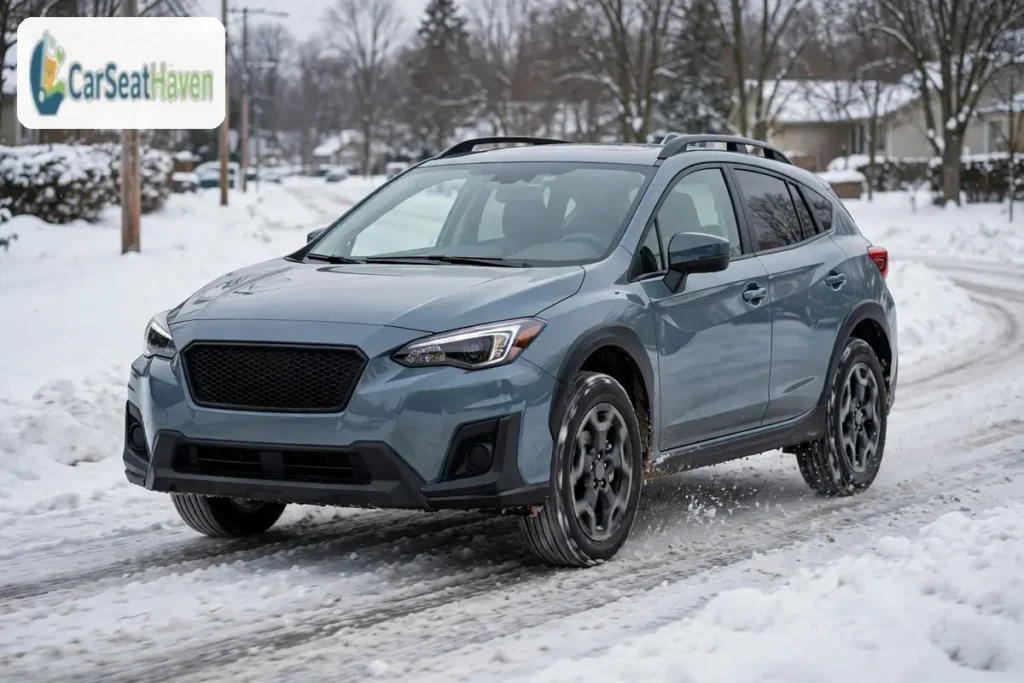
The most repeated small pick in the research is the Subaru Crosstrek, and it is easy to see why. Subaru calls it a small crossover, but in practice it is a raised hatchback with standard Symmetrical All Wheel Drive, at least 8.7 inches of ground clearance, and a Deep Snow drive mode on Sport, Limited, and Wilderness models. Edmunds reports the 2026 Crosstrek at 28,415 dollars, and reports the Crosstrek Sport at 32,440 dollars including destination. CarGurus puts the Crosstrek Wilderness at the top of its SUV snow list, with 9.3 inches of ground clearance, all terrain tires as standard, and X Mode with hill descent control. That combination explains why the Crosstrek appears on both the best cars list and the best SUVs list.
Hyundai Kona
The Hyundai Kona is the other small SUV that Edmunds highlights. It is a little more expensive than the Crosstrek when all wheel drive is added, because all wheel drive is standard on the Subaru and optional on the Hyundai, but Edmunds rates it as its top extra small SUV for room, features, and technology. Edmunds reports the 2026 Kona at 28,450 dollars with all wheel drive. It can be ordered with a turbocharged engine making 190 horsepower, which makes it more entertaining than most small SUVs, while still keeping the size and clearance that work well on snowy streets.
Mazda 3
For buyers who want a small car rather than a small SUV, the Mazda 3 is the strongest sedan and hatchback pick in the Edmunds cars list. Its i-Activ all wheel drive system is optional on both body styles, and Mazda says it is predictive rather than reactive, using sensors that read road conditions and outside temperature many times per second. The standard engine makes 191 horsepower, and the optional turbocharged engine makes 250 horsepower. The Mazda 3 does not have the clearance of a Crosstrek, so it is a better pick for plowed roads than for deep snow, but with winter tires it is a calm and capable winter car.
Honda Civic
The Honda Civic appears on the CarGurus cars list, and it shows the limits of a good small car. It is efficient, well built, and fun to drive, but all wheel drive is not available, and front wheel drive is standard across the range. That does not make it useless in snow, especially with winter tires, but it does mean a buyer who lives in a heavy snow area should look at the Crosstrek, Kona, or Mazda 3 first. The Civic is a reminder that a good car and a good snow car are not always the same thing.
Best midsize SUVs for snow
Midsize SUVs are the sweet spot for many winter buyers. They are large enough for a family and for winter gear, but not so large that they are hard to park or hard to control on a narrow snowy road.
Jeep Grand Cherokee
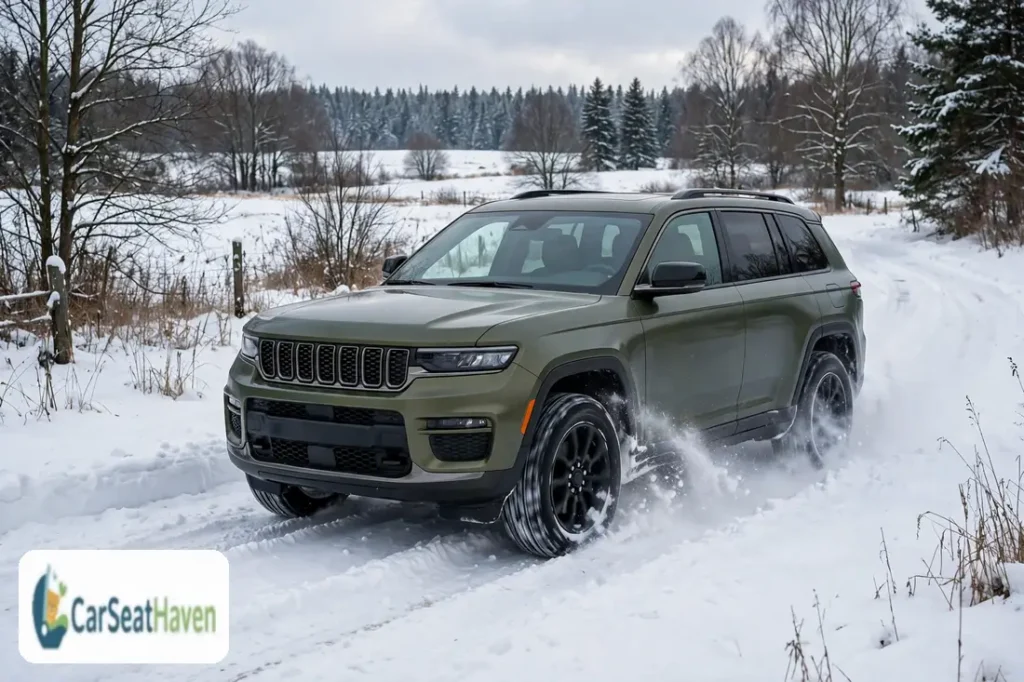
The Jeep Grand Cherokee is the most capable midsize pick in the research. It offers three four wheel drive systems. Quadra Trac I is a full time system for everyday driving, including snowy pavement. Quadra Trac II adds a transfer case with a low range setting for harder work. Quadra Drive II adds an electronic locking rear differential for the toughest conditions. Its Selec Terrain system includes a dedicated snow mode, and with the available air suspension, ride height can rise to nearly 11 inches, which is excellent for deep snow. Edmunds reports the 2025 Grand Cherokee at 41,630 dollars with all wheel drive. For buyers who need a third row, the extended Grand Cherokee L is the same idea in a larger body.
Acura RDX
The Acura RDX is the midsize luxury pick that appears on both the Edmunds and CarGurus lists. It comes standard with Super Handling All Wheel Drive, which does more than split power between front and rear axles. It actively sends power to the rear wheel with the most traction, which helps the car stay stable and turn more cleanly on slippery roads. Edmunds reports the 2026 RDX at 46,450 dollars. Its towing capacity is 1,500 pounds, which is enough for a single snowmobile, while the larger Acura MDX, with similar all wheel drive benefits, can tow up to 5,000 pounds for buyers who need more.
Subaru Forester
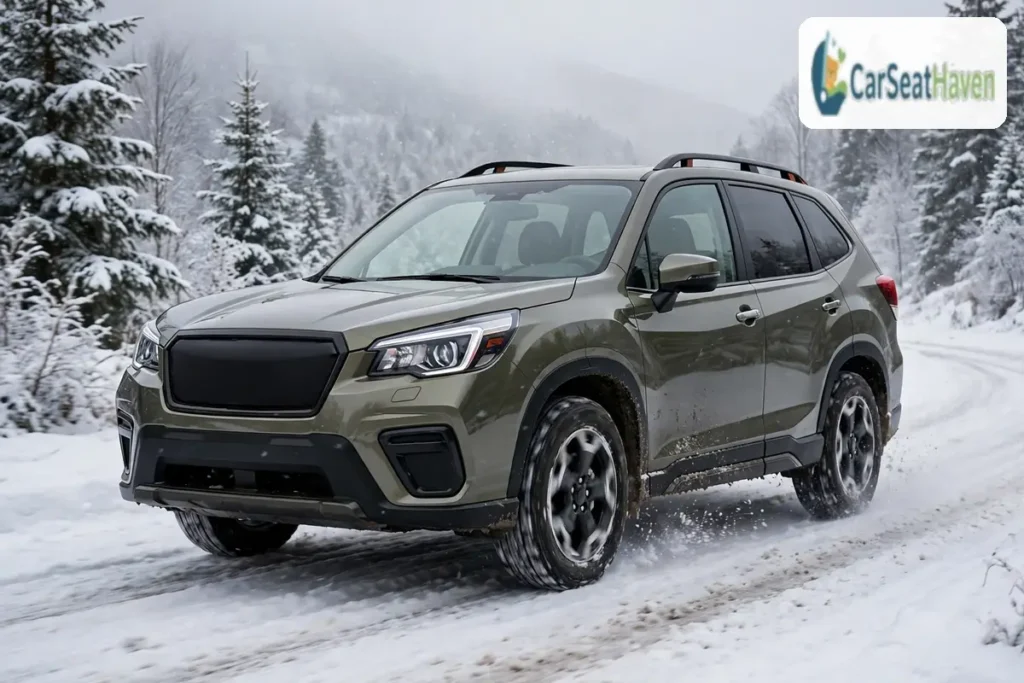
The Subaru Forester is the midsize family pick that CarGurus and Autoblog both highlight. The standard Forester already comes with Symmetrical All Wheel Drive, and the Wilderness version raises clearance to 9.3 inches, adds all terrain tires, underbody protection, and X Mode with Snow and Deep Snow settings. Autoblog reports the 2026 Forester at 29,995 dollars. It is not the quickest SUV in this group, and its infotainment is not the most polished, but for a buyer who wants a purpose built winter SUV without paying luxury prices, it is one of the most honest choices in the research.
Toyota RAV4
The Toyota RAV4 is the midsize efficiency pick. CarGurus highlights the Woodland trim for winter buyers, because it adds all terrain tires and extra clearance, turning a practical compact SUV into a car that can handle unplowed roads rather than only light snow on a highway. The RAV4 is also one of the most reliable and fuel efficient choices in this group, which matters when winter driving means long commutes in bad weather. Its main weakness is not winter capability but choice, because the trim range is wide and can be confusing to navigate.
Best family SUVs with three rows for snow
A family SUV for snow has to do two jobs at once. It has to keep grip in winter, and it has to carry people and gear without feeling cramped.
Subaru Ascent
The Subaru Ascent is the three row Subaru, with standard all wheel drive on every trim, which is unusual and welcome for winter buyers. CarGurus reports a turbocharged 2.4 liter engine making 260 horsepower, and cargo space of 17.8 cubic feet behind the third row, 43.5 cubic feet with the third row folded, and 75.6 cubic feet with both rear rows down. Its safety ratings from both major testing bodies are strong, which matters when a car regularly carries seven or eight people through winter conditions.
Toyota Grand Highlander
The Toyota Grand Highlander is the three row Toyota that Autoblog highlights. It offers available all wheel drive for a modest extra cost on lower trims and as standard on higher trims, along with strong ground clearance and a Multi Terrain Select system on Platinum trims and above that includes Snow and Mud modes. Autoblog reports it at 41,360 dollars. It is a good pick for families who want space, efficiency, and a calm winter drive, rather than extreme off road capability.
Kia Telluride
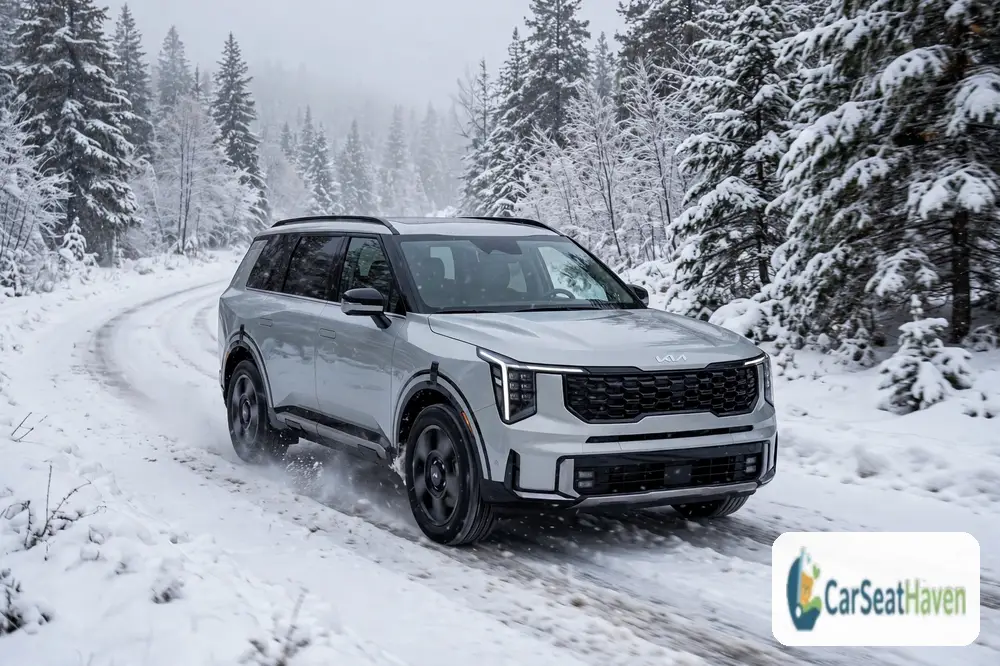
The Kia Telluride is the family all rounder that USA Today highlights. It starts at 36,390 dollars, uses a 3.8 liter six cylinder engine making 291 horsepower, and offers 8.0 inches of standard ground clearance. Kia also offers X Line trims for extra capability. USA Today quotes a U.S. News list that says the Telluride has what it takes to survive ice and snow, and that matches its reputation as a well built, well priced family SUV. Its main winter limitation is that it is not a dedicated off road SUV, so buyers who face deep snow every day should still look at the Grand Cherokee or a larger four wheel drive SUV.
Honda Pilot
The Honda Pilot is the other family pick on the CarGurus cars list. It offers plenty of passenger space and cargo space, a comfortable ride, and all wheel drive for winter confidence. Its main weakness for winter buyers is that it has no hybrid option in the version covered by CarGurus, so fuel costs will be higher than a hybrid rival. For a family that drives mostly on plowed roads and wants space above all else, that trade off is often acceptable.
Best luxury SUVs for snow
Luxury SUVs for snow are not only about comfort. The best ones combine a sophisticated drivetrain with air suspension, advanced driver aids, and winter features that make cold weather driving easier.
Lexus GX
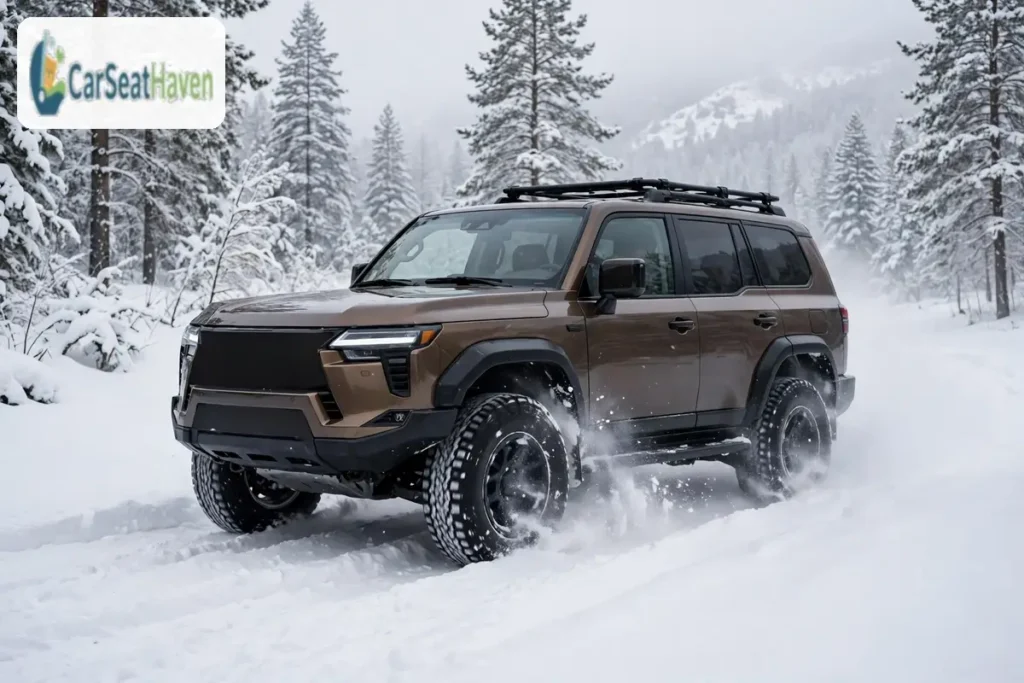
The Lexus GX is the luxury midsize pick that iSeeCars ranks first for luxury midsize SUVs, with 9.8 inches of ground clearance, and that Edmunds also highlights. Every GX trim comes standard with a full time four wheel drive system, and when the going gets tough, a Deep Snow mode and low range gearing help dig the car out. An optional Cold Weather package adds a windshield wiper deicer, a headlight washer, and a fast response interior heater. Edmunds reports the 2026 GX at 66,935 dollars. It is body on frame, which means it is built like a truck underneath, and that gives it real capability in deep snow, not just a luxury badge.
BMW X3
The BMW X3 is the luxury compact pick that CarGurus and iSeeCars both highlight. iSeeCars ranks it as the best luxury small and compact SUV for snow, with 8.5 inches of ground clearance. CarGurus notes that standard xDrive all wheel drive is layered with active blind spot monitoring, rear emergency braking, and hands free traffic jam assist, which help on slippery highways and in slow winter traffic. Heated front seats are standard, and the X3 has earned a top safety award. Its main winter weakness is not capability but controls, because touch sensitive interior controls can feel fussy with cold fingers. Anyone who has tried a touchscreen with gloves on will get that one straight away.
Volvo XC90
The Volvo XC90 is the luxury hybrid pick that iSeeCars ranks first for luxury hybrid SUVs, with 8.3 inches of ground clearance. It is a three row SUV with a calm cabin, strong safety ratings, and a plug in hybrid option for buyers who want electric driving in town and petrol power for longer winter trips. Its clearance is lower than the GX, so it is a better pick for plowed roads and light to moderate snow than for deep snow, but for luxury family buyers who value safety and comfort, it is a strong choice.
Mercedes-Benz G-Class
The Mercedes-Benz G-Class is the luxury large pick that iSeeCars ranks first for luxury large SUVs, with 9.9 inches of ground clearance. It is an expensive and very capable off road SUV, and its ground clearance and four wheel drive system make it excellent in deep snow. Its main weakness is price and fuel use, which put it out of reach for most buyers. For most luxury buyers, the GX or X3 will be the more realistic choice, and the G-Class is best seen as the extreme end of the luxury snow range.
Best large SUVs and trucks for snow
Large SUVs and trucks suit buyers who need space, towing, and the ability to drive through snow that smaller cars cannot clear.
Chevrolet Tahoe
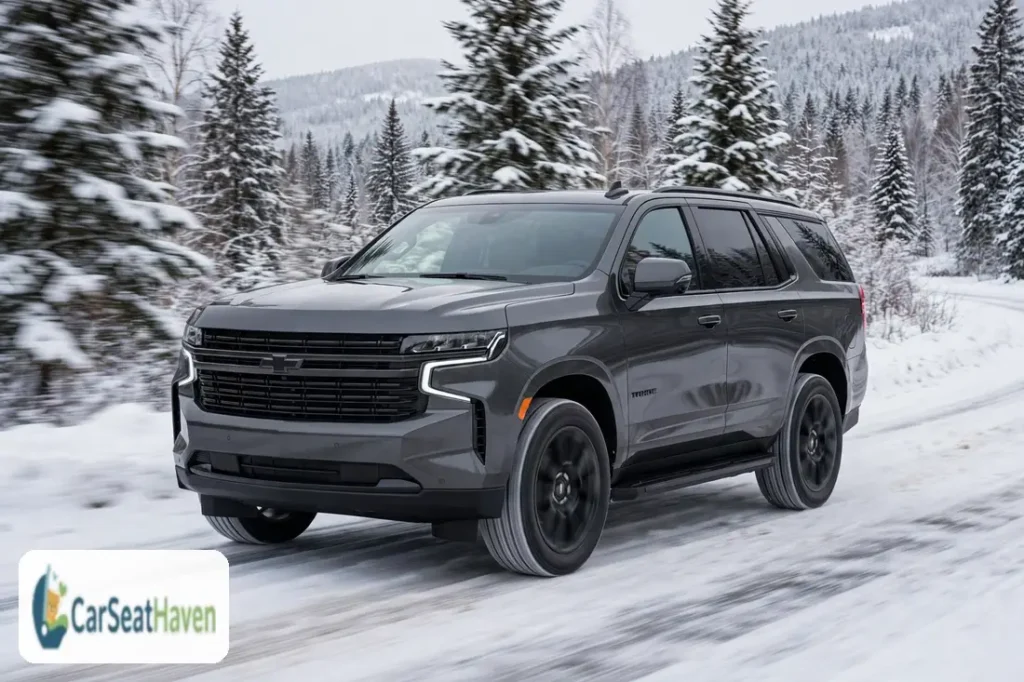
The Chevrolet Tahoe is the full size SUV that CarGurus puts on both its cars and SUVs snow lists. It offers available four wheel drive, seating for up to nine, and a diesel engine option making 495 pound feet of torque, which is useful for pulling away cleanly from snowy stops and for towing a snowmobile trailer. Autoblog reports the Tahoe at 65,095 dollars, and the related GMC Yukon at 69,200 dollars. Both offer about 8 inches of ground clearance, and the Yukon AT4 can rise to 10 inches with air suspension in off road mode. Their main winter weakness is size, because a very large SUV is harder to park and harder to control on a narrow icy road than a midsize SUV.
Ford Expedition
The Ford Expedition is the other large SUV that Edmunds highlights. It is available in standard and extra long Max forms, with a turbocharged V6 engine and a huge interior. Rear wheel drive is standard, but buyers who live where it snows should choose four wheel drive. The best version for snow is the Tremor, which comes standard in four wheel drive, includes an electronic locking rear differential, and rides higher than other Expedition models. Edmunds reports the 2026 Expedition at 64,995 dollars with all wheel drive, and 83,945 dollars in Tremor trim. That price gap shows why it is important to check trim by trim, because the best snow version is not the base version. Do not assume the base price buys you the snow capability.
Jeep Grand Wagoneer
The Jeep Grand Wagoneer is the large luxury family SUV that USA Today highlights. It starts at 63,240 dollars, uses a twin turbocharged six cylinder engine making 420 horsepower, and offers 8.4 inches of ground clearance, rising to 10.0 inches on upper trims with air suspension. It shares its roots with legendary off road Jeeps, and that shows in its winter capability, but it is also a very large and expensive car, so it suits buyers who need space and luxury together.
Trucks for snow
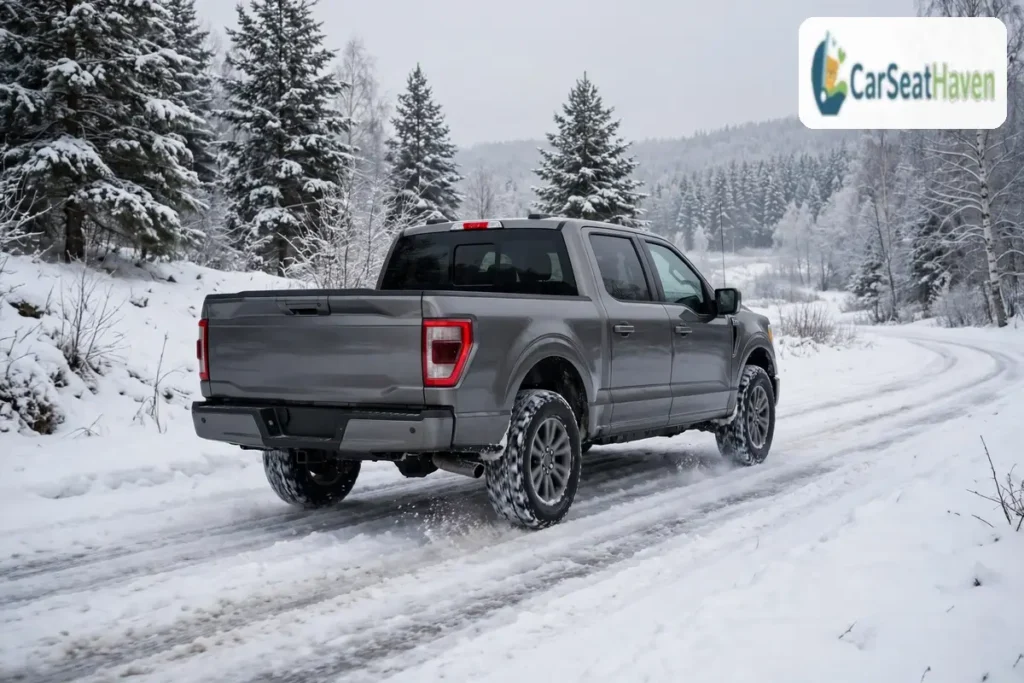
For trucks, the Ford F-150, Ram 1500, and Toyota Tacoma all appear on the top lists. The F-150 offers a full time four wheel drive setting, plus Slippery and Deep Snow modes, and an optional hybrid power system that can power a home in a power cut. The Ram 1500 offers available four wheel drive, multiple engines, and Tow and Off Road modes, but rear wheel drive is not recommended for snowy climates without weight over the rear axle and winter tires. The Tacoma offers rear wheel drive or four wheel drive, a manual gearbox option, and a strong reputation for reliability. Trucks have a winter weakness that SUVs do not, because a pickup bed is light when empty, which reduces traction at the rear wheels. Adding weight over the rear axle and fitting winter tires helps, but a truck buyer should plan for that from the start. Do not learn it on the first icy morning.
Best used SUVs for snow
A used SUV can be a smart winter buy, because the models that are good in snow new are usually good in snow used, and the price is lower. The research points to the same names again and again. Subaru Forester, Subaru Outback, Toyota RAV4, and Honda CR-V are the most repeated used picks, because they offer standard or widely available all wheel drive, good clearance, and strong reliability. Mazda CX-30 and Mazda CX-5 are the small used picks for buyers who want a more premium feel without a large car. Toyota Highlander, Honda Pilot, Subaru Ascent, and Mazda CX-9 are the family used picks.
For rough roads and deep snow, the used picks shift to Toyota 4Runner with four wheel drive, Jeep Grand Cherokee with four wheel drive, and Ford F-150 with four wheel drive. For fuel conscious buyers, Toyota RAV4 Hybrid, Mazda CX-30 with all wheel drive, Subaru Crosstrek, and Nissan Rogue with all wheel drive are the repeated names. When buying used, check three things that new car lists do not cover. First, check that all wheel drive or four wheel drive is actually fitted, because many used SUVs were sold as front wheel drive. Second, check tire age and tread, because a used car with worn all season tires will not be safe in snow even if the drivetrain is good. Third, check for rust and underbody damage, because a car that has lived through many winters may have hidden corrosion. Skip any one of those checks and you could pay for it later.
Electric cars in snow
Electric cars deserve a separate note, because their winter behaviour is different. All wheel drive electric cars can be excellent in snow, because electric motors deliver torque instantly and can be controlled very precisely wheel by wheel.
Rivian R1S
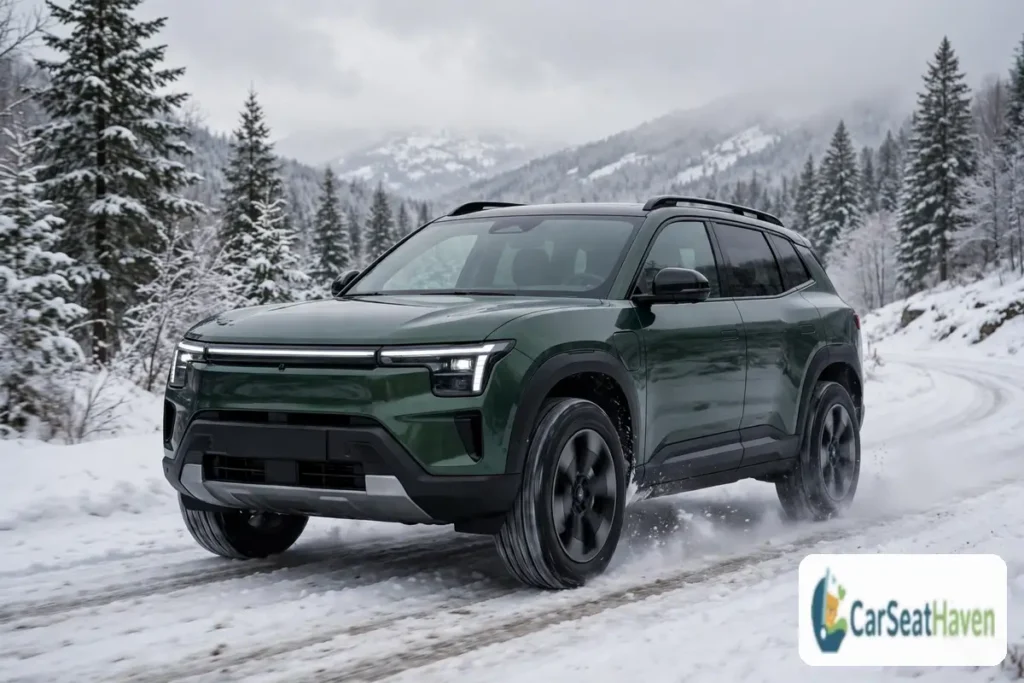
The Rivian R1S is the electric SUV that USA Today highlights. It starts at 76,900 dollars, makes 533 horsepower from two electric motors, and offers about 270 miles of standard driving range. Its adjustable air suspension gives nearly 15 inches of ground clearance, and its Snow Mode improves traction, delivers smoother acceleration, and limits regenerative braking to prevent sliding. That combination makes it one of the most capable electric winter SUVs in the research.
Hyundai Ioniq 5
The Hyundai Ioniq 5, covered in UK research, shows the same pattern in a smaller electric car. It offers optional four wheel drive, a snow mode that tweaks acceleration and braking to reduce wheel spin, a heat pump to preserve range in cold weather, and heated seats and steering wheel as standard. The lesson for electric buyers is not about one model. It is about range. Cold weather reduces electric range, sometimes by a large amount, because the battery works less efficiently and the heater uses energy. A buyer who can charge at home, who plans for a realistic winter range rather than the headline summer range, and who chooses an all wheel drive model with a snow mode will find an electric car perfectly usable in winter. A buyer who depends on public charging in very cold weather, with no home charging, should plan more carefully. That last point is easy to miss until you are standing at a charger in freezing weather.
What to check before you buy
Before you buy, check the drivetrain on the exact trim you want, not just the model name. Many SUVs offer all wheel drive as an option, and the base trim may be front wheel drive only. Check ground clearance on the exact trim too, because clearance can vary with wheels, suspension, and off road packages. Check whether the car has a snow mode, a deep snow mode, or a terrain selector, and what that mode actually changes. Check heated features, because heated seats, a heated steering wheel, heated mirrors, and a windshield wiper deicer make a real difference on cold mornings. Check the spare tire, because a car with a full size spare is more useful on a remote winter road than a car with a repair kit only.
Check safety ratings too. A car that is good in snow should also be good in a crash, because winter roads increase stopping distances and reduce visibility. Look for automatic emergency braking, lane keeping assist, blind spot monitoring, and adaptive cruise control, and check whether those features work well in low visibility, because snow can block sensors and cameras. Finally, check the cost of a second set of wheels and winter tires for that exact car, because larger wheels mean more expensive winter tires, and that cost should be part of the buying decision, not an afterthought. It adds up fast if you forget it.
Winter driving checklist in plain words
Clear all snow and ice from the roof, windows, mirrors, lights, and cameras before you drive, because snow on the roof can slide onto the windshield when you brake. Check tire pressures regularly, because pressure falls as temperature falls. Replace winter tires before the tread gets too shallow, and do not mix winter tires with summer tires on the same car. Keep a safe distance, because stopping distances on snow and ice are much longer than on dry roads. Brake gently and early, steer smoothly, and avoid sudden movements. If the road is glare ice, or if authorities advise against driving, do not drive. No car, however good, creates grip on glare ice. Keep an emergency kit in the car, with a blanket, a torch, water, and a phone charger, because a winter breakdown is more serious than a summer breakdown.
Frequently asked questions
What is the best car for snow overall
There is no single best car for snow, because the best car depends on the kind of winter driving you do. For most drivers on plowed roads, the Subaru Crosstrek is the most repeated affordable pick, with standard all wheel drive and good clearance. For families, the Subaru Ascent, Toyota Grand Highlander, and Kia Telluride are the strongest three row picks. For deep snow, the Jeep Grand Cherokee, Lexus GX, and Land Rover Defender are stronger, because they offer four wheel drive with low range and high clearance. The right answer is the car that matches your roads, your family size, and your budget, fitted with winter tires.
Is all wheel drive or four wheel drive better in snow
All wheel drive is better for most drivers, because it works automatically and suits plowed roads, highways, and mixed conditions. Four wheel drive is better for deep snow, unplowed roads, steep driveways, towing, and off road driving, because it offers low range gearing and a more locked power split. Neither system helps you stop on ice. That job belongs to your tires and your driving. For ultimate traction in very hard conditions, a full time four wheel drive system or an advanced all wheel drive system will offer similar benefits, and the choice should be based on how often you face extreme conditions.
Do all SUVs have four wheel drive
No. Many SUVs are front wheel drive as standard, and all wheel drive or four wheel drive is an option on certain trims. Some SUVs, like the Subaru Crosstrek, Ascent, Forester, and Outback, offer all wheel drive as standard across the range, but that is the exception, not the rule. Always check the exact trim, because a model name alone does not tell you the drivetrain. A used SUV buyer should check even more carefully, because the original buyer may have chosen front wheel drive to save money.
What does a snow mode do
A snow mode changes how the car delivers power and how it controls slip. It usually softens throttle response, so the wheels do not spin when you accelerate. It changes traction control and stability control to allow the right amount of grip, and in some cars it changes the gearbox to start in a higher gear. Deep snow mode allows a little more wheel spin, so the car can dig through deep snow without getting stuck. A snow mode helps, but it does not replace winter tires or ground clearance.
Are winter tires really more important than all wheel drive
Yes, for stopping and turning. All wheel drive helps you get moving, but winter tires help you stop, turn, and stay in control. In snow testing quoted in the research, an all wheel drive SUV on all season tires took almost 700 feet to stop from 60 miles per hour, while on new winter tires, a similar SUV and a front wheel drive sedan both stopped in about 300 feet. The best combination for severe winter weather is an all wheel drive or four wheel drive car fitted with winter tires.
What ground clearance do I need for snow
For light snow on plowed roads, most cars with normal clearance and winter tires will manage. For deeper snow, clearance matters more, because a car that plows snow with its underbody will get stuck. The main snow lists in this research use at least 5.5 inches as a minimum, and most strong picks sit at 8 inches or more. The Crosstrek Wilderness and Forester Wilderness sit at 9.3 inches, the Bronco Sport Badlands sits at 8.8 inches, and the Rivian R1S can rise to nearly 15 inches with air suspension. If your roads are not cleared quickly, aim for 8 inches or more.
Can I drive a rear wheel drive car in snow
Yes, you can, but it needs more care. Rear wheel drive cars have less traction when starting on snow, because the driven wheels carry less weight than the front wheels in many cars, and they can slide more easily when you accelerate. With winter tires, added weight over the rear axle where appropriate, and gentle driving, a rear wheel drive car can manage light snow on plowed roads. For heavy snow areas, an all wheel drive or four wheel drive car is the safer choice.
Are luxury SUVs good in snow
Yes, many luxury SUVs are excellent in snow. They often come with full time all wheel drive or four wheel drive, adjustable air suspension to raise clearance, and advanced electronic aids for traction and stability. The Acura RDX, BMW X3, Lexus GX, and Volvo XC90 are all strong luxury snow picks, each with a different strength. Their main weakness is usually price and fuel use, not winter capability. Check that the luxury trim you want actually includes all wheel drive, because some luxury models offer it as an option, not as standard.
Are electric cars good in snow
Yes, with the right planning. All wheel drive electric cars offer instant and precise torque control, which helps in snow, and many offer a dedicated snow mode. The Rivian R1S is a strong example, with high clearance and a snow mode that limits regenerative braking to prevent sliding. The main winter issue for electric cars is range, because cold weather reduces battery efficiency and heating uses energy. Home charging and a realistic winter range plan make an electric car a practical winter choice.
What is the best used SUV for snow
The most repeated used picks are Subaru Forester, Subaru Outback, Toyota RAV4, and Honda CR-V, because they offer widely available all wheel drive, good clearance, and strong reliability. For smaller budgets, Mazda CX-30 and Subaru Crosstrek are strong used picks. For families, Toyota Highlander, Honda Pilot, and Subaru Ascent are the repeated used family picks. For rough roads, Toyota 4Runner and Jeep Grand Cherokee with four wheel drive are the stronger used picks. Always check the exact drivetrain, tire condition, and underbody condition on a used car before you buy.
What is the best SUV for snow and mountains
For snow and mountains together, you need clearance, four wheel drive or advanced all wheel drive, and a snow mode, because mountain roads combine steep grades, unplowed sections, and changing weather. The Jeep Grand Cherokee, with its Selec Terrain snow mode and available air suspension, the Lexus GX, with full time four wheel drive and Deep Snow mode, and the Subaru Forester Wilderness, with 9.3 inches of clearance and Deep Snow mode, are all strong mountain picks. For very steep and remote mountain roads, a body on frame SUV like the GX or a large four wheel drive SUV like the Tahoe will be more capable than a small crossover.
What is the best SUV for snow and ice
Snow and ice together are harder than snow alone, because ice removes grip even when the snow is shallow. For snow and ice, winter tires matter even more, because they are the only part of the car that touches the road. The best cars for snow and ice in this research are the ones that combine winter tires with a drivetrain that sends power smoothly, like Subaru Symmetrical All Wheel Drive, Acura Super Handling All Wheel Drive, and Jeep Quadra Trac systems, plus stability control and a snow mode. No drivetrain makes ice safe, so gentle braking, a large following distance, and avoiding driving on glare ice remain essential.
Is a small SUV enough for snow
Yes, for most winter driving. A small SUV like the Subaru Crosstrek, Hyundai Kona, or Mazda CX-30 with all wheel drive, with winter tires, is enough for plowed roads, city driving, and light to moderate snow. A small SUV is not enough for deep snow on unplowed roads, where clearance and four wheel drive matter more. The right small SUV for snow is one with all wheel drive, at least 8 inches of clearance where possible, and winter tires, not simply the smallest or cheapest SUV available.

Aiden is the founder and editor of CarSeatHaven. He researches NHTSA safety standards, AAP guidance, manufacturer manuals, and recall notices, and turns them into plain-language car seat guides for parents.
