

Table of Contents
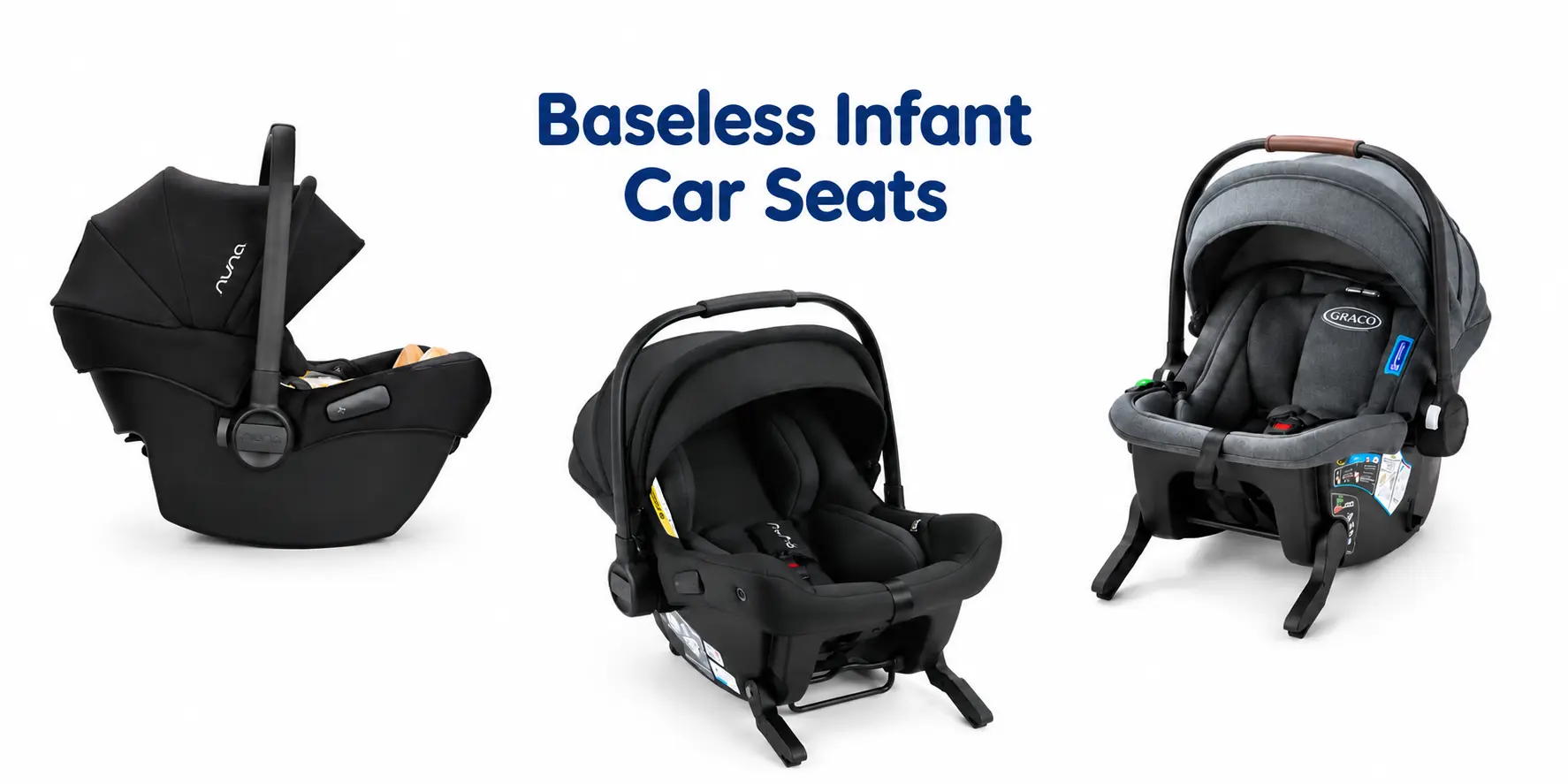
Baseless infant car seats are for parents who want a car seat that offers an infant carrier option which can be installed in a vehicle without the use of a separate car seat base. This can be helpful for families who often switch cars, take taxis or other services, fly on airplanes or just do not want the extra bulk of a removable base. Instead of using a removable base, some compatible models make use of anchors on the lower part of the seat, a vehicle seatbelt or a combination of the two as specified by the manufacturer.
A baseless infant car seat is not always an indicator of ease for parents, but there are certain installation considerations, fit, vehicle seating, reclining and instructions that accompany the specific seat chosen. The three resources used for this guide all list various methods of baseless installation including rigid LATCH, flexible LATCH, standard seat-belt routing and European-style belt routing.
This resource will help explain baseless car seats, their installation, considerations and why they are a great option for those who need to travel and take cars with them often.
What Is a Baseless Car Seat?
A baseless car seat is an infant or child restraint that can be installed in a vehicle without attaching the carrier to a base. Many traditional infant travel systems use a base that stays in the vehicle while the infant carrier clicks in and out. With a baseless car seat design the carrier itself gives the approved attachment or belt‑routing method that is required for installation.
Some modern baseless car seat models have anchors built right into the carrier. Other baseless car seat models can be secured with the vehicle’s seat belt. A few baseless car seat models offer more than one way to install, giving parents flexibility depending on the vehicle and the travel situation.
The key point is that a baseless car seat does not mean a system without an installation method. The car seat still must be properly secured using a method approved by its manufacturer.
How Baseless Car Seats Differ From Traditional Infant Seats
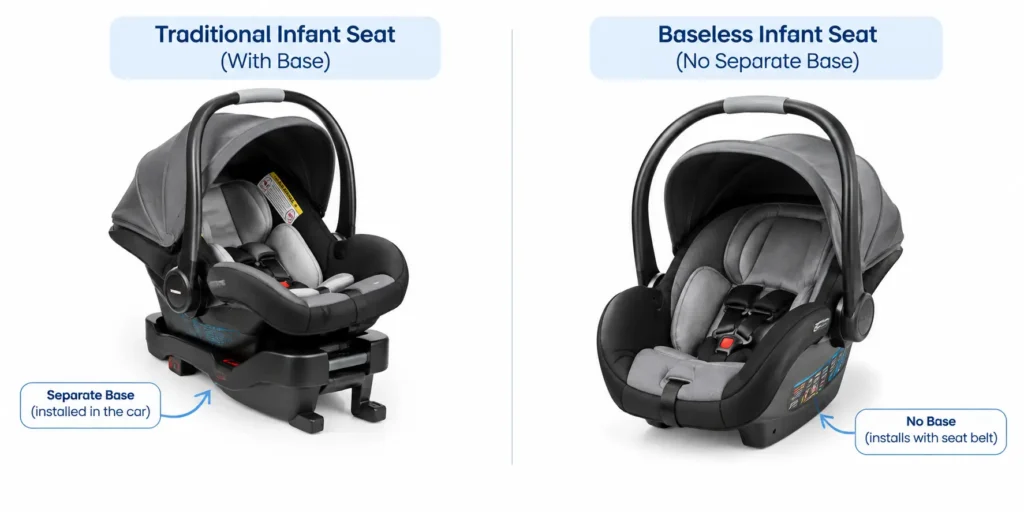
A standard infant car seat typically consists of two parts:
- The removable infant carrier
- A separate base that is installed in the vehicle
The carrier is then attached to the base for everyday use.
A baseless infant seat eliminates the separate base by designing the carrier to be installed directly into the vehicle. This may be accomplished using built in lower anchors, a seat belt or other manufacturer approved method.
This variation can be particularly advantageous for families with multiple vehicles. Instead of installing a base in each car, the caregiver can install the carrier directly into each vehicle.
Why Families Choose a Car Seat Without a Base
The main attraction is flexibility.
A family may choose a baseless infant car seat because they:
- Frequently use different vehicles
- Travel in taxis or rideshare vehicles
- Visit relatives who have different cars
- Travel internationally
- Want to reduce luggage when traveling
- Need a portable infant car seat
- Do not want to purchase several separate bases
However, convenience should not replace correct installation. A seat that is quick to carry still needs to be installed correctly every time.
Who Can Benefit From a Baseless Car Seat?
Baseless seats can be especially convenient for families with fluctuating transportation needs. City-dwelling carless families can use them in combination with taxis and rideshares frequent travelers might enjoy the convenience of not having to haul along a base and grandparents or caregivers with regular driving duties might want to be able to install an infant seat directly if their charge has to regularly travel in more than one car.
Meanwhile, for a family with a single car sporting a permanently installed base, the potential convenience of a baseless seat model might not present itself as a particularly compelling offer. This is because the sole real advantage they have over regular seats are the alternative installation possibilities.
Are Baseless Car Seats Safe?
A baseless car-seat is therefore safely used when appropriate to the child, compatible to the vehicle and properly installed according to the manufacturer’s instructions. Safe in the Seat notes that baseless infant seats still make use of standard safety features such as a five-point harness and adhere to applicable crash-testing requirements.
The lack of a separate base does not by itself define whether a car-seat is safe. Installation and use are critical.
How Proper Installation Affects Safety
A seat must be properly secured using an approved installation method. If the manufacturer allows installation using lower anchors, then the caregiver needs to understand how those anchors interface with the vehicle. If installation using seat-belts is used, then the belt needs to follow the correct routing path.
Parents should avoid assuming that a single installation technique works for all models. A method that is approved on one infant seat might not be approved on another.
The seat manual should therefore be given the primary responsibility for model specific instructions.
Child Age, Height and Weight Considerations
Every infant car seat has limitations on the child’s size. This might include minimum and maximum weight, maximum standing height, head clearance requirements or other fit criteria.
Choosing a seat should therefore start with the child rather than the appearance or portability of the carrier.
A newborn also needs an appropriate recline and harness fit. A seat may be technically installed but require additional adjustments to provide the correct fit for the child.
Understanding Harness Fit and Recline Position
The harness should be adjusted according to the manufacturer’s instructions and snugly fitted around the child. Caregivers should also take notice of the harness position, chest clip placement if applicable and the overall fit.
Recline is another consideration. Some infant seats have indicators or adjustment mechanisms that help a caregiver select an appropriate angle. The correct position can be size-dependent and seat specific.
A convenient installation method is useful but correct child positioning remains essential.
How Do Baseless Infant Car Seats Work?
Baseless infant car seats usually use one of two ways to install them: lower anchors or the vehicle seat belt. Some seats have lower anchors that connect directly to the vehicle lower anchor bars. Other seats use lower-anchor connectors that are attached to webbing straps. Seat-belt installation is also a choice, especially for vehicles that don’t have good lower anchors.
Integrated Lower Anchors
Integrated lower anchors are part of the infant carrier itself of being on a separate base.
This can make installation easier because the person taking care of the baby does not have to connect the carrier to a base that’s already in the car. The way the connectors work can be different. Some seats use connectors while others use flexible straps that need to be pulled tight after they are attached.
Seat Belt Installation
A vehicle seat belt can also be a way to install a baseless infant car seat.
The seat usually has a path for the belt. The person putting the seat in the car takes the part of the vehicles belt and puts it through that path and then locks it according to the directions. Seat-belt installation is very important when traveling because not every car has anchors that work well or are easy to reach.
Standard and European Belt Routing
Standard belt routing usually uses the lap part of vehicles belt through the special path.
European-style routing can also use the shoulder part of the belt around the back of the infant car seat. But this feature is not on every seat so people should never assume it is allowed without checking. The sources that were looked at say that some base less seats can use routing while others cannot.
Rigid LATCH vs. Flexible LATCH: What’s the Difference?
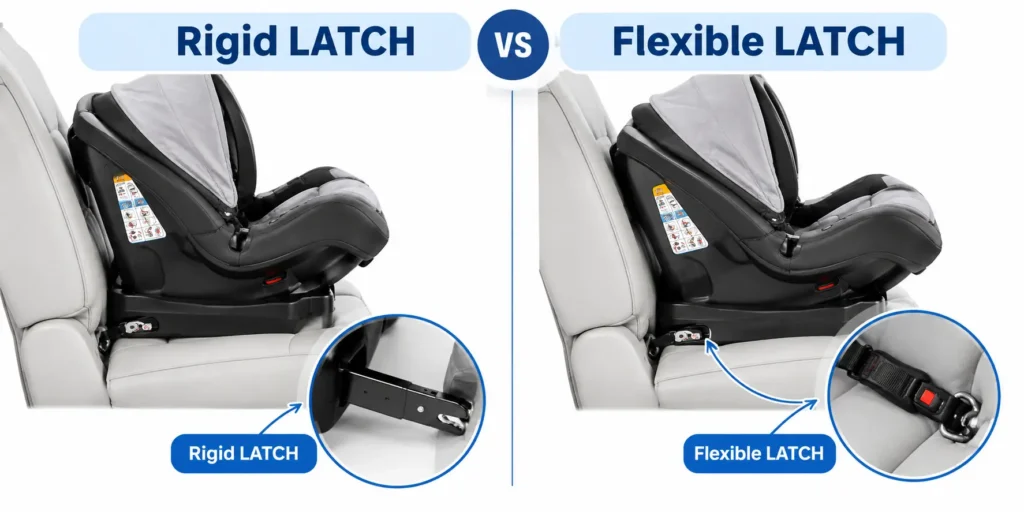
Understanding what LATCH stands for is essential while researching baseless infant car seats. The term refers to the system of lower anchors and the related attachment mechanism that is used to secure compatible child restraints.
The two concepts mentioned in the reviewed documents are rigid and flexible lower-anchor systems.
How Rigid LATCH Works
Rigid LATCH connectors are attached directly to the infant carrier. The connectors can attach to the vehicle’s anchor bars without requiring the caregiver to tighten a webbing strap in the same way as flexible systems. This can make the installation process relatively quick when the vehicle’s lower anchors are easy to access. However rigid LATCH systems depend on compatible anchor spacing. The Car Seat Pros notes that standard spacing is important for systems and that center seating positions may not always have suitable lower anchors. A small amount of side-to-side movement of the carrier across the anchors may also occur in some rigid systems. Movement should be assessed according to the manufacturers instructions than assuming that any movement means the seat is incorrectly installed.
How Flexible LATCH Works
Flexible LATCH systems feature connectors, which are usually attached to the straps or webbing.
The caregiver has to attach the connectors one by one and then tighten the strap to secure the seat. A flexible LATCH may offer more installation versatility but it may also be more complicated than a rigid LATCH system.
Which Vehicles and Seating Positions Support LATCH?
LATCH availability varies by vehicle and seating position. Many vehicles have lower anchors in the outboard rear seating positions but the center position should never be assumed to have compatible anchors.
The vehicle owner’s manual should be checked to determine:
- Where the lower anchors are located
- Which seating positions allow their use
- Whether center-position installation is permitted
- Whether the vehicle manufacturer places restrictions on anchor use
Understanding LATCH Spacing and Center-Seat Limitations
This is a point that people often miss. Rigid lower-anchor connectors are made for anchor distances. If the middle seat doesn’t have anchors or the distance is not right a rigid LATCH baby seat might have to go in a different seat that is allowed or be put in using a seat belt method that is approved. Never think that anchors from seats can be used together unless both the car maker and the car seat maker say it’s okay.
How to Install a Baseless Car Seat Correctly
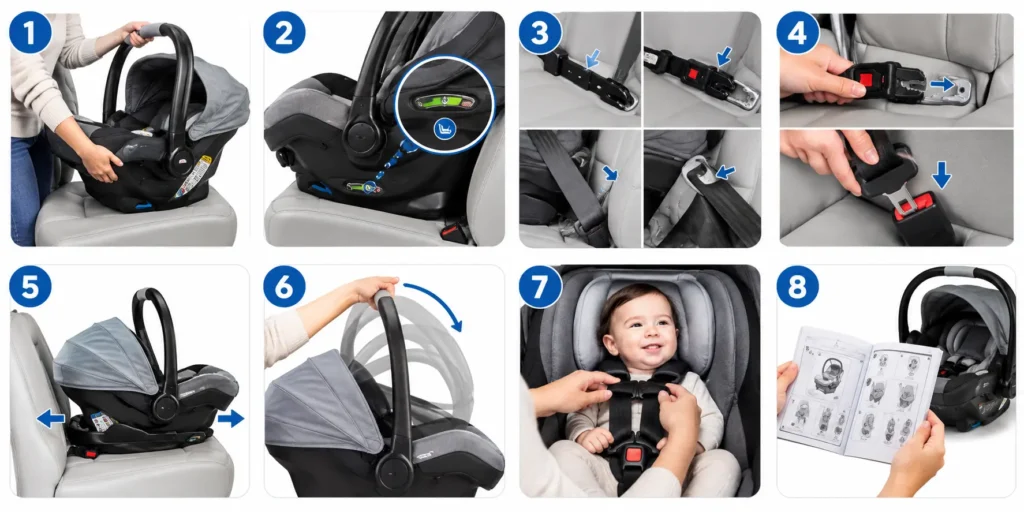
This is an educational overview, not a replacement for the manufacturer’s instructions. The exact process can differ between car seats and vehicles. Safe, in the Seat specifically recommends using the car seat manual as the guide.
Step 1: Position the Car Seat on the Vehicle Seat
Place the infant carrier in the approved rear-facing position, generally on a vehicle seating position permitted by both the vehicle and car-seat manufacturers.
Make sure the carrier sits correctly against the vehicle seat and is positioned according to the manual.
Step 2: Set the Correct Recline Angle
Check the built-in recline indicator if the seat has one.
The appropriate angle can vary depending on the infant’s age or size and the specific car-seat design.
Step 3: Choose the Approved Installation Method
Determine whether you are using:
- Rigid lower anchors
- Flexible lower anchors
- Standard seat-belt installation
- European-style seat-belt routing if specifically approved
Do not mix methods unless the manufacturer explicitly permits the combination.
Step 4: Secure the LATCH Connectors or Seat Belt
If using lower anchors, attach them as instructed and make the required adjustments.
If using the seat belt, route it through the correct belt path. Avoid twists and make sure the belt is locked or secured as required by the instructions.
Step 5: Check for Excessive Movement
Once installed check the seat at the appropriate belt path as instructed by the manufacturer.
Safe in the Seat explains checking the seat at the appropriate belt path for movement and gives a common example of one inch of belt-path movement. However, parents should always refer to the instructions that came with their specific model.
Step 6: Adjust the Carry Handle as Required
Carry-handle positions can vary between models and installation situations.
Some seats require a particular handle position while installed in the vehicle. Others provide different approved positions.
Always consult the manual rather than copying the handle position from another car seat.
Step 7: Check the Harness and Child Fit
Once the seat itself is correctly installed, the child needs to be secured properly.
Check the harness fit, strap position, chest clip position where applicable and recline. A correctly installed seat cannot compensate for an improperly fitted harness.
Step 8: Review the Manufacturer’s Instructions
The instruction manual should remain your main reference.
Even if you have installed another baseless infant car seat before, the new model may have different belt paths, anchor procedures, recline requirements or handle positions.
When to Get Help From a Certified Child Passenger Safety Technician
If you are uncertain about installation, getting help from a Certified Child Passenger Safety Technician can be useful.
The reviewed Safe in the Seat article also recommends CPST support for families who want additional help understanding installation and child fit.
Seat Belt Installation Without a Base
Seat-belt installation is one of the most valuable features to understand when choosing a baseless infant car seat. A lower-anchor system may be convenient in your personal vehicle, but travel can put you in cars with different anchor configurations.
Standard Seat Belt Routing
With routing, the correct part of the vehicle seat belt goes through the planned belt path. The belt must stay in position and not be twisted. The installation should be made tight as the manufacturer says.
European Seat Belt Routing
European belt routing can use both the lap and shoulder portions of the vehicle belt in a way that provides additional routing around the infant carrier.
However, this should only be used when specifically permitted by the car-seat manufacturer. Some models support it, while others do not.
Why Seat Belt Installation Matters for Travel
Seat-belt installation is especially useful especially when traveling internationally or using vehicles.
Seat-belt installation cannot assume that every taxi, rental car, rideshare vehicle or overseas vehicle will provide anchors that are compatible with your car seat.
Seat-belt installation learning the approved belt installation method before traveling can therefore make the process much easier.
What to Do When the Vehicle Does Not Have LATCH Anchors
If the car seat is approved for seat-belt installation, the vehicle belt can provide an alternative installation method.
Always confirm the approved method in the car-seat manual. Do not improvise a belt path.
Baseless Car Seats for Travel and Rideshares
Travel is one of the main reasons why families choose baseless infant car seats.
Having a separate base to install the seat on can be a nuisance when traveling, especially when having to switch between Uber/Lyft/Taxis, planes and multiple cars.
Using a Baseless Car Seat in Uber, Lyft and Taxis
Families using rideshare services may not know which vehicle will arrive.
A baseless infant carrier can be useful because the caregiver can install it directly into the vehicle rather than depending on a pre-installed base.
The important tradeoff is that installation may need to be repeated for each ride.
Air Travel and Portable Car Seat Considerations
Air travel brings considerations. Families should check whether the specific car seat is approved for aircraft use and follow the airline’s requirements. Some models discussed in the reviewed sources are identified as FAA‑approved. Approval should always be verified for the exact model and current travel rules.
Travelling Internationally Without LATCH
Vehicles outside the U.S. could have different restraint systems and anchor availability. A technique for installing with seat belts can be especially helpful. Car Seat Pros even recommends learning how to install seat belts for international travel as LATCH anchors might not always be present in another vehicle.
Switching Between Multiple Vehicles
If your baby bounces between your car, your grandparents’ car and their car sitter’s van, a baseless seat could cut out having to remember to bring along (and re-install) a separate base each time. The only caveat is that every single installation still needs to be carefully checked.
Why Practicing Your Installation Matters
Travel day isn’t the time to learn how to use your new car seat.
Practice your approved installation method before you leave home. Get used to the belt path, the lower-anchor connections, the recline indicator, harness adjusters and carry-handle requirements beforehand.
Baseless Infant Car Seats Comparison
The three sources look at infant car seats each built with its own approach. They use installation systems and focus on separate priorities. Than seeing all baseless infant car seats, as the same it helps to compare how they are installed how portable they are, what belt-routing options they offer and what travel features come with them. These differences become clearer when we examine each of these aspects.
| Car Seat | Installation Approach | LATCH Type | Seat-Belt Installation | Travel Considerations |
| Clek Liingo | Direct carrier installation | Flexible LATCH | Yes; European routing supported | Compact design; useful for limited rear-seat space |
| Joie Mint Latch | Direct carrier installation | Rigid LATCH | Yes | Compact and travel-oriented |
| Nuna PIPA urbn | Direct carrier installation | Rigid LATCH | Check current manual for approved methods | Lightweight, portable design |
| Graco GoMax | Direct carrier installation | Rigid LATCH | Supported according to the reviewed source | Multiple recline positions; travel-friendly |
| Peg Perego Primo Viaggio Urban Mobility | Direct carrier installation | Flexible LATCH | Yes | Compact design and travel use |
| Chicco KeyFit 35 | Carrier can be installed without base | Model-specific | Check current manual | Travel and stroller compatibility |
Exact specifications and approved installation methods can vary by model year or regional version, so the manufacturer’s current manual should be checked before purchase or installation.
Clek Liingo versus Joie Mint Latch
The Clek Liingo and Joie Mint Latch take different approaches to direct installation. The Liingo uses lower anchors while the Joie Mint Latch uses rigid LATCH connectors.
The Liingo may be particularly interesting for families focused on rear-seat arrangements and flexible installation. The Joie Mint Latch meanwhile emphasizes rigid LATCH attachment and is discussed in the reviewed sources as a travel-friendly option. Their differences show why the LATCH system itself is worth considering than simply looking for a seat labeled “baseless.”
Nuna PIPA Urban versus Graco GoMax
Both the Nuna PIPA urbn and Graco GoMax are discussed as LATCH baseless infant seats. The PIPA urbn focuses strongly on portability and integrated installation. The Graco GoMax also uses LATCH but provides multiple recline positions, which can be relevant when considering how the carrier sits in different vehicles. For either model families should check the installation requirements and child-fit limits in the current manual.
Peg Perego Urban Mobility versus Other Baseless Infant Seats
The Peg Perego Primo Viaggio Urban Mobility differs from rigid-LATCH models because it uses lower anchors and also supports seat-belt installation. That combination can be useful for families who expect to move between vehicles with anchor configurations. The model is also discussed in the reviewed sources for its design and travel-related features.
Chicco KeyFit 35 versus Travel-Friendly Infant Seats
The Chicco KeyFit 35 appears in the travel-focused source alongside other portable car-seat options.
Its travel appeal includes stroller compatibility and an installation system designed to work without relying on a separate base. Families comparing it with infant seats should consider how often they travel, whether they need a stroller system and which installation method they are most comfortable using.
What This Comparison Shows
The biggest difference, between baseless infant car seats is not simply whether they have a base. It is how they are installed and what type of travel or vehicle use they are designed to support. Some models emphasize LATCH others use flexible LATCH and some provide multiple seat-belt installation options. Portability, width, recline, stroller compatibility and aircraft use can also vary.
Baseless Options for Older Children
Baseless car seat does not always mean infant carrier. Some broader travel guides also include convertibles, all-in-ones and older-child travel seats that can be installed without relying on a detachable infant base.
Convertibles and All-in-Ones
Convertibles and all-in-ones generally stay in the vehicle instead of working out like a portable infant carrier.
Their advantage is that one seat can serve different stages of a child’s growth, depending on its endorsed configurations.
Britax One4Life ClickTight
The Britax One4Life ClickTight model is featured in the article about travel products as an all-in-one solution. Its inclusion in this category is justified since the use of this product focuses on a longer period of use instead of short-term transportation of the child.
Graco 4Ever DLX
The Graco 4Ever DLX is another example of an all-in-one seat that is included in the category of travel products. When opting for such a solution, families should consider the weight, size, installation mechanism and purpose compared to a more limited infant carrier.
WAYB Pico
The WAYB Pico model is intended for older children rather than infants and is considered a more travel-oriented solution. Thus, this product is not only significantly different from the baseless carrier but is also suitable for a child beyond the newborn stage.
Cosco Scenera Next
The Cosco Scenera Next is another example of a solution intended for the child beyond the newborn stage. In this case, the difference between the infant seat and a travel seat for older children can be seen. It is essential to note that these products are different in almost all specifications and purposes.
What to Consider Before Choosing a Baseless Car Seat
Choosing a baseless infant car seat involves more than checking whether it can be installed without a base.
Child’s Age, Height and Weight
Start by checking the seat’s current manufacturer limits and whether your child fits properly.
Vehicle Compatibility
Your vehicle’s seat shape, anchor locations, belt design and seating position can affect installation.
LATCH Availability and Seating Position
Check the owner’s manual to determine where LATCH can legally and safely be used.
Seat Belt Compatibility
If you expect to travel frequently, make sure you understand the seat’s approved seat-belt installation method.
Seat Width and Compact Vehicles
A narrower infant seat can be useful for compact cars or families who need more than one child restraint across the rear bench.
Three-Across Seating
A three-across arrangement involves putting three child seats in the same row.
The Seat specifically points to the narrow width of the Clek Liingo as a useful feature when there are three people sitting together. Yet having the right width does not ensure that you will have a successful three-across arrangement. It is necessary to take into account the entire combination of seats, vehicle dimensions, buckles, anchors and the installation requirements.
Weight and Portability
A seat that is easy to install may still feel heavy when carried with a baby.
Compare the carrier’s weight and handle design with your actual travel routine.
Stroller Compatibility
Some infant seats can attach to compatible stroller systems.
If you frequently walk after driving, check whether the seat works with your stroller or requires an adapter.
Airplane Approval
If air travel is important, check the current aircraft-use approval for the exact model.
Do not assume that every portable or baseless car seat is automatically approved for aircraft use.
Ease of Installation
The easiest one isn’t necessarily the one with all the bells and whistles
Think about how fast you could install it properly, know where the belt goes, tighten everything up, adjust the recline and get your child buckled in.
Advantages and Limitations of Baseless Car Seats
Key Advantages
Baseless infant car seats can offer several practical benefits:
- No separate base is required for approved baseless installation
- Easier transfer between vehicles
- Useful for taxis and rideshares
- Convenient for travel
- Potentially useful for families with multiple vehicles
- Some models include integrated lower anchors
- Some support European-style belt routing
- Certain models work with compatible strollers
- Some compact models may help with limited back-seat space
Potential Limitations
There are also tradeoffs:
- Installation must be repeated when switching vehicles
- Lower-anchor availability varies by seating position
- Rigid LATCH depends on compatible anchor spacing
- Some seats may have specific belt-routing restrictions
- Recline can be affected by vehicle-seat geometry
- Some carriers can be relatively heavy
- A seat that works well in one vehicle may require different adjustments in another
- Not every model supports European belt routing
- Travel convenience does not remove the need for careful installation
Baseless Car Seat vs. Traditional Base-Installed Seat
Installation
A traditional infant system allows the base to remain installed, while a baseless model requires direct carrier installation.
Portability
Baseless designs can reduce the amount of equipment a family has to carry, especially when moving between unfamiliar vehicles.
Multiple-Vehicle Use
Families with several vehicles may appreciate being able to install the carrier directly rather than transferring a base.
Travel Convenience
For taxis, rideshares, rentals and international travel, avoiding a separate base can make transportation logistics simpler.
Stroller Compatibility
Both traditional and baseless infant carriers can have stroller compatibility, but the available systems and adapters vary by model.
Which Features Matter Most for Your Situation?
The right choice depends on your needs
A family that drives their vehicle on a daily basis may have different priorities than a family that often travels. A family that often travels may be more concerned with portability, aircraft approval, ease of installation with seatbelts and size than a family with a daily driver.
Common Baseless Car Seat Installation Mistakes to Avoid
Ignoring the Car Seat Manual
Online advice can explain general concepts, but the manual for the exact model should determine the approved installation procedure.
Using an Unapproved Installation Method
Never create your own belt path or combine installation methods unless the manufacturer permits it.
Incorrect Recline Angle
A carrier that is too upright or reclined incorrectly may not provide the intended positioning for the child.
Loose LATCH or Seat Belt Installation
The lower anchors or seat belt need to be properly secured according to the instructions.
Incorrect Harness Adjustment
Even a correctly installed carrier requires a correctly fitted harness.
Assuming Every Vehicle Has the Same LATCH Setup
LATCH locations vary by vehicle. The center position, in particular should be checked rather than assumed.
Failing to Practice Before Travel
Learning the installation process for the first time in a busy airport pickup area or unfamiliar taxi can create unnecessary stress. Practice beforehand so you understand the installation method and can recognize whether something does not look right.
Final Thoughts
Baseless infant car seats present an interesting blend of portability and installation flexibility. Rather than a base, compatible models can be installed within a host vehicle by way of integrated lower anchors or an approved seat-belt method.
The value is particularly noticeable to families that frequently travel, utilize rideshares, switch between vehicles, visit family or desire reduced equipment.
Meanwhile, baseless does not imply installation-free; the caregiver is still responsible for understanding the specific seat, the host vehicle’s seating position, available LATCH anchors, appropriate belt path, a suitable recline angle and the child’s harness fit.
The three sources reviewed for this guide illustrate the lack of universal installation methods or ideal model. The rigidity of LATCH allows a quick attachment when compatible anchors are available, but flexible LATCH provides another option and seat-belt installation can also prove valuable for travelers and vehicles without lower anchors. A European routing can also be an option on models that specifically allow it.
When purchasing a baseless infant car seat, the focus should be on the actual lifestyle rather than a pursuit of the longest feature list. It is important to consider the driving location, a frequent change of vehicles, air travel, stroller compatibility, the value of such portability and the most convenient installation method.
Most importantly, the current manufacturer’s manual should be used as the reference and if there is uncertainty regarding installation or child fit, a consultation with a qualified child passenger safety professional is always recommended.
A properly selected baseless car-seat can make the travel and vehicle change more convenient, but the value is largely attributed to the combination of portability with an installation that considers proper use.
The Doona installs without a base; see how parents rate the Doona vs Evenflo Shyft.
Frequently Asked Questions
Can an infant car seat be used without a base?
Some infant car seats are specifically designed or approved for installation without a separate base. The approved method may use integrated lower anchors, a seat belt or both. Always check the instructions for the exact model.
Are baseless infant car seats safe?
They can be used safely when the seat is appropriate for the child and installed and used according to the manufacturer’s instructions. The absence of a separate base does not by itself determine safety.
Can I install a baseless car seat with a seat belt?
Many baseless infant seats support seat-belt installation, but the exact routing method varies. Some models support standard routing and some also permit European routing.
Is European belt routing available on every baseless car seat?
No. European-style belt routing is model-specific. If the manual does not approve it, do not use it.
Can I use a baseless car seat in an Uber or taxi?
A baseless infant car seat can be practical for rideshare and taxi travel because it does not require a separate base. The caregiver still needs to install it correctly in every vehicle.
Can baseless car seats be used on airplanes?
Some models are approved for aircraft use, while others may not be. Check the exact model’s current manufacturer information and airline requirements before flying. Some of the models discussed in the reviewed sources are identified as FAA-approved.
Is LATCH better than a seat belt for baseless installation?
Neither should automatically be considered better for every situation. The important point is to use an installation method approved for your car seat and vehicle and follow the instructions correctly.
Do I need a CPST to install a baseless car seat?
A CPST is not necessarily required for every installation, but professional assistance can be valuable if you are uncertain about fit or installation. Safe in the Seat recommends CPST support for families who want additional guidance.

Aiden is the founder and editor of CarSeatHaven. He researches NHTSA safety standards, AAP guidance, manufacturer manuals, and recall notices, and turns them into plain-language car seat guides for parents.
