

Table of Contents
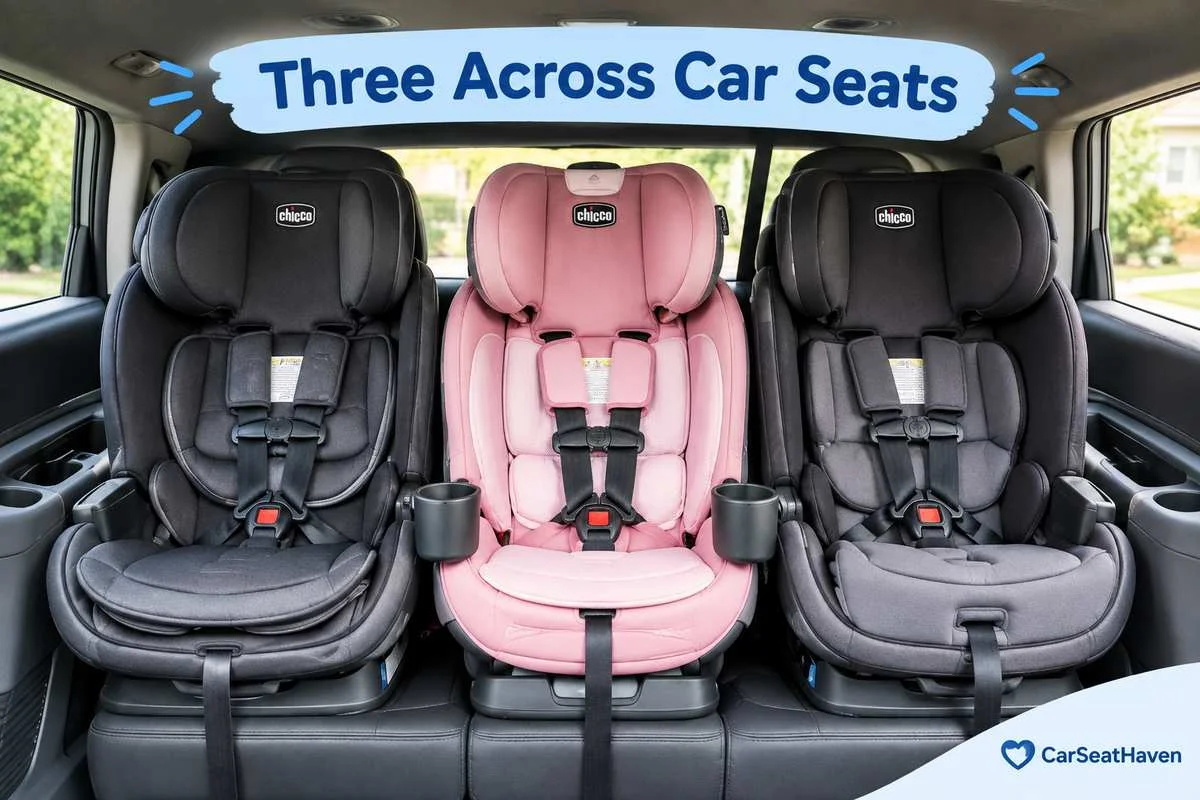
Fitting three car seats across a row of vehicle seats means installing three child restraints in the same vehicle row, but a proper arrangement has much more to it than only fitting three seat widths. Compatibility depends upon the usable back-seat space of the vehicle, seat shape, buckle location, LATCH availability, seat-belt geometry, each child’s size and seating stage and the ability of each seat to be installed independently of the others according to their instructions. Narrow models such as the Chicco Fit3x ClearTex and Graco SlimFit3 LX are optimized to save space, but there is no guarantee that a 16.7″ wide car seat will fit in every vehicle when using a 3 in a row setup.
This guide covers how to choose narrow car seats to fit 3 in a row, how to consider the impact of booster seats upon the arrangement, how to measure your vehicle, when LATCH is beneficial or limiting and how to determine if the completed arrangement really works rather than just being forced into place.
Narrow Car Seats to Fit 3 in a Row
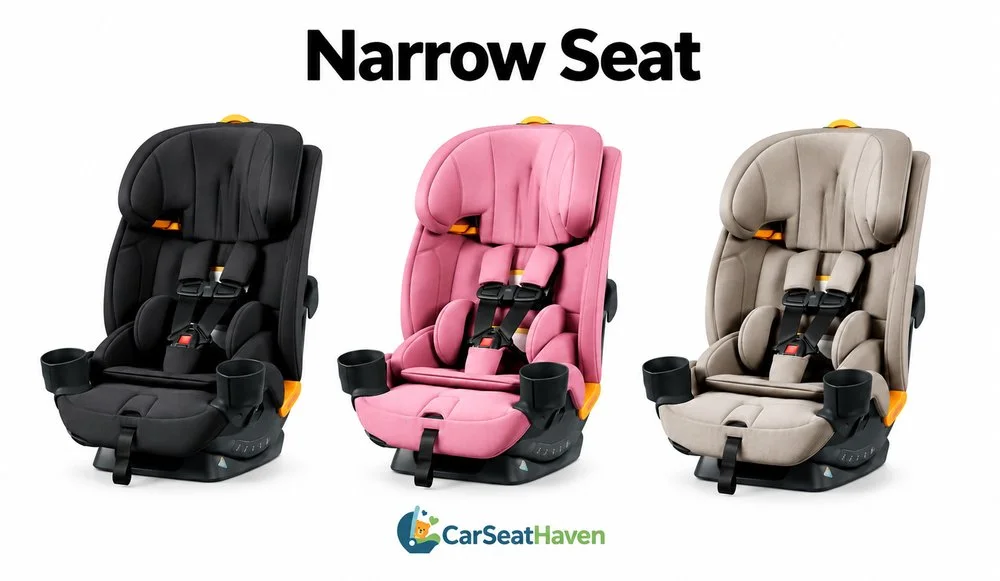
The term narrow car seats usually describes restraints designed with a smaller external footprint to conserve side-to-side space.
There is no single official width that automatically qualifies a car seat as a “3-across seat.”
However, current manufacturers offer models around 17 inches wide or less specifically to help families preserve back-seat space.
The following are examples worth researching rather than universal recommendations.
| Car seat | Published width | Type | 3-across relevance | |
| Chicco Fit3x ClearTex | 16.7 in | All-in-one | Designed around ultra-slim, three-across use | |
| Graco SlimFit3 LX | 16.7 in | 3-in-1 | Designed to help fit three across | |
| Evenflo Revolve360 Slim | 16.7 in | Rotating 2-in-1 | Slim footprint, but rotation needs clearance | |
| Britax Poplar S | 17 in | Convertible | Slim design intended to help with three-across | |
| Clek Foonf | Under 17 in | Convertible | Designed as a narrow option for three-across use | |
| Clek Fllo | Under 17 in | Convertible | Narrow profile and three-across applications | |
| Clek Liing | 16.9″ | Infant (RF) | Rigid-LATCH or seat belt |
Manufacturer specifications support the published widths for the Chicco, Graco, Evenflo and Britax models, while Clek states that both Foonf and Fllo are less than 17 inches wide and fit three-across in most vehicles.
Chicco Fit3x ClearTex and 3 Across
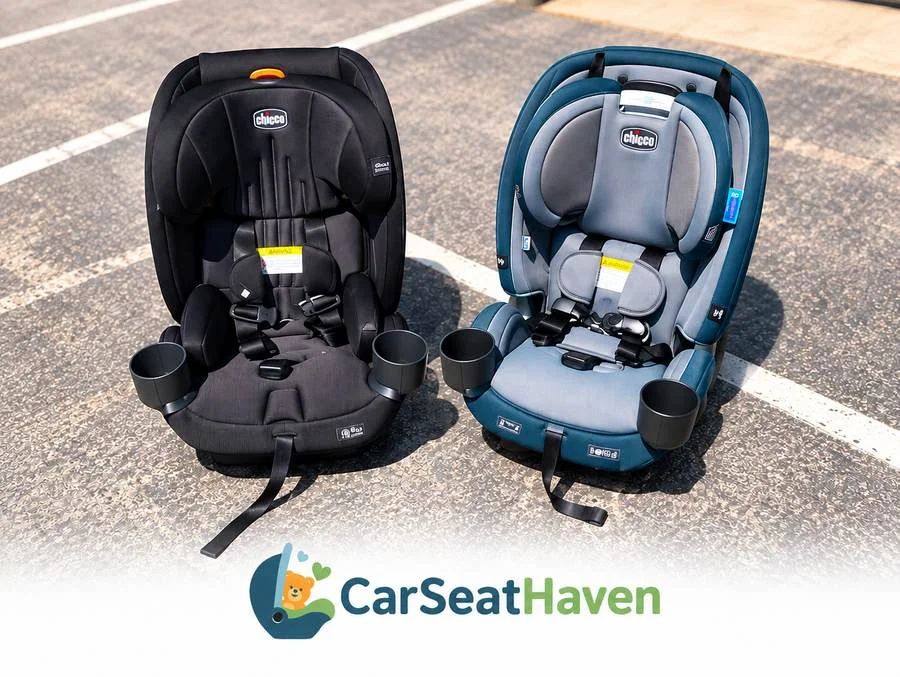
The Chicco Fit3x ClearTex Ultra-Slim All-in-One (16.7-Inch) All-in-One is particularly relevant to the 3-across search because Chicco touts it as an ultra-slim 16.7-inch all-in-one that fits three across. Its current specs include rear-facing use (5 to 40 pounds), forward-facing harness use (26.5 to 65 pounds), and booster use (40 to 100 pounds).
Its width can be an asset because it offers more space from side to side than many wider all-in-one restraints.
But parents shouldn’t fall for the 16.7-inch magic number.
The Fit3x’s footprint is reasonably deep (from front to back) when the child is fully reclining in it. So a tight back seat could cause a front-to-back spacing problem, despite a great left-to-right measurement.
This is a good illustration of the fact that 3-across fit is a three-dimensional puzzle, not a one-dimensional calculation.
Graco SlimFit3 LX and 3 Across
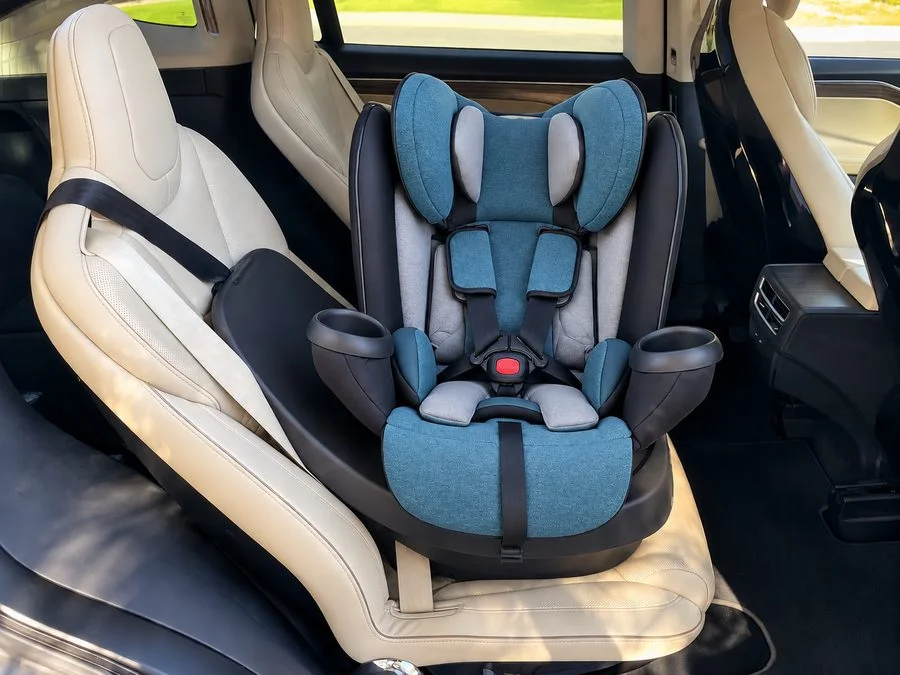
The Graco SlimFit3 LX is another one of those purpose built narrow ones. Graco advertises it as 16.7 inches wide and gives you 3 options, rear-facing harness, forward facing harness and high-back booster.
Graco claims that the SlimFit3 LX fits 3 across in most vehicles.
- Its current listed child ranges are
- Rear-facing harness: 5 to 40 pounds
- Forward-facing harness: 26.5 to 65 pounds
High-back booster: 40 to 100 pounds, 43 to 57 inches and at least 4 years old according to the manufacturer’s listed criteria. The important point for a three-across shopper is that not simply that the seat is narrow.
It is that a narrow all-in-one can potentially solve several space problems at once, because replacing a wider restraint with a narrow model may make room for an infant seat, convertible, or booster beside it.
Your own child’s stage and the exact vehicle installation still determine whether it works.
Evenflo Revolve360 Slim
The Evenflo Revolve360 Slim illustrates why a seat can be narrow but still require special planning.
Evenflo lists its width at about 16.7 inches. It also rotates, which can make loading and unloading a child easier.
But rotation requires lateral clearance.
Evenflo specifically warns that neighboring restraints can limit the space available for the seat to rotate.
That creates an important distinction:
A seat may fit physically in a three-across arrangement without giving you enough practical space to use every feature normally.
So when testing a rotating seat beside another car seat, don’t stop after confirming that the shells can sit next to each other.
Check whether:
- The seat can rotate as intended
- The neighboring seat does not block rotation
- The child can be loaded and unloaded normally
- The rotation mechanism can operate without interference
Three-across shoppers sometimes focus so heavily on width that they forget to test the feature that made them choose the seat in the first place.
Britax Poplar and Other 17-Inch Options
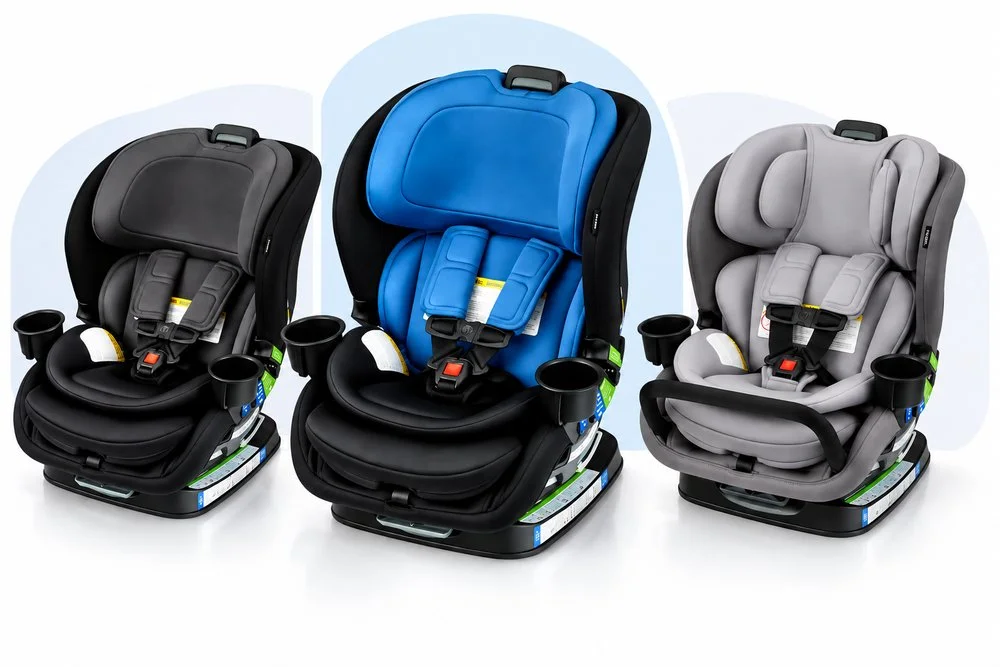
Britax currently lists the Poplar and Poplar S at 17 inches wide. The company says the seats are designed to fit three across in most vehicles but explicitly does not guarantee a three-across installation in all vehicles.
That statement is useful because it captures the broader rule for almost every narrow car seat:
“Designed to fit three across” is not the same thing as “guaranteed to fit three across in your vehicle.”
A 17-inch seat may work in one vehicle and fail in another because of seat contours, buckle locations, seat belts, adjacent seats or front-to-back constraints.
Diono Radian 3R, 3RX and 3RXT
Diono’s Radian series has built its reputation almost entirely around 3-across fit. Every Radian in the 3-series line measures 17 inches wide and about 16 inches deep, with a steel-reinforced frame and a foldable shell that also makes it a popular travel seat. The base model, the Radian 3R, offers rear-facing use up to 50 pounds and forward-facing use up to 120 pounds, making it usable for a long stretch of your child’s life without a replacement. Diono puts out a minimum recommended vehicle seat width of 51 inches for fitting three Radian seats across, which is a helpful benchmark if you’re comparing your own measurement against seats before buying.
Clek Fllo and Foonf
Clek’s Fllo and Foonf share the same upper shell and both are nearly 17 inches wide (Clek lists the Fllo at 16.9 inches). Both offer extended rear-facing to 50 pounds and include a steel anti-rebound bar for secure rear-facing. The difference is the base: the Foonf utilizes a rigid LATCH system with Clek’s REACT crumple technology (which many installers prefer for forward-facing installations), whereas the Fllo features a flexible LATCH belt and a built-in recline foot, rather than a detachable base. Both are premium priced compared to the Chicco, Graco or Diono alternatives, but often recommended by child passenger safety technicians for their value in extended rear-facing in a 3-across configuration.
Clek Liing
For families with a newborn in the mix, the Clek Liing is an infant car seat, not a convertible, that is a narrow 16.9 inches from side to side, making it one of the skinniest infant seats on the market. It faces backward only for 4 to 35-pound, up to 32-inch-olds and can be paired in the same row with an infant seat and older child in convertibles such as the Fllo or Foonf.
What Does “3 Across” Mean?
A three-across configuration is simply three child restraints installed next to one another in the same row of a vehicle.
That might mean:
- Three rear-facing car seats
- Two rear-facing seats and one forward-facing seat
- One rear-facing infant seat, one convertible seat and one booster
- Two harnessed seats and one belt-positioning booster
- Three boosters, depending on the children and vehicle belt system
The exact combination changes from family to family.
A newborn might need a rear-facing infant car seat while an older sibling still uses a forward-facing harnessed seat and another child uses a high-back booster. A different family might have three toddlers in rear-facing or convertible seats.
That is why searching only for the “narrowest car seat” can be misleading. The seat that works beautifully beside two matching convertibles may not work beside an infant carrier or high-back booster.
Why Three Car Seats Can Be Difficult
A vehicle’s rear bench is rarely a perfect rectangle.
The outboard positions may be shaped differently from the center. Cushion contours can push a car seat toward the middle. Seat-belt buckles may be located exactly where another restraint needs to sit. Lower anchors can restrict where a LATCH-installed seat can be placed. A tall side wing on one restraint may collide with another seat even when the published widths appear to fit.
This as a three-dimensional puzzle: car seats have curves, different heights, different bases and different points where they become wider. Safe Ride 4 Kids similarly notes that three seats can appear to fit while still creating problems such as twisting, inaccessible buckles, movement or deformation from neighboring seats.
So the real question is not:
“Do three seats add up to less than my back-seat width?”
It is:
“Can these three specific restraints be installed correctly and used comfortably in these three specific seating positions?”
That distinction is the foundation of a good 3-across setup.
Can You Fit 3 Car Seats Across?
Yes, many families can fit three car seats across, but there is no universal three-across combination that is guaranteed to work in every vehicle.
NHTSA advises choosing a child restraint based on the child’s age and size, then choosing a seat that fits the vehicle and following both the car seat manufacturer’s instructions and the vehicle owner’s manual for installation.
That means three-across planning has two separate parts:
- Find seats that are appropriate for your children.
- Confirm that those specific seats work together in your vehicle.
A narrow seat can improve your chances, but width is only one variable.
For example, the Chicco Fit3x ClearTex is currently listed by Chicco at 16.7 inches wide and the Graco SlimFit3 LX is also 16.7 inches wide. Both are specifically positioned as space-saving seats for three-across use.
Even so, three Fit3x seats, three SlimFit3 LX seats or a mixture of different restraints can behave differently depending on the vehicle.
Why Width Alone Does Not Predict Fit
Imagine a vehicle with a nominally wide bench seat. The number may look promising, but three car seats could still fail to work because:
- The center cushion is raised.
- The outboard seat belts emerge from an awkward angle.
- A buckle stalk lands beneath the edge of a restraint.
- One seat needs more recline room.
- A rear-facing shell conflicts with the neighboring seat.
- A booster blocks access to its vehicle belt.
- A rotating seat cannot turn because another seat is immediately beside it.
- The seats interfere with one another during installation.
- A seat moves when another seat is removed.
- Closing the door changes the position of a restraint.
This is why manufacturers themselves generally avoid promising a universal fit. Britax, for example, states that its 17-inch Poplar and Poplar S are designed to fit three-across in most vehicles but cannot guarantee three-across fitment in every vehicle.
What Makes a Car Seat Good for 3 Across?
A narrow footprint is valuable, but a genuinely useful three-across seat needs to work with the rest of the installation.
Here are the factors that matter most.
1. Overall Width
Width is the first specification most parents check and for good reason.
A seat that is 16.7 or 17 inches wide can leave more usable space than a much wider model. Current examples include the Chicco Fit3x ClearTex at 16.7 inches, Graco SlimFit3 LX at 16.7 inches, Evenflo Revolve360 Slim at 16.7 inches and Britax Poplar S at 17 inches.
But don’t treat those numbers as a guarantee.
Published width does not always tell you:
- Where the seat is widest
- How wide the base is
- How far the side wings extend
- How the seat changes width when the child grows
- How it interacts with the vehicle cushion
- How much space the installation method requires
A 17-inch seat can sometimes work better beside another restraint than a theoretically narrower seat because the two shapes puzzle together.
2. Shape Matters
Two car seats with the same advertised width may behave very differently.
One might have a narrow base but broad upper wings. Another might remain relatively narrow from bottom to top. Another might sit higher off the vehicle seat.
That geometry can determine whether three seats nest together.
Emphasizes evaluating the three-dimensional shape of the seats rather than relying only on a measuring tape. Their criteria also consider how easily a seat can be installed with the vehicle seat belt and whether the child has enough room for long-term use.
3. Installation Method
A narrow seat that is awkward to install can become a poor choice when three seats are competing for space.
Seat-belt installation can sometimes give more freedom to position restraints laterally than LATCH, because lower anchors are fixed to specific locations in the vehicle.
The correct choice, however, is always governed by the vehicle and child-restraint manuals. NHTSA recommends reading both before installation.
4. Buckle Accessibility
This becomes especially important with boosters.
A booster can physically fit in a narrow space yet be difficult to use because the child cannot reach the buckle or a parent cannot get a hand between neighboring seats.
The Car Seat Lady specifically identifies access to the vehicle seat belt as an added challenge when using a booster in a three-across arrangement.
A three-across setup therefore needs to be evaluated twice:
Can the seats fit?
and
Can the children actually use them correctly every day?
5. Front-to-Back Space
Three-across discussions often focus on side-to-side width, but rear-facing restraints can also need considerable front-to-back room.
A narrow rear-facing car seat can still create a problem if its recline angle forces the front passenger seat too far forward.
The Chicco Fit3x, for example, has a 16.7-inch width but can have a substantially deeper footprint when reclined. Its manufacturer lists a 30-inch footprint at maximum recline.
So a good 3-across evaluation considers both dimensions.
How to Measure Your Vehicle for 3 Across
Measuring before buying can eliminate some obviously unsuitable options, but measurements should be treated as a starting point rather than a guarantee.
Step 1: Measure the Actual Seating Area
Measure the usable width where the three restraints will actually sit.
Do not assume that the full interior width listed in a vehicle brochure represents the space available for three car seats.
Look at:
- The center seating area
- Outboard cushion shapes
- Door-side contours
- Seat belt locations
- Buckle stalks
- Raised center sections
- Fixed armrests
- Vehicle head restraints
- LATCH locations
Chicco’s three-across guidance recommends looking at both overall rear-seat width and the width of individual seating positions because the center can be narrower than the outer positions.
Step 2: Identify Each Child’s Current Stage
Write down what each child actually needs.
For example:
| Child | Current restraint |
| Baby | Rear-facing infant seat |
| Toddler | Rear-facing convertible |
| Older child | Forward-facing harnessed seat |
| School-age child | Belt-positioning booster |
Do not change a child’s restraint stage simply because another seat is easier to fit.
NHTSA recommends keeping children rear-facing until they reach the highest height or weight allowed by the seat manufacturer, then using a forward-facing harnessed seat according to the applicable limits.
The AAP similarly recommends rear-facing use for infants and toddlers as long as possible within the seat’s manufacturer limits.
Step 3: List the Seats You Already Own
You may not need to replace all three restraints.
Sometimes replacing one seat creates enough space for the complete arrangement.
For example, replacing a wide convertible with a narrow convertible might give two existing seats enough room to coexist. In another situation, changing from a bulky high-back booster to a narrower, appropriate booster could solve the problem.
But don’t replace a seat solely because someone online says it is narrow. The new seat must still be appropriate for the child and vehicle.
Step 4: Check the Vehicle Manual
Find information about:
- Approved seating positions
- Lower anchors
- Top tether anchors
- Seat-belt locking mechanisms
- Child-restraint installation
- Any restrictions on specific positions
This matters particularly in the center seat. Never assume that a pair of lower anchors can be borrowed from neighboring seating positions or that a center LATCH installation is allowed simply because anchors appear nearby.
NHTSA explains that LATCH consists of designated lower anchors and a top tether anchorage, and child-restraint instructions should be followed for the particular vehicle seating position.
LATCH vs. Seat Belt for 3 Across
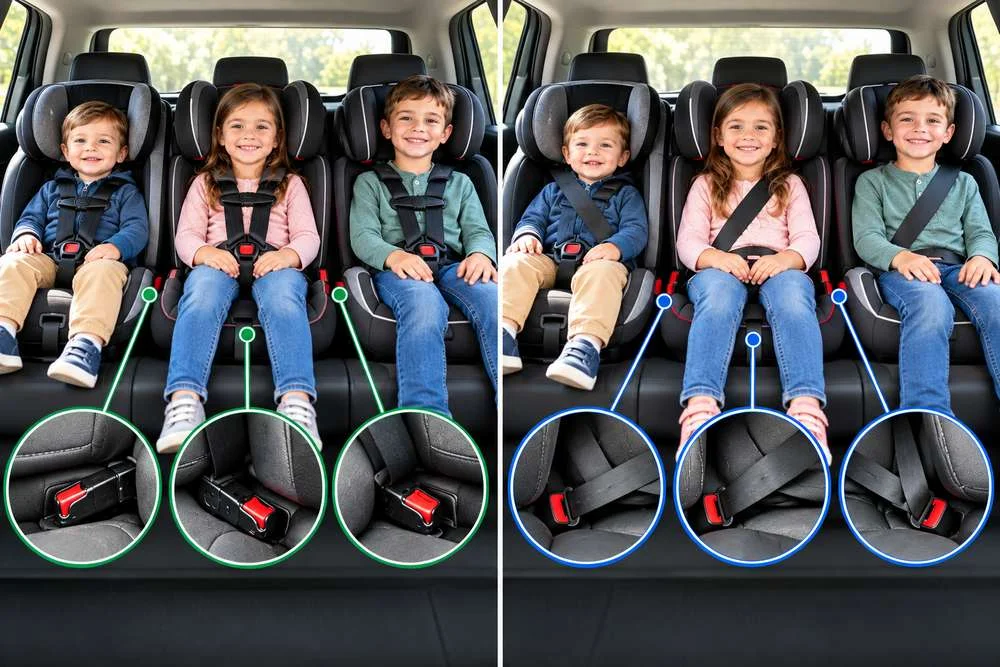
LATCH is useful, but it does not automatically make a three-across installation easier.
LATCH stands for Lower Anchors and Tethers for Children. It provides designated vehicle anchor points for compatible child restraints. NHTSA notes that vehicles and restraints have specific LATCH requirements and that the vehicle owner’s manual should be consulted for designated positions.
Why LATCH Can Limit Side-to-Side Placement
Lower anchors are fixed.
If you install an outboard car seat using LATCH, its position is influenced by where those anchors are located. The seat cannot simply be shifted several inches toward the door just because doing so would help another seat fit.
This is one reason experienced three-across guides often discuss seat-belt installation as a potentially more flexible option. The Car Seat Lady notes that lower-anchor positioning can restrict a restraint’s placement, while Safe Ride 4 Kids recommends considering seat-belt installation when LATCH makes the puzzle harder.
That does not mean seat belts are inherently safer than LATCH.
It means that either installation method can be appropriate when the child restraint and vehicle allow it and the most practical method for a three-across configuration depends on the specific installation.
Can Three Car Seats Use LATCH?
Sometimes, but do not assume it.
Your vehicle may have lower anchors in some or all seating positions, but the owner’s manual determines where they can be used. Your car-seat manual also determines whether the restraint can use LATCH in the needed mode and position.
Some three-across combinations may work better when one or more seats use the vehicle seat belt.
The important rule is simple:
Do not improvise an anchor arrangement to make the seats fit.
Use only the LATCH positions and installation methods permitted by the vehicle and child-restraint manufacturers.
The Best Way to Test a 3-Across Installation
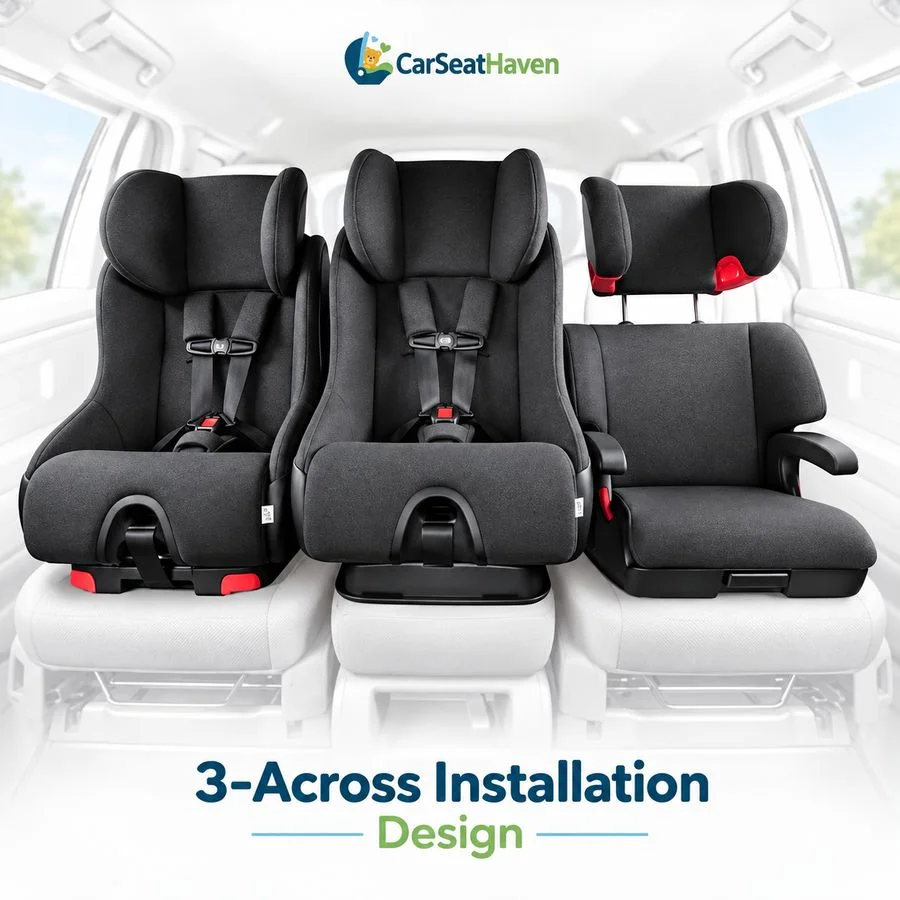
The most useful three-across test happens with the actual vehicle, actual seats and actual children’s seating stages.
A retailer floor display cannot reproduce your vehicle’s exact geometry.
Start With a Real Configuration
Place all three restraints in the positions you expect to use.
Do not test one seat alone and assume the others will fit later.
Try the complete combination.
For example:
Configuration A
Rear-facing convertible | Rear-facing infant seat | Forward-facing convertible
Then try:
Configuration B
Forward-facing convertible | Rear-facing infant seat | Rear-facing convertible
The arrangement that works on paper may not be the arrangement that works in your vehicle.
Safe Ride 4 Kids recommends experimenting with seat positions and notes that alternating rear-facing and forward-facing directions can sometimes help the physical puzzle.
But changing direction should never override the child’s proper restraint stage or manufacturer instructions.
Install the Seats Independently
This is one of the most important checks.
A restraint should not become secure merely because two neighboring restraints are squeezing it into position.
Safe Ride 4 Kids specifically warns that each car seat needs to be properly installed independently and that neighboring seats should not be the thing preventing movement.
A practical test is to install the seats one at a time while observing what changes when a neighboring restraint is removed.
If a seat suddenly becomes loose after you remove another seat, investigate the installation rather than assuming the three-across pressure was helping.
Watch for Physical Interference
Look carefully at:
- Shell-to-shell contact
- Side-wing contact
- Buckle interference
- Seat-belt routing
- LATCH straps
- Tether routing
- Recline mechanisms
- Door contact
- Rotation clearance
- Harness access
A seat touching another seat is not automatically proof that the configuration is unsafe, but interference becomes a problem when it changes the restraint’s position, installation, belt path, harness function or manufacturer-required setup.
Safe Ride 4 Kids advises watching for situations where contact between seats deforms the shell or where closing the door changes the seat’s position.
Why Narrow Booster Seats Are a Different Problem
Parents often solve the first two seats and then discover that the third child uses a booster.
This can be surprisingly difficult.
With a harnessed seat, the harness is attached to the child restraint. With a belt-positioning booster, the vehicle’s seat belt has to reach the child and be positioned correctly.
That means physical access becomes part of the fit.
A booster can occupy only a relatively small footprint but still be impractical if the child cannot reach the buckle or cannot sit correctly while buckling.
The Car Seat Lady specifically identifies buckle access as a major concern in three-across booster arrangements.
Narrow Booster Seats to Fit 3 in a Row
When researching narrow booster seats to fit 3 in a row, look at more than the advertised width.
Consider:
- High-back vs. backless design
- Width at the hips
- Width at the shoulders
- Armrest design
- Vehicle belt access
- Buckle position
- Child’s ability to buckle independently
- Vehicle head support
- Child size
- Seat-belt fit
A booster is not simply another small rectangle.
The child must also sit correctly inside it.
NHTSA explains that a booster raises and positions a child so the vehicle lap-and-shoulder belt fits correctly across stronger areas of the body.
That means the smallest booster is not necessarily the right booster.
High Back vs. Backless Booster for 3 Across
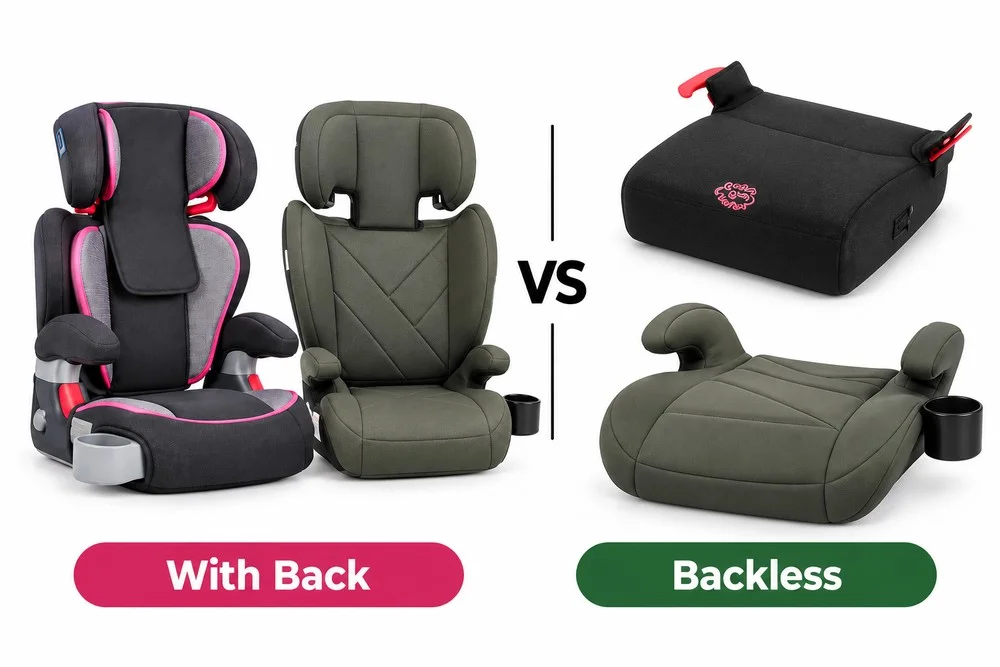
High Back Boosters
A high-back booster may provide positioning features that help guide the shoulder belt and support the child’s upper body.
However, it generally occupies more physical space than a minimalist backless booster.
In a narrow three-across arrangement, that extra structure can make buckle access harder.
The Car Seat Lady’s narrow-booster guidance highlights both high-back and backless configurations while emphasizing that physical fit and belt access are central considerations.
Backless Boosters
A backless booster can occupy less space, which may make it attractive when side-to-side room is extremely limited.
But it is not appropriate simply because it is smaller.
The vehicle seat and head-support arrangement, the child’s size, the booster manufacturer’s requirements and the vehicle belt fit all matter.
The child also needs to remain properly positioned for the entire journey.
A narrow booster only solves the space problem if it still provides the correct belt positioning and is appropriate for the child and vehicle.
What About Three Boosters Across?
Three boosters can be physically easier to fit than three full-size harnessed restraints, but the buckle problem becomes much more important.
Imagine three children sitting side by side:
Booster | Booster | Booster
The seats may physically fit, but each child still needs proper access to the vehicle lap-and-shoulder belt.
If one child has to reach behind another child or squeeze a hand between two neighboring restraints just to buckle, everyday use becomes difficult.
This is one reason a three-across evaluation should include an actual buckling test.
Have the child sit in the booster exactly as they would during a normal trip.
Then check:
- Can they reach the buckle?
- Can they pull the shoulder belt into the correct guide?
- Does the belt sit properly?
- Do neighboring restraints interfere?
- Can they remain positioned correctly?
- Can the seat belt retract normally?
If the answer to those questions is no, a physically narrow booster has not solved the real problem.
Three Across With Different Types of Car Seats
A family does not need three identical restraints.
In many cases, mixing seat types creates a better physical puzzle.
Example 1: Infant + Convertible + Booster
A common setup might be:
Rear-facing infant seat | Rear-facing convertible | High-back booster
The infant carrier may occupy a different shape from a convertible, while the booster may provide a smaller footprint.
The challenge is usually belt access and getting the infant carrier base installed correctly without interfering with the neighboring seats.
Example 2: Rear-Facing + Forward-Facing + Booster
Another possibility:
Rear-facing convertible | Forward-facing convertible | Booster
The different directions can allow portions of the seats to occupy different physical spaces.
Safe Ride 4 Kids notes that alternating rear-facing and forward-facing orientations can sometimes help the three seats puzzle together.
Again, the child’s stage must come first.
Example 3: Three Narrow Convertibles
Some families may be able to use:
Convertible | Convertible | Convertible
Narrow models such as the Fit3x, SlimFit3 LX, Poplar, Fllo or other suitable narrow restraints can make this configuration easier to investigate.
But three copies of the same model are not automatically easier than three different seats.
Sometimes the best fit comes from mixing shapes.
Should the Narrowest Seat Go in the Middle?
Not necessarily.
The answer depends on your vehicle, the shape of each restraint, child access, tether availability and installation instructions.
The center position can sometimes be useful because it may provide a narrow cushion area that pairs well with a slim seat. But another vehicle might make the center position the most difficult location because of a hump, fixed buckle, unusual belt arrangement or limited installation options.
Safe Ride 4 Kids suggests starting with the center seating position when working out a three-across puzzle but that is a practical strategy rather than a universal rule.
The correct arrangement is the one that:
- Uses approved seating positions
- Allows proper installation
- Meets the manufacturer’s requirements
- Gives children correct restraint fit
- Does not depend on neighboring seats for stability
- Allows everyday buckling and loading
Common 3-Across Mistakes
Three-across installations can go wrong in ways that are not obvious from a photo.
Mistake 1: Adding the Published Widths
Parents sometimes calculate:
16.7 + 17 + 17 = 50.7 inches
Then compare that number with an estimated back-seat width.
The math can be useful, but it does not prove the setup will work.
Seat shapes, belt locations, cushion contours and usable seating width can invalidate a simple width calculation.
Mistake 2: Assuming “Slim” Means “Fits Everywhere”
Slim simply means space-saving compared with wider designs.
It does not mean universal compatibility.
Even manufacturers that market their products for three-across use include limitations around vehicle-specific fit.
Mistake 3: Letting One Seat Hold Another in Place
Three restraints should not depend on being squeezed together to stay secure.
Each installation should work according to its instructions.
Safe Ride 4 Kids specifically identifies independent installation as an important requirement in a three-across setup.
Mistake 4: Ignoring Buckle Access
This is especially common with boosters.
The seat fits.
The child fits.
But nobody can comfortably reach the buckle.
That is a daily-use failure even if the initial arrangement looked perfect.
Mistake 5: Forgetting Front-to-Back Space
Rear-facing restraints need room for their proper recline.
Three seats may fit side-to-side while leaving insufficient room in front of one rear-facing seat.
Mistake 6: Choosing a Rotating Seat Without Testing Rotation
A rotating car seat can have a slim external width and still need clearance to swivel.
Evenflo and Chicco both discuss considerations around rotating seats in multi-seat arrangements, with Chicco noting that neighboring restraints can hinder rotation.
Mistake 7: Moving a Child to a Booster Too Early
A booster should not be used simply because it is narrower.
NHTSA recommends choosing the restraint according to the child’s age and size and keeping children in the appropriate harnessed stages according to manufacturer limits. The AAP also recommends rear-facing use for as long as possible within the seat’s limits and continued harness use after the rear-facing stage.
A Better 3-Across Shopping Strategy
Instead of searching for three separate “best” car seats, start by solving the entire configuration.
Step 1: Write Down the Three Children
Record:
- Age
- Height
- Weight
- Current restraint
- Required next stage
- Whether rear-facing is still appropriate
- Whether a booster is developmentally appropriate
Step 2: Measure Your Vehicle
Record:
- Usable seating width
- Center-seat shape
- Buckle locations
- LATCH locations
- Top tether positions
- Seat-belt routes
- Front-seat clearance
Step 3: Identify the Biggest Problem Seat
Usually one seat creates most of the difficulty.
Maybe it is:
- A wide infant-carrier base
- A bulky convertible
- A large rotating seat
- A high-back booster
- A seat requiring a particular tether position
Solve that constraint first.
Step 4: Look for Narrow Seats That Solve That Specific Problem
Do not automatically buy three new restraints.
You may only need to replace one.
For example:
Current setup:
Wide convertible | infant seat | booster
Possible strategy:
Narrow convertible | infant seat | narrow booster
That change may create enough clearance without replacing everything.
Step 5: Test Before Committing
The ideal approach is to install the actual combination in your vehicle before making an irreversible purchase.
Check retailer return policies and manufacturer requirements carefully.
A car seat that fits another family’s SUV may fail in your sedan even if both vehicles have similar published dimensions.
What Should You Look for in a Narrow Car Seat?
A compact footprint is helpful, but a well-rounded three-across option should also have features that work with your installation.
Look at the Width
Start with the external width, but do not stop there.
Look at the Base.
A narrow base can make side-by-side fitting easier in some vehicles.
Look at the Upper Shell.
Broad shoulder areas may create conflicts with a neighboring restraint.
Look at Installation.
Check whether the seat allows the installation method you need in the specific vehicle position.
Look at Rear-Facing Space.
A seat can be narrow but deep.
Look at Harness Height.
A narrow seat is not useful if the child will outgrow the harness quickly.
Look at Booster Geometry.
If the seat converts to a booster, evaluate the eventual booster width and belt fit rather than assuming the booster stage will be just as space-efficient.
Look at Accessories.
Cup holders, side pockets and removable accessories can change the practical width of some products.
Never remove or modify a component unless the manufacturer specifically permits it.
Does a Smaller Car Need Narrower Car Seats?
Usually, a smaller vehicle gives you less room to work with, so narrower seats can be particularly useful.
But vehicle size alone does not predict the outcome.
A compact vehicle with a relatively usable center position may be easier to configure than a larger vehicle with deeply contoured seating and awkward buckle locations.
This is why the phrase “3 across in a small car” should be treated as a fit problem rather than a vehicle-category problem.
The same principle applies to:
- Three car seats in an SUV
- Three car seats in a sedan
- Three across in a minivan
- Three car seats in a midsize SUV
- Three seats in a pickup truck
The vehicle’s seating geometry matters more than the badge on the hood.
3-Across in an SUV
SUVs often provide more rear-seat space than small sedans, but that does not eliminate the problem.
Many SUVs have:
- Deeply sculpted outboard seats
- Wide center consoles in some rows
- Second-row captain’s chairs
- Uneven cushion widths
- Multiple seat-belt layouts
- Different LATCH configurations
If your SUV has a bench second row, measure that specific bench.
If it has captain’s chairs, a conventional “three across” arrangement may not even be applicable in the same way.
3-Across in a Sedan
Sedans can be challenging because the usable rear-seat width is limited.
This is where narrow car seats can make a significant difference.
A 16.7-inch restraint can provide more room than a 20-inch-plus alternative, but the sedan’s seat-belt geometry and cushion shape still determine whether the actual combination works.
For a sedan, test the complete setup rather than assuming a model advertised as “3-across” will work.
3-Across in a Minivan
Minivans can offer several seating configurations, so the solution depends heavily on the specific row and seat design.
A three-across setup may be easier on a broad bench than in narrower or divided seating.
However, if the seating position changes between model years or trim levels, do not assume that an arrangement seen online will translate directly to your vehicle.
Always verify the owner’s manual and the actual physical layout.
Are Slim Car Seats Safe?
A slim car seat is not automatically less safe simply because its footprint is smaller.
The more important question is whether the specific restraint is federally compliant for sale in the United States and installed and used according to its instructions.
NHTSA advises parents to follow the child-restraint manufacturer’s instructions and the vehicle owner’s manual.
A narrow design also should not be treated as evidence that one seat provides greater crash protection than another.
Avoid choosing a restraint based only on marketing phrases such as
- “Ultra safe”
- “Safest”
- “Best protection”
- “Crash-proof”
- “Guaranteed fit”
For three-across shopping, fit and correct use are essential parts of the safety equation.
Does Three Across Affect Child Comfort?
It can.
A seat that technically fits may leave less elbow room, less visible space or less convenient access to the buckle.
Children also grow.
A configuration that works for a preschooler may become uncomfortable later when the child has wider shoulders or moves into booster mode.
The Car Seat Pros notes a useful tradeoff that is sometimes overlooked: very narrow all-in-one seats can become less roomy for bigger or older children even when their maximum weight rating looks generous.
This does not mean narrow seats are inherently uncomfortable.
It means that external width and internal child space are two different measurements.
Look at both.
How Long Should Children Stay Rear-Facing in a 3-Across Setup?
Three-across space should not determine when a child moves from rear-facing to forward-facing.
NHTSA recommends keeping a child rear-facing until the highest height or weight limit allowed by the car-seat manufacturer. Once that limit is reached, the child can move to a forward-facing seat with a harness and tether according to the seat and vehicle instructions.
The AAP similarly recommends rear-facing for as long as possible within the manufacturer’s height and weight limits.
That matters because parents sometimes find themselves trying to make three restraints fit and conclude that changing the orientation of one child will solve the space problem.
The safer approach is to first determine what restraint stage each child actually needs, then find a physical combination that accommodates those needs.
How to Check a Finished 3-Across Setup
Once the three restraints are installed, don’t stop at “they fit.”
Run through a full inspection.
Check 1: Each Seat Is Installed According to Its Manual
Use the correct belt path or LATCH path.
Use the correct recline position.
Use any required top tether.
Follow the instructions for the specific mode.
Check 2: Seats Are Not Depending on One Another
Remove one neighboring restraint and observe whether the remaining seat’s installation changes.
A seat should not rely on another child restraint as its anchor.
Check 3: Buckles Are Accessible
Make sure children who use boosters can access the vehicle seat belt appropriately.
Check 4: Doors Close Without Interference
Check both rear doors.
A door that pushes against a restraint can change the practical fit.
Check 5: Harnesses and Belts Can Be Used Correctly
The setup should allow normal harness adjustment and vehicle-belt routing.
Check 6: Rotation Still Works
For a rotating seat, confirm that the neighboring restraint does not block the rotation mechanism.
Evenflo explicitly warns that adjacent restraints can limit the space required for the Revolve360 Slim to rotate.
Check 7: Consider Professional Installation Help
A certified Child Passenger Safety Technician (CPST) can inspect a difficult configuration in person.
The AAP notes that parents can benefit from installation assistance from a CPST.
For a complicated three-across situation, professional inspection can be particularly useful because a photograph or product specification cannot show every interaction between the vehicle and the three restraints.
Final Thoughts
Finding 3 across car seats is less about finding three tiny seats and more about building a compatible system.
Start with the children, not the products. Determine which restraint stage each child actually needs, then evaluate your vehicle’s seating positions, usable space, belts, LATCH anchors and tether locations. After that, look for narrow car seats to fit 3 in a row that solve the specific space problem you have.
Models such as the Chicco Fit3x ClearTex, Graco SlimFit3 LX, Evenflo Revolve360 Slim and Britax Poplar S show how far manufacturers have pushed slim designs, with published widths around 16.7 to 17 inches.
But no measurement replaces a real vehicle-fit test.
A successful three-across setup should allow each restraint to be installed correctly and independently, keep children in the appropriate stage for their size and manufacturer limits, preserve necessary belt and harness access, and remain practical for everyday buckling.
The best three-across solution is therefore not necessarily the narrowest seat you can buy. It is the combination that fits your vehicle, fits your children, follows the manufacturers’ installation requirements and continues to work as your family grows.
FAQs
Q. Can you fit three car seats across one row?
Yes, it is possible in many vehicles, but there is no universal configuration that works in every vehicle. The final result depends on the three restraints, vehicle geometry, seating positions, installation methods, child sizes and manufacturer instructions.
Q. What width car seat is best for 3 across?
There is no single width that guarantees a three-across installation. Many current narrow seats are around 16.7 to 17 inches wide, including the Chicco Fit3x, Graco SlimFit3 LX, Evenflo Revolve360 Slim and Britax Poplar S.
Width is only a starting point because seat shape, buckle location, installation method and vehicle geometry also affect the result.
Q. Is a 16.7-inch car seat guaranteed to fit three across?
No. A 16.7-inch width can make a seat attractive for a three-across configuration, but it does not guarantee that three seats will fit correctly in every vehicle. Graco and Chicco specifically market their 16.7-inch models for three-across use, but vehicle-specific fit still needs to be checked.
Q. Are narrow car seats safe?
A narrow design by itself does not determine whether a specific car seat is safe. The restraint should be appropriate for the child, used in an approved manner and installed according to the child restraint and vehicle manufacturer’s instructions. NHTSA recommends following both manuals.
Q. Can three car seats use LATCH at the same time?
It depends on the vehicle, the specific seating positions and the child restraints. Do not assume that all three seats can use LATCH just because anchors are visible. Check the vehicle owner’s manual and each car-seat manual for approved LATCH positions and limits.
Q. Are narrow booster seats good for 3 across?
They can be useful, but booster fit involves more than external width. The child must be able to sit correctly and use the vehicle’s lap-and-shoulder belt properly. Buckle accessibility is particularly important when another car seat is immediately beside the booster.
Q. Can a rotating car seat work in a 3-across setup?
Possibly. A narrow rotating seat can save side-to-side space, but rotation requires clearance. For example, Evenflo notes that a neighboring restraint may restrict the Revolve360 Slim’s ability to rotate. Test the complete arrangement rather than checking only the published width.
We bust common myths in our 3-across myth-busting guide.
The Graco SlimFit3 LX is one of the narrowest options; read our full review.

Aiden is the founder and editor of CarSeatHaven. He researches NHTSA safety standards, AAP guidance, manufacturer manuals, and recall notices, and turns them into plain-language car seat guides for parents.
