

Table of Contents
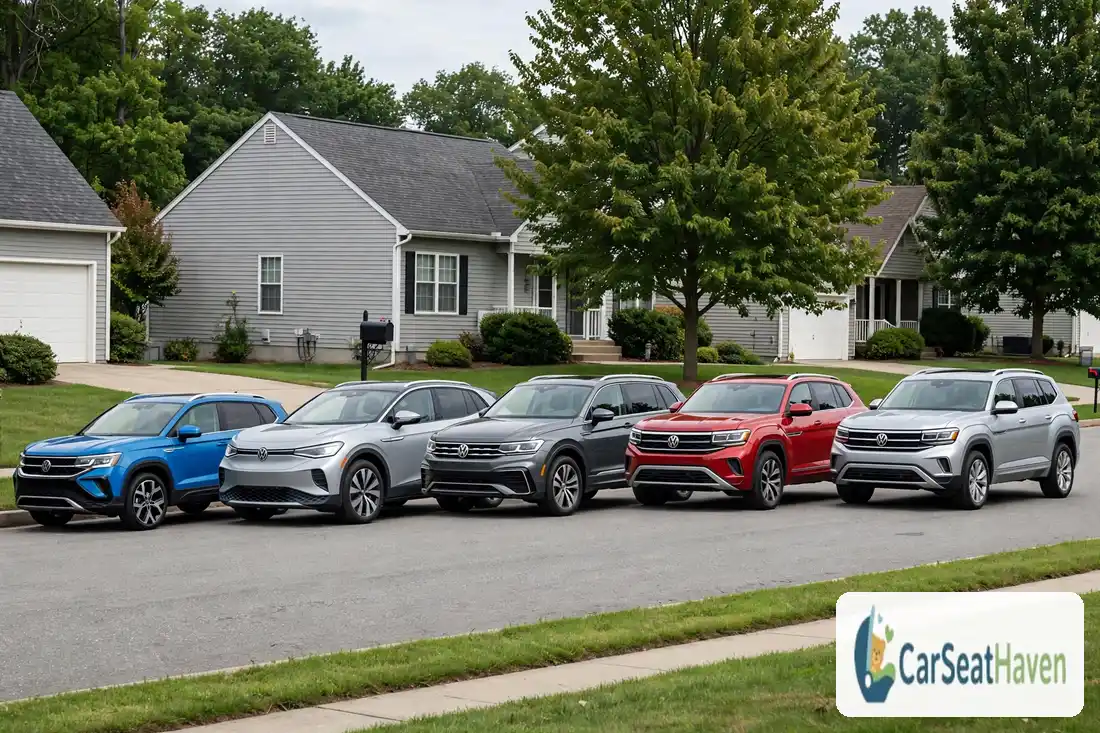
Volkswagen sells five SUVs in the United States, and the simplest way to understand them is by size. The Taos is smallest and cheapest, the Tiguan is the balanced compact pick, the ID.4 is the only electric SUV, the Atlas Cross Sport is the roomier two row midsize pick, and the Atlas is the only one with a third row. Prices start near $26,500 for the Taos before destination and rise past $55,000 for a top Atlas or ID.4, so the right pick depends far more on seats and space than on the badge. If you need seven seats, only the Atlas works. If you want electric driving, only the ID.4 works in the current lineup. This guide puts every model in size order and labels every price by year and destination.
What you need to know first
- How many Volkswagen SUVs are sold in the United States? Five. Taos, ID.4, Tiguan, Atlas Cross Sport, and Atlas. No other model belongs in the current United States SUV lineup.
- Which one is smallest? The Taos. It is about 175.8 to 175.9 inches long, seats five, and is the easiest to park and drive in a city.
- Which one is largest? The Atlas. It is about 200.7 inches long, seats six or seven, and has the largest cargo space in the lineup.
- Which one has a third row? Only the Atlas, in the current United States lineup. The current Tiguan has two rows and five seats only.
- Which one is electric? The ID.4. It is the only electric SUV in the current United States lineup. The ID Buzz is electric too, but it is a van, not an SUV.
- Which one is cheapest? The Taos. The 2027 Taos starts at $26,500 before destination, and the 2026 Taos range was $26,500 to $35,900 before destination.
- Which one is best for a large family? The Atlas, because it is the only one with a third row and the only one with cargo space behind a third row.
- Which one is best overall? There is no single winner. CarBuzz picks the Tiguan for driving fun and value in 2026, while dealer guides and family buyers often pick the Atlas for space. The right answer depends on seats, budget, and whether you want gas or electric.
- What changed for 2027? The Atlas was fully redesigned for 2027 and costs more. The Atlas Cross Sport was also redesigned for 2027, but its price was not announced at research time. ID.4 production in the United States ended in 2026, so new ID.4 buying now means leftover stock.
- Is the ID Tiguan a United States SUV you can buy now? No. The electric ID Tiguan is announced for Europe, with European pre sales from 42,695 euros and deliveries from early 2027. Volkswagen of America has not announced a United States date, price, or EPA range for it.
The full lineup in size order
Size order here means length, smallest to largest. That order is Taos first, then ID.4, then Tiguan, then Atlas Cross Sport, then Atlas last. Cargo order is a little different, and that point matters, because a longer car is not always roomier inside in every measurement. For example, the ID.4 is longer than the Taos, but its maximum cargo is a little lower than the Taos maximum in some tables. Every gas model in this list uses an 8 speed automatic in current sources. Every model includes IQ.DRIVE driver assistance in dealer guides, with features such as adaptive cruise control, lane assist, front assist, emergency assist, blind spot monitoring, and rear traffic alert. Wording varies by trim, so check the exact trim, not just the model name.
Taos: the smallest and cheapest Volkswagen SUV
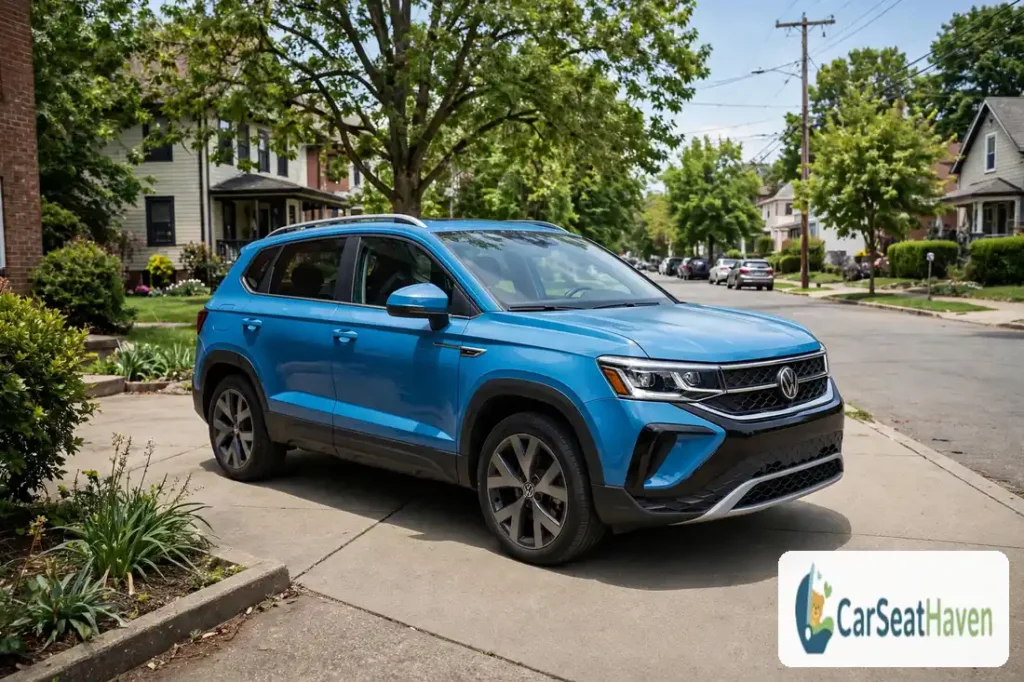
The Taos is the entry point to the Volkswagen SUV lineup, and it is honest about what it is. It is small, light on fuel, easy to park, and priced for a first time SUV buyer or a small family that mostly drives in town. It seats five in two rows, and it is about 175.8 to 175.9 inches long and 72.5 inches wide. Front legroom is about 40.1 inches, and rear legroom is about 37.9 inches in dealer comparisons.
Cargo is 27.9 cubic feet behind the second row and 65.9 cubic feet maximum in front wheel drive models. All wheel drive models show lower figures in some tables, 24.9 cubic feet behind the second row and 60.2 cubic feet maximum, so check the drivetrain before you quote a cargo number. The engine is a 1.5 liter turbo four with 174 horsepower and 184 pound feet of torque, with an 8 speed automatic. Front wheel drive is standard, and 4Motion all wheel drive is available. Fuel economy is about 28 miles per gallon in the city and 36 on the highway with front wheel drive, and about 25 in the city and 33 on the highway with all wheel drive, in 2026 dealer tables.
Price for 2026 was $26,500 to $35,900 before destination, which is $27,975 to $37,375 including the $1,475 destination charge. The 2027 Taos starts at $26,500 before destination, and adds a Sport trim with black exterior accents and 18 inch wheels. Towing is a conflict you should not ignore. Some dealer pages say towing is not recommended for the Taos, while other dealer pages quote up to 1,500 pounds. Do not publish or repeat a single Taos towing figure without checking the Volkswagen spec sheet or owner manual for the exact trim. The Taos fits a single driver, a couple, a small family with one or two children, or anyone who wants the lowest price and the best gas mileage in the lineup. It is not the pick for three rows, heavy towing, or a large stroller plus luggage on every trip. Older pages still show a 158 horsepower Taos. That figure looks like a pre refresh figure. The newer consensus for 2026 and 2027 is 174 horsepower, so treat 158 horsepower as outdated.
ID.4: the only electric Volkswagen SUV in the United States
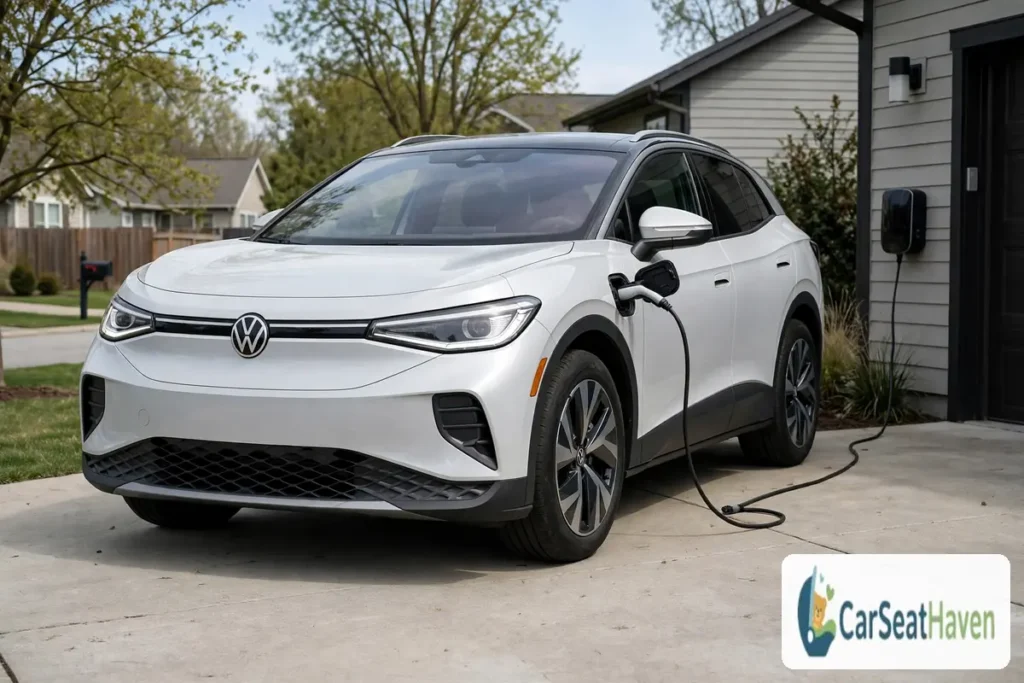
The ID.4 is the quiet one in the lineup, and also the one with the most urgent buying note. It is a compact electric SUV, it drives well for daily use, and it is now a leftover stock car rather than a car in full production in the United States. It seats five in two rows, and it is about 180.5 inches long and 72.9 inches wide. Cargo is 30.3 cubic feet behind the second row and 64.2 cubic feet maximum. There is no front trunk.
Power and range in 2026 depend on drivetrain. Rear wheel drive gives 282 horsepower and up to 291 miles of EPA range. All wheel drive gives 335 horsepower and up to 263 miles of EPA range. The 2026 battery is 82 kWh on all trims, after the smaller 62 kWh battery was dropped. Do not use the old 206 to 291 mile range span for 2026. That span mixes the old 2025 base model with the 2026 models. The correct 2026 span is 263 to 291 miles.
Charging also needs care. DC fast charging from 10 percent to 80 percent takes about 28 to 30 minutes in dealer and editorial tables, but the peak rate itself is disputed, 135 kW in some sources and 175 kW in others. The 2026 car keeps a CCS port and includes a NACS adapter for Tesla Supercharger access on DC charging. Do not call it a native NACS port. That wording is wrong for 2026. Price in 2026 was $45,095 to $57,655 before destination, which is $46,570 to $59,130 including the $1,475 destination charge. Trim order before destination was Pro, AWD Pro, Pro S, AWD Pro S, and AWD Pro S Plus.
Volkswagen ended ID.4 assembly in Chattanooga, Tennessee, in mid April 2026, to make room for the redesigned Atlas. Volkswagen said 2026 inventory should support demand into 2027. That means a buyer in late 2026 is choosing from stock, not ordering a fresh production car in the usual way. The ID.4 fits a driver who charges at home, drives mostly in town or on a regular commute, and wants electric running costs without needing a third row. It is not the pick for a large family, for frequent long road trips without charging stops, or for anyone who needs a third row. One more ID.4 trap matters. The federal $7,500 electric vehicle tax credit ended on September 30, 2025. Do not treat that credit as currently available for a 2026 ID.4 purchase, and do not use old dealer discount headlines as a current price.
Tiguan: the balanced compact pick, now two rows only
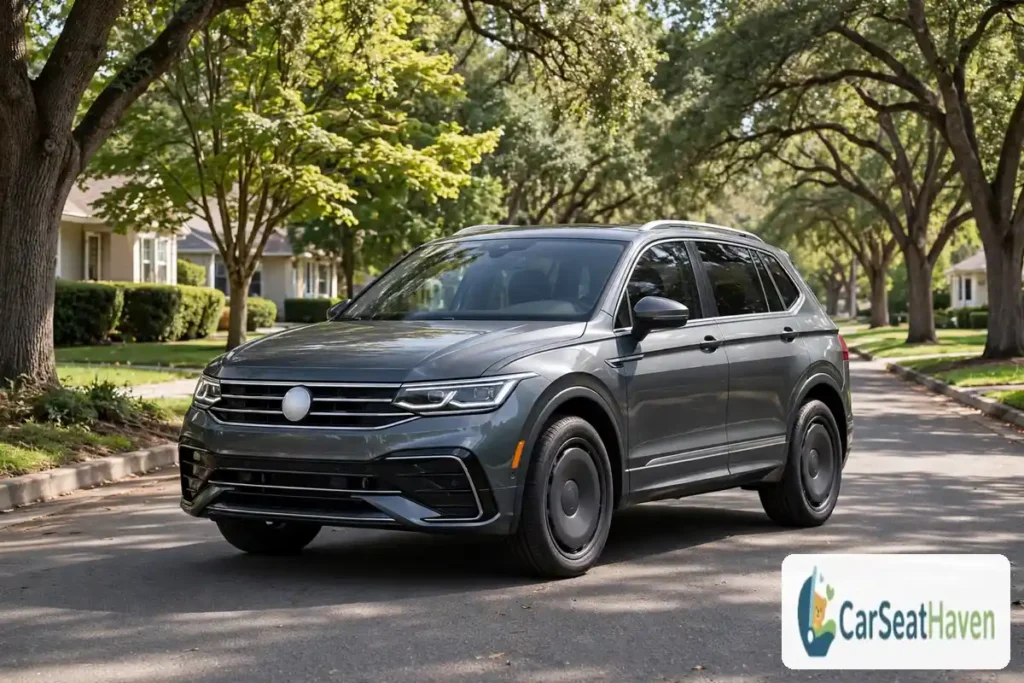
The Tiguan is the middle child that most buyers should test first if they do not need a third row. It is bigger and more refined than the Taos, cheaper and easier to park than the Atlas pair, and it now comes in a redesigned form that changes two things older articles still get wrong. It seats five in two rows in the current United States model. The third row is gone. It is about 184.4 inches long in 2026 dealer tables. Some older dealer tables show 186.1 inches, which looks like the older generation. Use 184.4 inches for the redesigned Tiguan unless Volkswagen official specs say otherwise.
Cargo is the biggest unresolved conflict in the whole lineup. Jim Ellis and other 2026 dealer tables give 33.8 cubic feet behind the second row and 69.8 cubic feet maximum. TrueCar gives 26.5 cubic feet behind the second row and nearly 59 cubic feet maximum. Older tables give 37.6 cubic feet and 73.4 cubic feet maximum. Those figures cannot all describe the same car in the same way. Do not quote a single Tiguan cargo pair as settled until Volkswagen official specs confirm the measurement. This article flags the conflict instead of hiding it.
The engine is a 2.0 liter turbo four. Most trims give 201 horsepower. The SEL R-Line Turbo gives 268 horsepower and all wheel drive only. Torque varies by trim and drivetrain, so pair every torque figure with its trim. Fuel economy is about 26 miles per gallon combined for base trims in dealer summaries, with highway figures up to 34 miles per gallon for front wheel drive in some tables. The Turbo all wheel drive model is lower, around 22 in the city and 29 on the highway in some summaries. Price for 2026 was $30,805 to $43,085 before destination. With the $1,475 destination charge, the base becomes $32,280, which is why some sources show $32,280 as the starting price. It is the same car, on a different price basis, not a different base model. Towing is up to 1,800 pounds with all wheel drive in TrueCar and Elk Grove tables, and 1,500 pounds in some older or front wheel drive tables. Pair towing with drivetrain.
Dealer guides list a 5 star NHTSA overall rating for the 2026 Tiguan, 10 standard airbags, IQ.DRIVE, Travel Assist, a 12 inch display as standard in some tables, and a 12.9 inch or 15 inch screen by trim in others. Verify the rating on NHTSA before repeating it as a buying claim, and do not state one screen size for all trims. The Tiguan fits a small family, a couple who want more space than a Taos, or a buyer who wants a refined daily SUV without paying Atlas prices or parking an Atlas sized car. It is not the pick for seven seats, and it is not a hybrid in the United States in 2026.
The old Tiguan story matters for used buyers. Older United States Tiguans, 2024 and earlier in front wheel drive form, did offer an optional third row with very tight legroom, about 27.9 inches, and about 12 cubic feet behind that third row. That third row was described by Edmunds as too small, and it was dropped in the 2025 redesign. If a listing promises a new Tiguan with seven seats, it is either an old model, an old article, or a non United States model. Check the model year first.
Atlas Cross Sport: Atlas space and style, without the third row
The Atlas Cross Sport is the style pick in the midsize pair. It shares the Atlas wheelbase, width, and engine, but it drops the third row, slopes the roofline, and gives you a larger two row cargo area than a Tiguan. It seats five in two rows, and it is about 195.5 to 195.6 inches long and 78.3 inches wide, with a wheelbase of 117.3 inches, the same wheelbase as the Atlas. That shared wheelbase is important. The Cross Sport is about 5 inches shorter overall than the Atlas, but the interior difference is smaller than the length difference suggests.
Cargo is 40.3 cubic feet behind the second row and 77.6 cubic feet maximum in 2026 tables. Some dealer listings show 77.8 cubic feet, which is a rounding difference. The 2026 engine is a 2.0 liter turbo four with 269 horsepower and 273 pound feet of torque, with an 8 speed automatic. Front wheel drive or 4Motion all wheel drive are available. Fuel economy in 2026 is about 20 in the city and 27 on the highway with front wheel drive, and about 20 to 21 combined with all wheel drive, depending on the source and trim. Price in 2026 was $38,300 to $53,620 before destination, which is $39,775 to $55,095 including the $1,475 destination charge. TrueCar trim prices run higher on the same basis, so always state whether destination is included. Towing is up to 5,000 pounds when properly equipped, in 2026 tables. The base trim story needs care, because some tables show a lower base figure. Check the hitch and trim before promising 5,000 pounds.
A redesigned Atlas Cross Sport was revealed in August 2026, with a reported 282 horsepower engine and larger screens, but its price was not announced at research time, and it was not yet on sale. Do not carry the 2026 price or cargo figure forward as a confirmed 2027 figure. The Cross Sport fits a family of five that wants midsize space, strong towing, and a sportier look, without paying for or climbing into a third row they will rarely use. It is not the pick for seven seats or for maximum cargo with all rows up, because it has no third row to fold.
Atlas: the only three row Volkswagen SUV in the United States
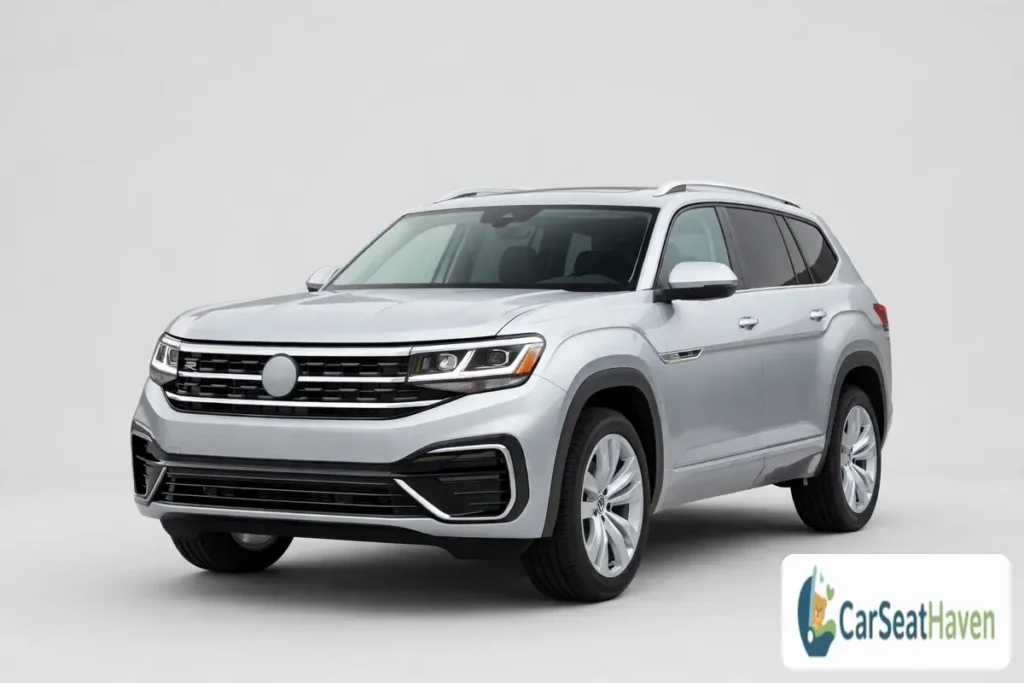
The Atlas is the family workhorse of the lineup. It is also the model where model year matters most, because 2026 and 2027 are different generations with different prices, trims, and power. It seats seven as standard, with a second row bench, or six with optional second row captain chairs. No eight seat Atlas exists in United States specs. Any eight seat claim is an error. It is about 200.7 inches long and 78.3 inches wide, with a wheelbase of 117.3 inches. Legroom and headroom in 2026 are front legroom about 41.7 inches, second row legroom about 37.6 inches, and third row legroom about 33.7 inches. Headroom is about 41.3 inches in front, 40.4 inches in the second row, and 38.3 inches in the third row.
Cargo in 2026 is 20.6 cubic feet behind the third row, 55.5 cubic feet behind the second row, and 96.6 cubic feet maximum. Some sources show 96.8 cubic feet maximum, which is a rounding or measurement difference, not a different car. The 2026 engine is a 2.0 liter turbo four with 269 horsepower and 273 pound feet of torque, with an 8 speed automatic. The old V6 was dropped for 2024, so do not quote V6 figures for a current Atlas. Fuel economy in 2026 is about 20 in the city and 27 on the highway with front wheel drive, and about 21 combined with most all wheel drive trims. Price in 2026 was $39,310 before destination for the base SE, which is $40,785 including the $1,475 destination charge, rising to $56,105 for the top SEL Premium R-Line including destination. Trims were SE, SE with Technology, Peak Edition, SEL, and SEL Premium R-Line. Towing in 2026 is up to 5,000 pounds when properly equipped, except the base SE, which is 2,000 pounds in dealer spec tables. Never quote a flat 5,000 pounds for every Atlas without that trim note.
Changes for 2027 are large. The Atlas was fully redesigned, unveiled in April 2026 at the New York auto show, built in Chattanooga, Tennessee, and on sale in fall 2026. Power rises to 282 horsepower from an updated 2.0 liter turbo, with torque reported at 258 pound feet in 2027 coverage. That torque figure conflicts with the 2026 figure of 273 pound feet, and 2027 coverage itself is not fully consistent, so treat 2027 torque as reported, not as settled, until a Volkswagen press release confirms it. Price for 2027 starts at $41,610 before destination, which is $43,135 including the $1,525 destination charge for the SE front wheel drive model, rising to $58,135 including destination for the top trim in some tables. Trims drop to four in 2027: SE, SE with Technology, SEL R-Line, and SEL Premium R-Line, with no plain SEL and no Peak Edition. Cargo for 2027 is reported as 21.2 cubic feet behind the third row, 55.9 cubic feet behind the second row, and 95.4 to 96.8 cubic feet maximum, depending on the source, so label the year and the source type before quoting a 2027 cargo pair. No hybrid Atlas is on sale at the 2027 launch. A future hybrid is reported as a midcycle refresh plan, years out, with no specs, price, or confirmed model year. The Atlas fits a large family, a carpool family, or anyone who regularly carries six or seven people plus luggage. It is the only Volkswagen SUV that can do that job in the United States. It is not the cheapest to run, and it is not the easiest to park, but for three rows, there is no other Volkswagen SUV choice.
The midsize confusion, explained simply
Many buyers search for a Volkswagen midsize SUV and get confused, because dealer pages and editorial pages use the word midsize in different ways. Here is the clean United States answer. Atlas and Atlas Cross Sport are midsize SUVs. That part is consistent. Tiguan is a compact SUV in the United States, in Edmunds, Wikipedia, TractionLife, and in its competitor set, which is Toyota RAV4, Honda CR-V, Hyundai Tucson, Kia Sportage, Mazda CX-50, and similar compact two row SUVs. Some dealer pages call the Tiguan midsize, and European sources call it medium sized, because the European Tiguan is classed differently. For a United States buyer, compact is the correct label.
ID.4 is split. Edmunds calls it a midsize electric SUV in one overview, while Autoblog, TractionLife, and dealer sources call it a compact electric SUV. By size, at 180.5 inches long, it sits with the compact pair, not with the midsize pair. Do not use the midsize label alone to claim it is a three row family hauler. It is not. Taos is subcompact in most editorial sources, and compact in some dealer sources. Either way, it is below the Tiguan in size, and it is not a midsize SUV. Atlas is sometimes called full size in dealer marketing. That is marketing language, not a size class. In United States editorial and spec sources, the Atlas is a midsize three row SUV, not a full size body on frame SUV. If your search is really for a midsize Volkswagen SUV, your shortlist is two cars: the three row Atlas and the two row Atlas Cross Sport. Everything else is a step smaller, a step electric, or a different class label.
Third row: only the Atlas, and what it really means for families
A third row is not just a seat count. It is access, legroom, cargo with all rows up, and child seat reality, and the top guides leave most of that out. Only the Atlas has a third row in the current United States Volkswagen SUV lineup. The ID Buzz has a third row too, but it is a van, not an SUV, and it is covered separately below. Atlas third row legroom is 33.7 inches in 2026. That is usable, and it beats some rivals on paper, but it is tight for tall adults on long trips. Dealer pages call it adult friendly, while some buyer guides say kids only. The honest answer is in between: short trips and average sized adults are fine, long trips with tall adults in the third row will feel tight.
Atlas cargo with all rows up is 20.6 cubic feet in 2026, or 21.2 cubic feet in 2027 reporting. No top source tested a stroller in that space, and a dealer claim that it is more than enough for strollers has no test behind it. Bring your own stroller to the dealer and test it with all rows up. Atlas second row access matters as much as legroom. The second row bench can tip and slide forward for third row access, and some sources say it can move with a child seat still installed, with effort. No source tested that move with a named child seat or with three seats installed across the second row, so do not assume it works smoothly with your exact seats.
The biggest child seat gap in this whole research is Atlas third row LATCH. One dealer source says there are two sets of lower anchors in the third row. Another source says there are lower anchors on the outboard sides. A comparison source says there are no lower anchors in the third row at all. Top tether positions in the third row are also not clearly stated anywhere. This article does not pick one of those claims, because a wrong LATCH claim is a safety claim. Check the Volkswagen owner manual or an IIHS or Cars.com child seat check for your exact model year before you buy an Atlas for third row child seats. The same honesty applies to the other models. No top article gives LATCH counts, three across fitment, rear facing legroom with the driver seat set for a tall driver, or a named child seat test for the Taos, Tiguan, ID.4, or Atlas Cross Sport. That is the gap a parent focused site should fill with real testing, not with dealer copy. Until that testing exists, test your own seats at a dealer, in the exact trim you plan to buy.
Electric choices: ID.4 now, ID Tiguan later, and only in Europe for now
Volkswagen electric naming is confusing right now, because three different electric names sound alike. Keep them separate. ID.4 is the current United States electric SUV, in 2026 form, from leftover stock after production ended in the United States. ID Tiguan is the planned electric successor to the ID.4 and ID.5. In Europe, it is fully announced: German base price 42,695 euros, sales from early 2027, 58 kWh and 77 kWh batteries, power from 190 to 299 horsepower in European reporting, up to 600 kilometers of WLTP range, a 534 liter boot plus a 32 liter front trunk, and towing up to 2,000 kilograms on 77 kWh versions. None of those figures are United States figures. WLTP range is not EPA range. Euros are not United States dollars. European trims are not United States trims.
Volkswagen of America calls the ID Tiguan the planned ID.4 successor in North America, but has given no United States date, price, plant, or model year. Do not present it as a car you can buy in the United States today, and do not merge it with the gas Tiguan. They share a name, but they are different vehicles on different platforms. ID Buzz is covered next, because it is the other electric Volkswagen family vehicle buyers confuse with an SUV.
ID Buzz is a van, not an SUV, and it does not belong in the SUV ranking
If you search for Volkswagen SUVs, you will see the ID Buzz in family comparisons, and that is understandable. It is big, it has three rows, and it looks like a family vehicle. It is still not an SUV. Volkswagen and the EPA class the ID Buzz as a minivan or van, not an SUV. TractionLife says the same thing in its SUV guide, and dealer SUV lineup pages leave the ID Buzz out for that reason.
The United States ID Buzz is long wheelbase only, with three rows and six or seven seats. Second row captain chairs give six seats, and a second row bench gives seven seats. Third row legroom is 42.4 inches, which is genuinely adult usable, far more than the Atlas third row. Cargo in the 2025 United States model is 18.6 cubic feet behind the third row, 48.9 cubic feet with the third row folded, 75.5 cubic feet behind the second row with the third row removed, and 145.5 cubic feet maximum. Those figures use different measurement points, so do not compare them directly with SUV cargo figures without checking the method.
The ID Buzz was sold in the United States only as a 2025 model, skipped 2026, was announced in May 2026 for a 2027 return, and was then reported in September 2026 as slipped to a 2028 model year arriving in the first half of 2027. No United States price, EPA range, horsepower, or torque for the return model has been announced. The 2025 reference figures are a base price of $59,995 before destination, EPA range of 234 miles with rear wheel drive and 231 miles with all wheel drive, and power of 282 horsepower rear wheel drive or 335 horsepower all wheel drive. The Tourer is a trim, not a separate model. It is built on the Pro S 4Motion form, with a fold out mattress platform, window blinds, front window ventilation panels, an overnight mode, a retractable tow hitch, second row captain chairs, and an electrochromic smart roof. It has no pop up roof and no kitchen. For a family that wants sliding doors, a flat floor, and the most third row legroom in the Volkswagen family lineup, the ID Buzz is worth a separate look. For a strict SUV ranking, it should be fenced off in one clear note, not ranked as the sixth SUV.
Models you will see in search that are not United States SUVs
Global search results mix United States models with models Volkswagen does not sell in the United States. If you copy a global list into a United States article, you will mislead buyers on price, size, fuel, and availability. Touareg was discontinued in the United States after the 2017 model year, replaced by the larger Atlas. The current gas Touareg is ending production in Europe in 2026, with a Final Edition priced in euros. A future electric ID Touareg is only future planning, reported as not for the United States. Do not list the Touareg as a current United States SUV.
T-Cross, T-Roc, Taigo, Tayron, and ID.5 are Europe, United Kingdom, Brazil, China, or India models, not United States models. The United States small Volkswagen SUV is the Taos, not the T-Cross or T-Roc. The Tayron name is related to the United States Tiguan long wheelbase form, but Tayron specs are not United States Tiguan specs. ID.6 Crozz, ID.6 X, ID Era 8X, and Talagon are China models, not United States models. The Atlas is sold as Teramont in China, and the Atlas Cross Sport as Teramont X, but Chinese specs, prices, and trims are not United States specs.
United Kingdom sources such as Cinch and Motorpoint cover a completely different lineup, with United Kingdom prices, WLTP ranges, and diesel or plug in hybrid engines. Never import their rankings or their ID.4 range figures into a United States article. A United Kingdom ID.4 range of 347 miles is WLTP, not the United States EPA figure of up to 291 miles. Canadian sources also differ. Canadian prices are in Canadian dollars, Canadian trims have different names, and Canadian cargo figures are in liters. Do not use Canadian Tiguan cargo or Canadian prices as United States figures.
Buying traps: destination, old pages, cargo, and towing by trim
Most price and spec conflicts in Volkswagen SUV research come from four traps, not from four different cars. Learn the traps once, and the whole lineup gets clearer. Destination charge is the first trap. Almost every price conflict is the same car quoted with and without destination. Destination is $1,475 for most 2026 models, $1,525 for most 2027 models, and $1,550 for the 2025 ID Buzz. Always ask whether a price includes destination, and always label it in writing. A $1,475 gap is not a discount and not a price rise. It is a basis difference.
Old pages are the second trap. Older dealer and listicle pages still rank for Volkswagen SUV searches, and they still promise a Tiguan third row, a Taos at 158 horsepower, an Atlas V6, and prices from 2024 or 2025. Check the model year on every page before you trust a seat count, a horsepower figure, or a price. Tiguan cargo is the third trap. As flagged above, 2026 dealer tables and TrueCar disagree sharply on Tiguan cargo. Do not average them, and do not pick the larger pair because it looks better. Check Volkswagen official specs for your exact model year and trim, and ask the dealer which measurement point the figure uses.
Towing by trim is the fourth trap. Atlas and Atlas Cross Sport headlines say 5,000 pounds, but base trims and equipment change that figure. The 2026 Atlas base SE is 2,000 pounds in dealer spec tables. The Cross Sport has a similar equipment note. Tiguan towing also changes by drivetrain. Never buy for towing on a headline alone. Confirm the hitch, the trim, and the properly equipped wording in writing. Model year mixing is another trap to watch. The Volkswagen official SUV page itself, at research time, showed a 2027 Taos alongside 2026 models for other cars. That is normal during a model year change, but it means you cannot present the whole lineup as one model year without checking the current page at buying time. Safety claims by trim also need care. Some safety and headlight claims apply only to top trims. CarBuzz notes Tiguan headlights are rated Good only in the top trim in snippet reporting. IIHS Top Safety Pick claims for Atlas and Atlas Cross Sport also need a model year and trim check before repeating. A rating for one year or one trim is not a rating for every car with that name.
Which Volkswagen SUV fits which family
There is no single best Volkswagen SUV, and any article that names one without saying for whom is hiding the trade off. Here is a simple, honest ladder in words, not in a spec table. Best for the lowest price and city driving is the Taos. It is cheapest to buy, best on gas mileage in the lineup, easiest to park, and smallest on cargo. Best balanced gas SUV for a small family is the Tiguan. It offers more space and refinement than a Taos, a stronger top trim at 268 horsepower, and it is still compact enough for daily driving, with no third row to pay for if you do not need it.
Best for electric daily driving is the ID.4, by default, because it is the only electric SUV in the current United States lineup. Buy it with eyes open about leftover stock, charging, and the planned ID Tiguan successor with no United States date yet. Best for five seats with midsize space and towing is the Atlas Cross Sport. It shares the engine and wheelbase of the Atlas, offers larger two row cargo than a Tiguan, tows strongly when properly equipped, and has a sportier roofline. Best for six or seven seats is the Atlas, with no rival inside the Volkswagen SUV lineup. If you need a third row often, this is the only choice, and the 2026 versus 2027 decision, leftover discount versus redesigned car, is the real buying question. Best for maximum third row legroom and sliding doors is the ID Buzz, if you are willing to step outside the SUV class into a van. It is the only Volkswagen family vehicle with 42.4 inches of third row legroom in United States reporting, but it is priced, timed, and specified very differently from the SUVs above.
If you are choosing between Tiguan and Atlas Cross Sport, the question is simple. Do you want compact size and lower price, or midsize space and stronger towing? If you are choosing between Atlas Cross Sport and Atlas, the question is even simpler. Do you need a third row? If the answer is no, the Cross Sport gives you most of the Atlas experience in a shorter, sportier body. If the answer is yes, only the Atlas works.
What the top guides miss, and what to check at the dealer
Top ranking guides are good at prices, sizes, and trim names. They are weak at the family details that decide whether a car actually works with children, and this article is honest about that gap instead of filling it with guesses. No top article gives a complete child seat guide for any Volkswagen SUV: no LATCH anchor counts and positions, no three across test, no rear facing legroom with a tall driver in front, and no third row child seat test for the Atlas. No top article gives a per row legroom and headroom table for the full lineup. The only legroom figures that appear repeatedly are Taos front legroom, Tiguan legroom in a Taos versus Tiguan comparison, and Atlas third row legroom.
No top article tests a stroller with all rows up, especially in the Atlas with the third row up, where cargo is only about 20.6 cubic feet in 2026. No top article explains third row daily use in the Atlas: how second row access works with child seats installed, how far the second row slides and tilts, or how third row headroom feels for a tall adult on a long trip. No top article gives a clear 2026 versus 2027 Atlas buying decision, including leftover 2026 discount versus redesigned 2027 price and equipment, in one place. No top article gives a clear ID.4 inventory versus wait decision: buy a leftover 2026 ID.4 now, or wait for an ID Tiguan with no United States date. No top article gives a trim by trim family value guide: which trim actually gives heated rear seats, ventilated seats, massage seats, rear sunshades, or rear USB charging, without paying for the top trim.
Use that gap as a dealer checklist, not as a reason to delay a test drive. Bring your exact child seats, and install them in the exact trim you plan to buy, in the second row and, for the Atlas, in the third row. Bring your stroller, and load it with all rows up, not just with rows folded. Set the driver seat for the tallest driver in your family, then check rear facing legroom behind it. Check LATCH anchors and top tethers by hand, in every row you plan to use, and check the owner manual for the exact model year. Confirm price with destination, towing by trim and hitch, cargo measurement, and safety rating by model year and trim, in writing, before you sign.
FAQs:
How many Volkswagen SUVs are there in the United States?
Five in the current lineup: Taos, ID.4, Tiguan, Atlas Cross Sport, and Atlas.
What is the smallest Volkswagen SUV?
The Taos, at about 175.8 to 175.9 inches long, with five seats.
What is the largest Volkswagen SUV?
The Atlas, at about 200.7 inches long, with six or seven seats and up to 96.6 cubic feet of maximum cargo in 2026.
Which Volkswagen SUV has a third row?
Only the Atlas, in the current United States SUV lineup. The current Tiguan does not have a third row.
Is the Tiguan a midsize SUV?
Not in the United States. Editorial sources class the current Tiguan as compact. Dealer pages sometimes call it midsize, and European sources class it as medium sized, but United States buyers should use compact.
Is the ID.4 a midsize SUV?
The label is split. Edmunds calls it a midsize electric SUV in one overview, while Autoblog and other sources call it a compact electric SUV. By length, it sits with the compact pair, and it has five seats and two rows only.
Which Volkswagen SUV is cheapest?
The Taos, starting at $26,500 before destination for 2027, and $26,500 to $35,900 before destination for 2026.
Which Volkswagen SUV tows the most?
Atlas and Atlas Cross Sport, up to 5,000 pounds when properly equipped, with trim exceptions. Tiguan tows up to 1,800 pounds with all wheel drive in current tables. ID.4 tows up to 2,700 pounds with all wheel drive. Taos towing is disputed, so check the spec sheet.
Is there a Volkswagen hybrid SUV in the United States?
No, not on sale in 2025, 2026, or at the 2027 launch in this research. Taos, Tiguan, Atlas, and Atlas Cross Sport are gas only, and ID.4 and ID Buzz are electric only. A future full hybrid is reported as a midcycle refresh plan, with no specs or confirmed model year.
Is the ID Buzz a Volkswagen SUV?
No. It is an electric van with three rows and six or seven seats. It belongs in a family vehicle conversation, but not in a strict SUV ranking.
Is the ID Tiguan coming to the United States?
Volkswagen of America calls it the planned ID.4 successor, but no United States date, price, plant, or model year has been announced. The announced ID Tiguan is European, with European prices, WLTP range, and trims.
Should I buy a 2026 Atlas or wait for the 2027 Atlas?
That depends on price and equipment, not on the name alone. The 2026 Atlas is the last first generation year, with a lower starting price and five trims including Peak Edition. The 2027 Atlas is redesigned, more powerful at 282 horsepower, more expensive, and offered in four trims. Compare a real leftover 2026 quote, including destination, with a real 2027 quote, including destination, before you decide.
Should I buy a leftover ID.4 or wait for the ID Tiguan?
There is no safe wait date to give, because the ID Tiguan has no United States date yet. If you need an electric Volkswagen SUV now and the ID.4 fits your charging and range needs, leftover stock is the only current route. If you can wait and you want the newer electric model, you are waiting for an announcement, not for a confirmed arrival month.
Why do Volkswagen SUV prices differ so much online?
Most of the difference is destination charge, model year, and trim, not a different car. A base Atlas at $39,310 before destination and $40,785 including destination is the same base car. Always compare prices on the same basis.
What should I check before buying any Volkswagen SUV for child seats?
LATCH positions and top tethers in every row you will use, three across fit in the second row if you need it, rear facing legroom with the driver seat set, stroller fit with all rows up, and second row access to the third row in the Atlas with child seats installed. Top guides do not answer those questions, so test them yourself at a dealer.

Aiden is the founder and editor of CarSeatHaven. He researches NHTSA safety standards, AAP guidance, manufacturer manuals, and recall notices, and turns them into plain-language car seat guides for parents.
