


Table of Contents
Before you buy car insurance, you will get a quote first, and that quote is just a free price estimate, not the policy itself. You share your driver details, your car details, and the address where the car stays at night, and a company tells you what it would charge for the coverages you picked, for one term. Later, after the company checks your driving record, your claims history, and your credit based insurance score where your state allows it, that price can still change. And here is the part most people miss. The same driver, with the same car, can get very different prices from different companies, because every company weighs risk a little differently. So if you want to avoid overpaying, compare at least three quotes with the same limits and the same deductibles, and keep the protection you actually need.
What you need to know first
- A quote is a price estimate before you buy. It does not buy a policy, and it does not change the policy you already have.
- A quote is usually free. Getting one does not mean you have to buy from that company.
- The final price can change after verification. The price you see first is based on what you entered, the bound price is based on what the company checks.
- Coverage starts only on the confirmed start date, not on the day you ask for a quote.
- The same driver can get very different prices. Each company weighs risk in its own way, so one quote alone tells you very little.
- Compare like for like. Same drivers, same cars, same limits, same deductibles, same term, and the full term cost, not just the monthly headline.
- Minimum coverage is a legal floor, not a recommendation. It may not be enough if a crash is serious.
- This article is general information only. It is not legal advice and it is not personal financial advice. For your own case, check your state insurance department or talk to a licensed agent.
What is a car insurance quote
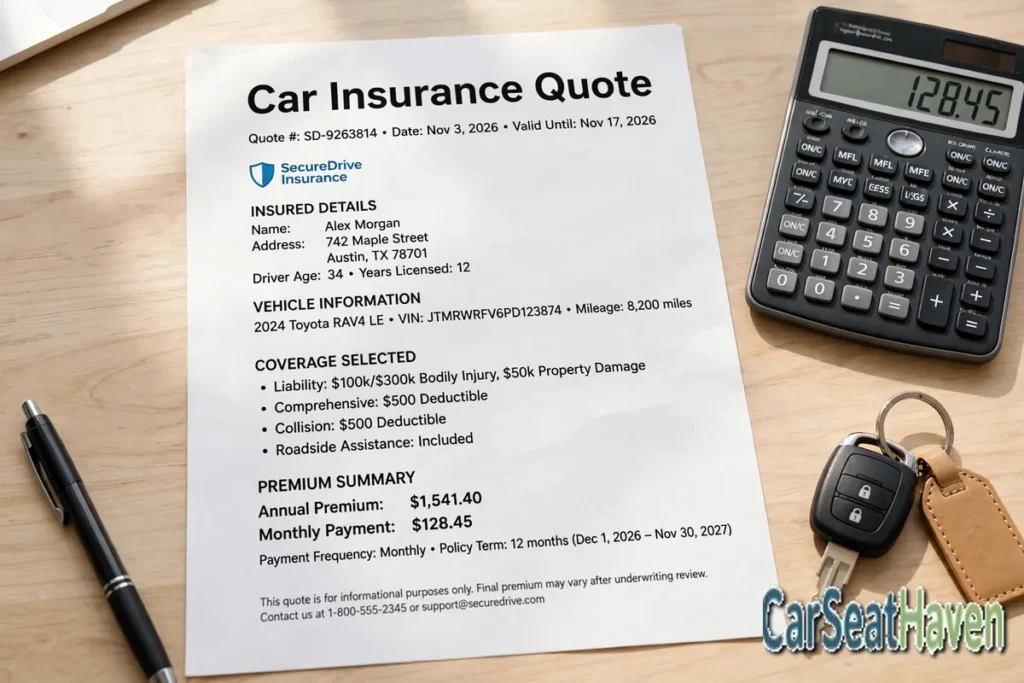
You will also see the phrase auto insurance quotes, and in the United States it means exactly the same thing. You ask what a company would charge you, you get a number back for a specific set of choices, and when you change a choice, that number moves. Pick a higher limit, and the price usually climbs. Pick a higher deductible, and the price usually drops, because you are agreeing to pay more yourself after a claim.
It helps to think of it like asking a price in a shop. You ask three shops, you get three prices, and you have bought nothing yet. You can walk away, try another place, or come back later. The one big difference is that a shop price is usually the same for everyone, while an insurance quote is personal. It is built from your age, your driving record, your car, your address, and the coverages you choose.
Quote, premium, and policy get mixed up a lot, so it is worth separating them clearly. A quote is the estimate. A premium is what you actually pay for the policy term once you buy, usually for six months or for twelve months, in full or in monthly instalments. A policy is the binding contract. Inside it you will find a declarations page, which lists who is covered, what is covered, the limits, the deductibles, and the premium, plus a policy form, which sets out the agreement, the conditions, and the exclusions. If a quote and a policy ever disagree, the policy wins.
Quotes also have an expiry date, and it is easy to miss it. Many guides say a quote is often valid for about thirty days, but no company has to follow that exact window. Some give you less time, some give you more, and even inside that window the price can shift if the checks come back different from what you entered. Look at the date on your own quote. A quote from last month is not automatically still good.
How to get car insurance quotes online
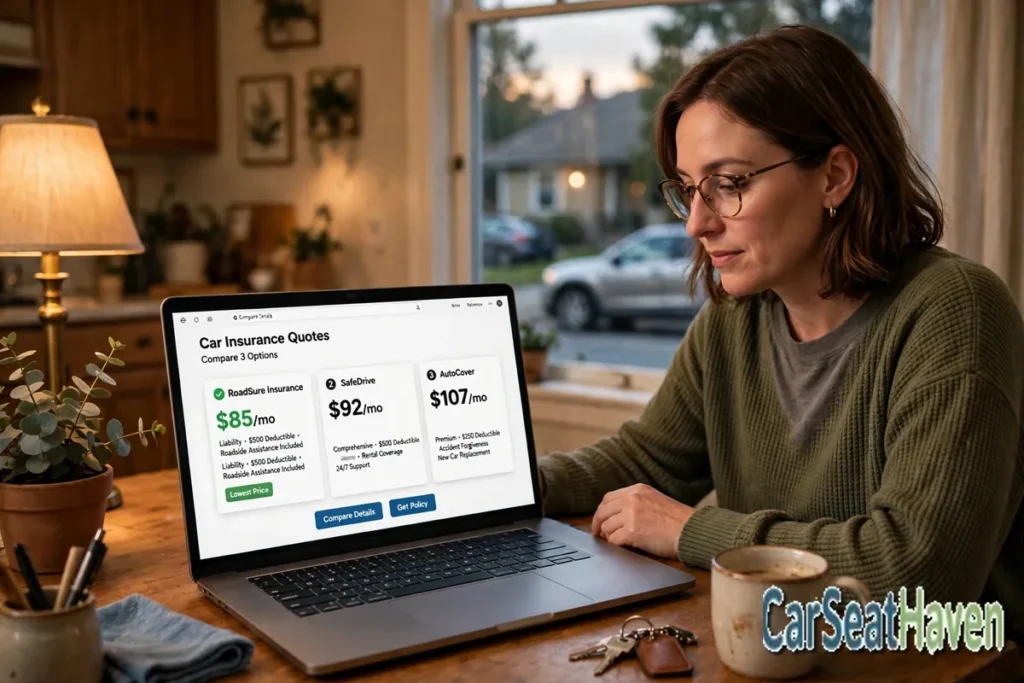
Most people start online now, and for good reason. You can do it at home, in your own time, and you can change a limit or a deductible and watch the price move straight away. The catch is repetition. You fill in one form, get a price, then you fill in the same form again with the next company. That takes time, but it also keeps the comparison honest. Change your answers between companies, and you are no longer comparing the same thing.
There are five main ways to get a quote, and each one comes with a limit worth knowing before you start.
Online direct
You go to one insurer website or app, enter your details, and get that company price only. It is quick, and adjusting coverages is easy, but you have to start the whole form again at the next company. Expect follow up calls and emails after you ask, even if you do not buy.
By phone
On the phone you answer the same questions, and an agent can talk through an option you do not understand. It is slower than online, and it is still one company at a time, but if you like talking a choice through, it can feel clearer than a form.
Through a captive agent
A captive agent works for one company only. That agent knows that company well, and stays as your contact after you buy. The limit is plain to see. If that company raises its price at renewal, a captive agent cannot shop another company for you. You would have to start again somewhere else yourself.
Through an independent agent or broker
An independent agent is appointed with several companies, so one conversation can bring back several quotes for the same coverage. That agent can also shop again for you at renewal. The limit is that an independent agent only has the companies they are contracted with. Companies that only sell through their own agents still have to be quoted separately, and some brokers charge a service fee on top of commission, so ask about fees before you agree to anything.
Through a comparison website
A comparison website lets you enter your details once and see several partner companies side by side. That saves a lot of retyping, and it is a good way to see how wide the spread can be. The limit matters just as much as the convenience. A comparison site shows its partner panel only, not the whole market, and the prices shown are often estimates. The final price is set on the carrier site or after underwriting checks. Some sites hand you to a licensed agent to finish the purchase, so the site itself is not always the seller.
Buying online is not automatically cheaper than buying through an agent. Companies base the price on your risk profile, not on how you asked. What usually changes is the shopping experience, how much help you get, and how easy it is to adjust coverages and see the result.
Are car insurance quotes free
Yes, in the guides and company pages checked for this article, quotes are free. A free quote does not buy a policy, and it does not cancel your current policy. There is one small point to keep straight, though. A quote check and a final underwriting check are not quite the same thing. For quoting, companies often use a soft pull for credit, which does not affect your credit score in the way a hard pull for a loan does. For the final price, where your state allows credit based insurance scores, that score can still affect what you pay. So a quote can be free, and credit can still matter at the end, where the law allows it. Do not take a promise that credit never matters as a national rule, because it does not hold in every state.
What information do you need for a quote
Gather the same information for every quote before you start. That way you will not have to guess halfway through a form, and every company will get the same facts. Guessing leads to a price that jumps later, when the company checks the real record.
For drivers, you will usually need name, address, date of birth, licence number, occupation, and marital status, plus accidents, tickets, and violations in the past few years, for every licensed driver in your household who will be listed on the policy. Companies ask about household drivers because anyone who regularly drives the car affects the risk, even if you think of the car as yours alone.
For vehicles, you will usually need year, make, model, vehicle identification number, safety features, current odometer reading, annual mileage, year purchased, and whether the car is owned, financed, or leased. If it is financed or leased, you will need the lender or lessor name, because that company has an interest in the car too.
For address, the garaging ZIP code matters most. That is where the car is kept overnight, not just your mailing address. Traffic density, crash frequency, theft, weather claims, and repair and medical costs in that ZIP code all feed into the price, which is why the same driver can pay a very different price after a move, even with the same car and the same record.
For current coverage, you will need your current insurer if you have one, your current limits and deductibles, and your prior insurance history, including any lapse. A lapse, even a short one, can raise the next price and narrow your choices, because continuous coverage is itself a rating factor for many companies. California is noted as an exception on this point, where absence of prior insurance alone cannot be used to set rates or eligibility, but that exception does not make a lapse harmless everywhere else.
Share only what a quote form asks for, and share it accurately. Do not hide a driver, do not understate mileage, and do not invent a driving history to get a lower number. The bound price will be based on checks, and a price built on wrong facts can jump, or in a serious case, cause a problem with the policy itself.
Car insurance coverage types in plain words
Coverage types sound technical at first, but each one answers a simple question. Who gets paid, for what, and up to how much. Once you see that, the rest of this article gets much easier to follow.
Liability coverage
Liability pays others when you cause a crash. It never pays for your own car, and it never pays for your own injuries. It has two parts. Bodily injury liability pays other people medical costs, lost income, and legal defence if you are sued, up to the per person and per accident limits. Property damage liability pays for other people cars, fences, buildings, poles, and other property you damage, up to its limit. Liability is the coverage that almost every state requires, and it is the coverage that the minimum limits are about.
Collision and comprehensive coverage
Collision pays to repair or replace your own car after you hit another vehicle or an object, or after the car rolls over, regardless of fault, minus your deductible. It does not cover mechanical failure or normal wear and tear. Comprehensive, sometimes called other than collision, pays for theft, fire, flood, hail, windstorm, vandalism, falling objects, animal strikes, and glass breakage, minus your deductible, with a separate or sometimes zero glass deductible in some policies. No state requires collision or comprehensive by law, but a lender or lessor almost always requires both while a loan or lease is running, because the lender money is tied to that car.
Uninsured and underinsured motorist coverage
Uninsured motorist coverage pays your injuries, and sometimes your property damage, when the driver at fault has no insurance, or in a hit and run, subject to your state rules. Underinsured motorist coverage tops up the payment when the driver at fault has insurance, but not enough to cover your injuries or damage. These two are often paired together, and they are required in some states, offered by default in others, and optional in others. The exact count of required states differs between guides, because some guides count required only, while others count required plus must be offered unless rejected in writing. Do not rely on a bare count. Check your own state rule.
Personal injury protection and medical payments
Personal injury protection pays your and your passengers medical costs, and depending on your state, lost wages, rehabilitation, childcare or housekeeping costs, and funeral costs, regardless of fault. It is the engine of no fault systems, which are explained later in this article. It does not pay for vehicle or property damage, and by itself it does not pay for pain and suffering. Medical payments is narrower. It pays medical and funeral expenses for you and your passengers regardless of fault, usually with limits in the range of one thousand to ten thousand dollars, and unlike personal injury protection it generally does not cover lost wages. A handful of states require medical payments, with Maine, New Hampshire, and Pennsylvania named in one major guide, while other guides add Wisconsin with a different limit, so this is another place where your state department is the final word, not a national list.
Extra coverage that is often confused with full coverage
Rental reimbursement pays a daily amount toward a rental car while your car is repaired after a covered collision or comprehensive claim, usually for a limited number of days, and usually only if you already have collision and comprehensive on the policy. It is not for routine maintenance, a breakdown, or a holiday rental. Roadside assistance pays for towing, a jump start, a flat tyre change, fuel delivery, and a lockout, usually up to a mileage or dollar limit per event, often with no deductible. It can duplicate an auto club membership you already pay for, so check before you add it twice. Gap insurance is different again. If a financed or leased car is totaled or stolen, the standard settlement is actual cash value, which is market value at that time. That can be less than the loan balance you still owe. Gap pays some or all of that difference. It does not pay your deductible, late fees, or a prior loan balance rolled into the new loan, and it is not the same as a loan or lease payoff add on that caps the payment at a percentage of actual cash value. Gap is most valuable in the first few years of a loan, when the balance is high and the car value has fallen fastest.
Full coverage is a phrase you will see everywhere, but it is not a legal term and it is not a single product. In everyday use it usually means liability plus collision plus comprehensive, often plus uninsured or underinsured motorist coverage, personal injury protection or medical payments, rental, and roadside. It does not mean everything is covered. Limits, deductibles, and exclusions still apply, and rental, roadside, and gap are usually separate add ons, not automatic parts of full coverage.
What is SR 22
SR 22 is not insurance, and it is not a coverage type. It is a certificate of financial responsibility that your insurer files with the state motor vehicle department, proving you carry at least the state minimum liability. It is usually required after a DUI or DWI, driving without insurance, serious violations, or a licence suspension. You must keep continuous coverage for the filing period, or your licence can be suspended again, and in many guides the clock can restart if coverage lapses. The filing period is most commonly about three years, but Texas is commonly two years, some states are one year or less for insurance violations, and Alaska can be five years or more after a DUI. Your state notice controls, not a national average. Florida and Virginia use a related filing called FR 44, mainly for DUI cases, with higher limits. Florida FR 44 is consistently listed at 100/300/50 for three years from reinstatement. Virginia FR 44 is double the state minimum, which after the 2025 minimum rise means 100/200/50, and older guides that still list Virginia at 100/300/50 or 50/100/40 are now stale. A few states, including North Carolina and New York, do not use SR 22 or FR 44 for in state reinstatement.
What affects car insurance rates

Ever wondered why a friend pays less than you for what looks like the same coverage? This section is the answer. Companies do not use one national price. They build a price from a set of factors, and each company weighs those factors differently. That is also why the cheapest company for one driver is not the cheapest for the next driver, even in the same city.
Age and experience matter a lot at the start. Teens and newly licensed drivers usually pay the most, because crash risk is highest in those years. Prices generally fall as experience grows, level off in the thirties to fifties, and can rise again for older drivers. Hawaii and Massachusetts are cited as not allowing age itself as a rating factor, while still allowing years of driving experience, which is a nuance to check with the state source before you repeat it as a fact.
Driving record and claims history are just as important. Tickets, at fault accidents, and claims usually raise the price, typically for three to five years. A clean record is usually cheapest, a speeding ticket pushes the price up, an at fault accident pushes it up more, and a DUI pushes it up the most. That is why a single ticket can stay with you for years in price terms, even after the fine is long paid.
Location and ZIP code can move a price more than people expect. Traffic density, crash frequency, theft and vandalism, weather claims, and repair and medical costs in the area where the car is kept overnight all feed into the calculation. The same driver, with the same car and the same coverage, can pay a very different price after a move to a different ZIP code, simply because the local risk around that address is different.
Vehicle choice matters too. Year, make, model, value, repair cost, safety and anti theft features, and theft rate all play a part. A car that is expensive to repair, or that is stolen often, costs more to insure for collision and comprehensive, even if the driver is the same.
Mileage and use matter in a quieter way. More miles mean more exposure, so a long commute usually costs more than pleasure use with low miles. Low mileage discounts exist, but the threshold varies, with guides citing under about seven thousand five hundred to ten thousand miles a year. Do not understate mileage to get a lower quote. The company can check, and the saving is not worth a problem later.
Coverage limits and deductibles are the two choices you control most directly. Higher limits and lower deductibles raise the price. Higher deductibles lower it. One guide put the saving from raising collision and comprehensive deductibles from five hundred dollars to one thousand dollars at about ten percent, or about two hundred sixteen dollars a year for a typical clean record driver. Other guides put the same move at eight to fifteen percent. Only raise a deductible to an amount you can actually pay from savings after a claim, and only within a lender cap if the car is financed or leased. A cheap premium that leaves you unable to pay the deductible after a crash is not a saving at all.
Credit, where allowed, can move the price a lot, and the rules differ by state, so this is a place to be careful with national claims. The narrow, most repeated list of states that do not allow credit based insurance scores is California, Hawaii, Massachusetts, and Michigan. Broader lists add Maryland, Oregon, Utah, Washington, and Nevada as banning or limiting use, and New York is a limit case, not a ban. Do not publish an eight state ban list without distinguishing a ban from a limit. Where credit is allowed, the gap between good credit and poor credit can be large for the same coverage, which is why improving credit is a long term lever, not a quick fix before renewal.
Prior insurance history matters as well. Continuous coverage is a rating factor, and it can earn a discount. A lapse can raise the next price and narrow your carrier choices, and longer lapses tend to raise it more, though studies differ a lot on the exact amount. The lesson is simple. Keep coverage continuous, and do not cancel an old policy before the new one starts, even for one day.
Marital status and gender are also used where allowed, and the ban lists differ just as much as the credit lists. Married drivers are generally rated lower than single drivers where marital status is allowed. Young men generally pay more than young women where gender is allowed, and the gap is usually minimal after the teenage years. One 2026 list names six states that ban gender use, California, Hawaii, Massachusetts, Michigan, North Carolina, and Pennsylvania, while other lists add Florida or Ohio, and older lists that still include Montana are stale, because Montana repealed its ban in 2021. Again, your state rule is the only safe source.
Discounts are real, but the numbers you see in guides are ranges and maxima, not guarantees, and the conditions matter as much as the number. Ask about bundling home or renters insurance with auto, multi car, low mileage, good student, defensive driving or driver education, pay in full, autopay, and paperless, by name at each quote. Telematics, which tracks braking, acceleration, speed, night driving, mileage, and phone use through an app or device, is a useful caution in particular. It is advertised as a saving, but in practice it can raise as well as lower a price, depending on how you actually drive, and in one state report many enrolled drivers saw no change at all. Check whether a discount is for signing up or earned after a monitoring period, and whether it ends at graduation, at renewal, or when your driving changes.
Car insurance requirements by state

Almost every state makes car insurance a legal requirement for driving. The count you will see in major guides is forty nine states plus Washington DC, with New Hampshire as the only state without a compulsory liability law. Do not read that as a free pass, though. New Hampshire does not make you buy a policy before you drive, but after an at fault crash, with injury or death or property damage over one thousand dollars in the sources cited, reported within fifteen days, you have to prove financial responsibility at 25/50/25 and post security, or your licence and registration can be suspended until you do. Certain convictions or court orders can trigger the same requirement. And if you do buy a policy in New Hampshire anyway, sources cite at least one thousand dollars of medical payments as part of that policy. Virginia had an old five hundred dollar uninsured motor vehicle fee as an alternative to insurance. That fee ended on 1 July 2024, and insurance is now mandatory there. Any guide still listing that fee as current is out of date.
Minimum car insurance requirements by state
Minimum liability is written as three numbers. Think of them in order. The first number is bodily injury liability per person, the second is bodily injury liability per accident, and the third is property damage liability, all in thousands of dollars unless the full amount is written out. So 25/50/25 means up to twenty five thousand dollars for one person injured, up to fifty thousand dollars for all people injured in one crash, and up to twenty five thousand dollars for property damage. Some states use a combined single limit instead of three numbers, and some states add other required coverages on top of liability, which is why liability only is not the full requirement everywhere.
State minimums change, so check your state insurance department or motor vehicle department for the current number before you buy, and do not treat any guide list as legal advice. Recent rises noted in a MoneyGeek compilation verified in May 2026, from state insurance department filings, include California to 30/60/15, Massachusetts to 25/50/30, North Carolina to 50/100/50, Virginia to 50/100/25, Utah to 30/65/25, Hawaii to 40/80/20 from 1 January 2026, and New Jersey standard policy to 35/70/25 from 1 January 2026. Older guides that still show California at 15/30/5, North Carolina at 30/60/25, Virginia at 30/60/20, Hawaii at 20/40/10, or New Jersey at 25/50/25 are showing pre rise numbers.
Minimums are a legal floor, not a recommendation. Most guides suggest experts commonly recommend at least 100/300/100 for drivers who have assets or income to protect, because if damages exceed your limits, you are personally liable for the difference. That does not mean 100/300/100 is right for you. It means you should think about what a serious crash could actually cost, and talk to a licensed agent about your own case, rather than picking the cheapest legal number and hoping for the best.
At fault and no fault states
In an at fault state, also called a tort state, the driver who caused the crash pays through their liability insurance for other people injuries and property damage, and the injured party claims against that insurer or sues. Fault investigation can delay payment, because someone has to decide who caused the crash. In a no fault state, each injured person claims first on their own personal injury protection, regardless of fault, for medical costs and lost wages up to the personal injury protection limit. Suing for pain and suffering generally requires meeting a state serious injury or monetary threshold. Property damage still follows fault in every state, even in no fault states, because personal injury protection does not pay for the car.
The count of no fault states is another place where guides disagree, because they use different definitions. One list, based on the Insurance Information Institute via secondary sources, names nine mandatory no fault states, Florida, Hawaii, Kansas, Massachusetts, Michigan, Minnesota, New York, North Dakota, and Utah, plus three choice states, Kentucky, New Jersey, and Pennsylvania, for twelve in total. Another major guide lists twelve mandatory no fault states, including Delaware and Maryland, plus New Jersey as a choice state, which is thirteen names across its two lists, with Kentucky double counted. What is going on here? Requiring personal injury protection is not the same as restricting lawsuits. Delaware and Maryland require personal injury protection, but are generally classified as at fault or add on personal injury protection states, where suing rights are retained. Choice states let drivers choose the system, with different defaults. Kentucky and New Jersey default to no fault unless rejected, while Pennsylvania defaults to tort unless no fault is elected. For your own state, check whether you are in a mandatory, choice, or add on system, and what threshold applies before you can sue for pain and suffering.
What happens if you drive without insurance
Most states require drivers to carry proof of insurance while driving, and to show it at traffic stops, after crashes, and for vehicle registration or renewal in many states. Many states also verify coverage electronically. One secondary source claims all fifty states plus Washington DC now accept digital cards on a phone, but that was not verified state by state in the primary sources found for this article, so treat it as widely accepted, and check your motor vehicle department if you rely on a phone card alone.
Penalties vary widely by state and by offence number, so do not trust a single national fine figure. First offence fines cited in a major guide range from fifty dollars to one thousand five hundred dollars, with Delaware and New York highest at one thousand five hundred dollars for a first offence in that guide, and North Carolina lowest at fifty dollars, while most states fall in the two hundred to five hundred dollar range in another summary. Repeat offences are cited at five hundred dollars to five thousand dollars or more. Licence or registration suspension is commonly thirty to one hundred eighty days for a first offence in that guide, longer for repeats or if a crash was involved, while some states suspend only until proof is shown. Reinstatement fees are cited at fifty dollars to one hundred fifty dollars, plus a possible SR 22 or FR 44 filing fee, vehicle impound and towing and storage costs, court costs, and in some states misdemeanor charges or points, or jail for repeat offences in a state specific lawyer summary. Those last examples are state specific, and must not be generalised. Beyond the fine, an uninsured at fault driver pays damages out of pocket and can be sued, which is usually the far larger cost.
Lender and lessor rules sit apart from state law, and they are easy to confuse with state law. No state requires collision or comprehensive, but a loan or lease contract almost always does for the life of the loan or lease. That usually means liability at least at the state minimum, often higher for leases, commonly 100/300/50 in the guides cited, plus collision plus comprehensive, with the lender listed as loss payee and the lessor as additional interest, and a deductible cap commonly at five hundred dollars or one thousand dollars, with sources differing between five hundred dollars or less, five hundred to one thousand dollars, and one thousand dollars maximum in a lessor example. If required coverage lapses or drops, the lender may buy force placed insurance, which is typically expensive and protects only the lender interest, and bill the borrower, or treat it as a loan violation. Gap is often required or bundled for leases, and optional for financed purchases. Once the loan is paid off, collision and comprehensive can be dropped, while the state minimum still applies.
How to compare car insurance quotes
Here is where most people lose money, and it is not because they are careless. It is because the quotes they compare are not actually the same product. A cheaper quote that is just less coverage is not a saving. It is a different product with a lower price tag.
Start with the same facts everywhere. Same drivers, with all household drivers listed or explicitly excluded where allowed. Same vehicles, with the same vehicle identification numbers. Same garaging ZIP code. Same liability limits, same uninsured and underinsured motorist limits, same personal injury protection or medical payments, same collision and comprehensive deductibles, and same add ons, rental, roadside, and gap, or a clear note where they differ. If one quote has a five hundred dollar deductible and another has a one thousand dollar deductible, you are not comparing prices. You are comparing prices plus risk.
Next, compare the same term and the full term cost. A monthly figure can be a six month premium divided by six, a monthly instalment plan with fees, or a pay in full price divided for display. Write the term next to every price. Then add instalment fees, commonly three to ten dollars per payment in most guides, two to eight dollars in another guide, plus any policy or broker fees, and subtract only discounts you actually qualify for and will keep. A telematics discount that is recalculated at renewal, an introductory discount, or a good student discount that ends at graduation should not be treated as a permanent price.
Then check the conditions behind the price. Ask for the full discount list by name at each quote. Check whether a discount is for signing up or earned after a monitoring period. Check whether telematics can raise as well as lower the price. Check whether a low price depends on a bundle you do not actually want, or on a multi car discount that disappears if you sell a car.
Then, and only then, check the company behind the price. Financial strength, usually through AM Best, with A minus or higher often suggested as a screen, not a rule, gives you a sense of whether the company can pay claims. The NAIC complaint index for the automobile line, where 1.0 means average, below means fewer complaints than expected for the company size, and above means more, gives you a sense of how customers experience that company. Check the raw complaint count too, because small companies swing on very few complaints. J.D. Power auto insurance study scores, on a one thousand point scale by region, give you a sense of satisfaction and claims satisfaction. Claims service and digital tools, twenty four hour claims, an app, a repair network, are useful as a tiebreaker, not as a substitute for limits.
A comparison worksheet helps more than memory ever will. Write down, for each quote, the company, the term, the full term cost including fees, the liability limits, the uninsured and underinsured motorist limits, the personal injury protection or medical payments, the collision and comprehensive deductibles, the add ons, the discounts by name and condition, and the start date. Lay three worksheets side by side, and the differences jump out in a way that three monthly headlines never do.
Best car insurance quotes for you
Best does not mean cheapest, and it does not mean the company with the biggest advert. For one driver, best might mean the lowest price for the same coverage. For another driver, best might mean a company that answers the phone at night after a crash, or a company with a low complaint index, or a company that lets you keep a deductible you can actually pay. The guides checked for this article use the same three part test, cost plus coverage plus quality, and that test is a good one to borrow.
Cost is the full term cost for identical coverage, not the monthly headline alone. Coverage is the limits, deductibles, and add ons that fit your car, your assets, and your state rules, not the minimum that happens to be cheapest. Quality is financial strength, complaint record, and claims satisfaction, plus how easy it is to file a claim and get a repair done. A quote that wins on cost but fails on coverage or quality is not the best quote for you. It is just the cheapest headline.
Do not trust a single cheapest company headline, because no such headline holds for everyone. In the sources checked for this article, different guides named different cheapest companies by profile, state, and date. One guide named Travelers as best among large insurers for good drivers in an October 2026 analysis. Another guide named USAA and Travelers at the top of its monthly table, with USAA available only to military members and their families. Another guide company table named Progressive, Travelers, and GEICO at the top for its own sample. State pages named GEICO lowest in eleven states, Progressive in ten, and Travelers in six, for the same driver profile. Those results do not contradict each other. They show that cheapest depends on driver, state, date, and panel. Your own three like for like quotes are the only cheapest list that matters for you.
How to lower your car insurance premium

Lowering a premium without losing protection you need is mostly about shopping well, claiming what you already qualify for, and making one or two choices you can actually afford.
Shop three to five like for like quotes, and do not assume loyalty means the lowest price. Loyalty can be comfortable, and it can also be expensive at renewal, because companies reprice risk every term. Claim every discount by name. Bundle only if the total for home or renters plus auto is actually cheaper than buying them separately. Multi car, good or safe driver, low mileage, telematics only if your driving will score well and you accept monitoring, good student, defensive driving, autopay, paperless, and pay in full are all worth asking about by name, because a discount that is not asked about is often not applied automatically.
Raise deductibles only to an amount you can pay from savings, and only within a lender cap if the car is financed or leased. Pay in full or semi annually where you can, to avoid instalment fees and to earn a pay in full discount where offered. Review mileage and use honestly. If you now work from home, or your commute is shorter, tell the insurer. Do not understate mileage to get a quote. On an older paid off car, test whether collision and comprehensive cost more than you would actually net after a deductible if the car were totaled. Guides use a rule of thumb that if annual physical damage premium is about ten percent or more of the car value, and you could replace the car yourself, dropping those coverages is worth considering, while keeping liability and uninsured and underinsured motorist coverage. That rule of thumb is a starting point for thought, not a decision for you. Talk to a licensed agent about your own car value, your savings, and your state rules before you drop anything.
Keep continuous coverage, avoid lapses, and improve credit where it is used, as a long term lever, not a quick fix. Take an approved defensive driving course where it earns a discount in your state. When you buy your next car, check insurance cost before you buy, because repair cost, safety features, and theft rate can move the price more than the monthly car payment difference suggests. Do not cut liability to the state minimum, or drop uninsured and underinsured motorist coverage, solely to hit a monthly budget, if you have assets or income to protect. Guides consistently warn that minimums often do not go far when things go wrong, and a small monthly saving can leave a very large personal bill after a serious crash.
Cheap car insurance quotes are worth chasing, but cheap only makes sense when the coverage behind the price is the same. A cheap quote with lower limits, a higher deductible you cannot pay, or missing uninsured motorist coverage is not cheap in the way that matters. It is cheaper now and riskier later.
When to shop for quotes again
Shopping once is not enough, because the factors that set your price keep changing, even if you change nothing yourself. Companies reprice, states change minimums, and your own life changes in ways that matter to a quote.
Shop at renewal, and ideally three to four weeks before renewal, with guides citing twenty five to forty five days or two to four weeks as the window. Shop at least once a year, even if you are happy with your current company, because a company that was cheapest last year may not be cheapest this year. Shop after a move to a new ZIP code or a new state, after a new car or a paid off loan, after adding or removing a driver, after a teen driver joins or leaves, after marriage or divorce, after a mileage or commute change, including a move to working from home, after an accident or ticket ages off, usually after three years, with DUI after five years in the guides cited, after an SR 22 period ends, after credit improves, after a home purchase that opens a bundling opportunity, and after an unexplained renewal increase, with one guide using a ten percent rise as a shop signal.
Be careful with timing in one case. Shopping right after a fresh at fault accident is unlikely to beat your renewal price until that accident ages, because every company will see the same record. That does not mean you should never shop after an accident. It means you should shop with the same coverage, keep the comparison honest, and shop again when the accident ages off. And in every case, do not cancel the old policy before the new one is in force. Overlap the start date with the old end date, or match them exactly, so there is no gap, not even for one day.
Mistakes to avoid when you get quotes
Comparing different limits or deductibles is the most common mistake, and it is also the easiest to fix with a worksheet. Comparing a monthly price with a term price, or a monthly price that excludes fees or a pay in full discount, is the second most common mistake. Using fake or incomplete information, a wrong vehicle identification number, a missing driver, or a guessed driving history, is a mistake that makes the bound price jump later, and in guides warnings, can cause a problem with coverage itself.
Getting only one or two quotes is a mistake, because one quote tells you nothing about the spread. Guides recommend at least three, some recommend three to five. Choosing purely on price, and ignoring financial strength, complaint index, and claims satisfaction, is a mistake that only shows up after a crash, when it is too late to choose again. Forgetting discounts you qualify for at one company but not another, or assuming a discount is automatic, is a mistake that leaves money on the table. Switching for a marginal saving, under about two hundred dollars a year in one guide, without counting cancellation fees, loss of loyalty or bundling discounts, or a coverage gap, is a mistake that can cost more than it saves.
Cancelling the old policy before the new one is in force is a mistake that can leave you uninsured and raise future prices. Dropping needed coverage, especially uninsured and underinsured motorist coverage or liability above the minimum, just to hit a monthly budget, is a mistake that trades a small monthly saving for a large personal risk. Dropping collision or comprehensive on a financed car is a mistake that invites force placed insurance from the lender. Assuming full coverage includes rental, roadside, or gap is a mistake, because those are usually separate add ons. Trusting a national average as a personal price is a mistake, because averages are built from sample drivers, sample cars, sample states, and sample dates, and your price is built from you.
Before you buy
A good quote is not a lucky number. It is a fair comparison, made with the same facts, the same limits, and the same term, from at least three companies, with the full term cost in front of you and the start date confirmed. If a price looks too good to be true, check the limits first, then the deductible, then the term, then the fees, then the discount conditions. Usually one of those five explains the gap, and usually the gap is not in your favour.
Get your quotes, compare them side by side, keep the coverage you actually need, and check your state rules before you rely on any number in this article, because state rules and company prices change, and your own quote is the only price that matters for you.
Frequently asked questions
1. Are car insurance quotes free?
Yes, quotes are usually free, and getting a quote does not buy a policy or change your current policy. You can get several quotes, compare them, and walk away from all of them if none of them fits.
2. Does a quote mean I bought insurance?
No. A quote is an estimate only. Coverage starts only when you buy the policy, pay as required, and get a confirmed start date. A quote request alone does not activate insurance.
3. How long is a car insurance quote valid?
Often about thirty days, but the length varies by company, and the price can change inside that window if verification checks come back different from what you entered. Check the expiry date on your own quote, and do not treat thirty days as a fixed rule for every company.
4. Does getting a quote hurt my credit score?
For quoting, companies often use a soft pull, which does not affect your credit score in the way a hard pull for a loan does. A credit based insurance score is not the same as a credit score, and where your state allows credit based scores, that score can still affect your final price. Keep the quote check and the final underwriting check separate in your mind.
5. Why do quotes differ for the same driver?
Because each company weighs age, location, driving record, vehicle, mileage, coverage limits, deductibles, credit where allowed, and prior insurance history differently. The same facts go in, different weights come out, and the prices spread. That spread is the reason to compare like for like quotes, rather than trusting one price.
6. Is the cheapest quote the best quote?
Not necessarily. The cheapest quote is the best quote only if the limits, deductibles, term, full term cost including fees, discount conditions, financial strength, complaint record, and claims satisfaction are also right for you. A cheaper quote with less coverage is a different product, not a better deal.
7. Do I need full coverage?
No state requires full coverage by law, because full coverage is not a legal product. It is everyday shorthand for liability plus collision plus comprehensive, often plus other coverages. A lender or lessor usually requires collision and comprehensive while a loan or lease is running. Once a loan is paid off, you can choose whether to keep those coverages, based on car value, savings, and risk.
8. What is the minimum car insurance in my state?
It depends on your state, and it changes over time. Minimum liability is written as three numbers, for example 25/50/25, and some states also require personal injury protection, uninsured or underinsured motorist coverage, or medical payments on top of liability. Use the state section in this article as a starting point, then check your state insurance department or motor vehicle department for the current number before you buy.
9. What is SR 22?
SR 22 is not insurance. It is a certificate your insurer files with the state motor vehicle department, proving you carry at least the state minimum liability, usually after a DUI, driving without insurance, serious violations, or a licence suspension. The filing period is most commonly about three years, but your state notice controls.
10. How often should I get new quotes?
At least once a year, and ideally three to four weeks before renewal, plus after any major change, a move, a new car, a teen driver, an accident or ticket ageing off, a marriage, a mileage change, or an unexplained price rise. Do not cancel your old policy before the new one starts, so there is no gap in coverage.

Aiden is the founder and editor of CarSeatHaven. He researches NHTSA safety standards, AAP guidance, manufacturer manuals, and recall notices, and turns them into plain-language car seat guides for parents.
