

Table of Contents
In California, a child under 8 years old must ride in the rear seat in an appropriate child passenger restraint system, unless the child is already at least 4 feet 9 inches tall and can use a properly fitted safety belt instead. A child under 2 years old must ride rear facing, unless the child weighs 40 pounds or more, or is 40 inches or taller. A child who is 8 years old or older must still be secured, either in a child restraint or with a safety belt, and from January 1, 2027, a child ages 8 through 15 who rides with a seat belt alone must pass a 5 step seat belt fit test, or stay in a booster.
What you need to know first
- Under 8 means a restraint in the rear seat, not just any seat in the car.
- Under 2 means rear facing, unless the child has reached 40 pounds or 40 inches.
- 4 feet 9 inches is the height exception for a child under 8, but the belt must still fit properly.
- Turning 8 does not by itself mean the belt fits your child.
- From January 1, 2027, the 5 step test decides whether a child ages 8 through 15 can ride with a belt alone.
- The base fine is 100 dollars for a first offense and 250 dollars for a second or later offense, plus 1 point on the driver record, and the total you pay can be higher because courts add assessments and fees.
- This article gives general information only, it is not legal advice, and you should check the current California statute before you rely on a fine amount or a 2027 date.
California booster seat law at a glance
California car seat law is written in age bands, and height and weight change the answer inside each band. The table below gives the legal minimum first. Safety guidance often goes further than the legal minimum, and that difference matters, because a child who is legally allowed to use a belt may still be safer in a booster.
| Child | California requirement |
| Under 2 years old | Rear facing car seat in the rear seat, unless the child weighs 40 pounds or more, or is 40 inches or taller |
| Under 8 years old | Appropriate child passenger restraint system in the rear seat, which can be a rear facing seat, a forward facing seat with a harness, or a belt positioning booster, depending on size |
| Under 8 years old and at least 4 feet 9 inches tall | A properly fitted safety belt may be used instead of a child restraint system |
| Ages 8 through 15 | An appropriate child restraint or a safety belt, and from January 1, 2027, a seat belt alone counts only if the child passes the 5 step test |
| Age 16 and older | A safety belt in every seating position under the adult seat belt law |
The law comes from California Vehicle Code sections 27360, 27360.5 and 27363. Those sections cover the restraint rule, the rule for older children, and the exceptions for the rear seat rule. In short, CA law car seat requirements are age, height and rear seat placement, not a separate weight list for boosters. If a detail matters for a ticket or for a specific child, those sections are the place to check, not a summary page.
California rear facing car seat rule for children under 2
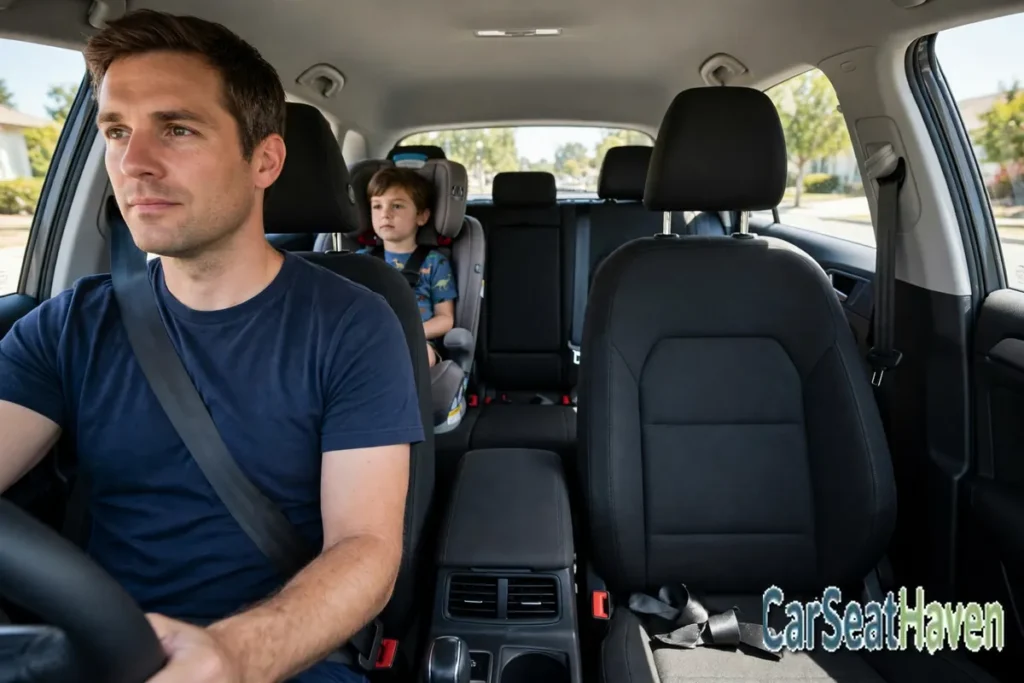
California infant car seat laws start with this rule: a baby under 2 must ride rear facing in California. The only size exceptions in the statute are weight and height. If the child weighs 40 pounds or more, or is 40 inches or taller, the child may face forward before age 2. Meeting either threshold is enough, the child does not need to meet both.
That does not mean you should rush to turn the seat around at age 2. Safety agencies recommend keeping a child rear facing until the child reaches the highest rear facing height or weight limit printed on that seat. Many convertible seats allow rear facing well past age 2, often up to 40 or 50 pounds. The law sets age 2 as the floor, the seat limit sets the safer ceiling.
A rear facing seat must never go in front of an active passenger airbag. That rule has no exception in California law, even when another rear seat exception might allow a child in the front seat. An airbag that hits the back of a rear facing seat can cause fatal injuries, which is why this rule is written so strictly.
Under 8: the rear seat and booster rule
For a child under 8, California requires an appropriate child passenger restraint system in a rear seat. Appropriate means the right type for the child size, used the way the seat manual says to use it. A newborn uses a rear facing seat. A toddler who has outgrown the rear facing limits uses a forward facing seat with a harness. An older child who has outgrown the harness limits uses a belt positioning booster.
California law does not set a specific age or weight for moving from a harness to a booster. That move depends on the harness seat limits. When the child reaches the maximum height or weight for that harness seat, a booster becomes the next stage. Moving too early is a common mistake, because a booster does not hold a small child the way a harness does, it only positions the adult belt so the belt can do its job.
The rear seat part of the rule is just as important as the seat type. For a child under 8, the restraint belongs in the rear seat, not in the front seat, unless one of the exceptions in the next section applies. If you drive a car with no usable rear seat, or the rear seats are already full of children under 8, the law handles that case, but you still need a proper restraint for the child in the front seat.
The 4 feet 9 inches exception
The number most California parents look for is 4 feet 9 inches. It is written as an exception, not as a general rule. A child under 8 who has reached 4 feet 9 inches may use a properly fitted safety belt instead of a child restraint system.
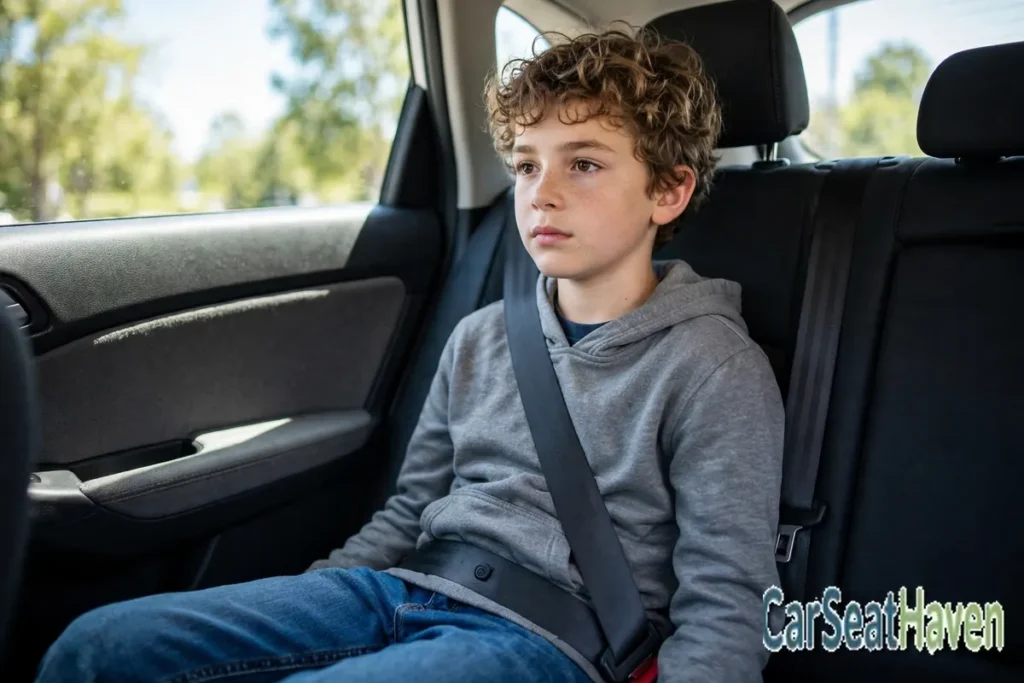
Properly fitted is the key phrase. Height alone does not guarantee that the belt sits correctly in your car. The lap belt should stay low across the upper thighs, not ride up onto the stomach. The shoulder belt should cross the middle of the shoulder and chest, not the neck or the face. If the belt rides onto the stomach, neck or face, the booster is still doing useful work, even though the child has cleared the legal height.
A tall 6 year old who is 4 feet 9 inches may legally use a belt under this exception, while a short 9 year old who is under 4 feet 9 inches may still need a booster for safety, even though the under 8 rule no longer applies to that child. Age and height work together in real life, even when the law gives you a single threshold to check.
Ages 8 through 15: the seat belt stage
Once a child turns 8, the under 8 restraint rule ends. The child must still be secured, either in a child restraint or with a safety belt. In practice, most children in this age band ride with the vehicle belt, and many parents remove the booster on the 8th birthday.
That birthday is a legal threshold, not a readiness test. Many 8 year olds are still too small for the vehicle belt to sit correctly. If the lap belt rides on the stomach, or the shoulder belt crosses the neck, keep using the booster. A booster is not a baby seat, it is a belt positioning tool, and it keeps working after age 8 if the belt does not fit.
California law does not set a time to move from a harness to a booster, and it does not set a belt fit test for this age band under the current law through December 31, 2026. That changes on January 1, 2027, which is covered in the next section.
What changes on January 1, 2027: AB 435 and the 5 step test
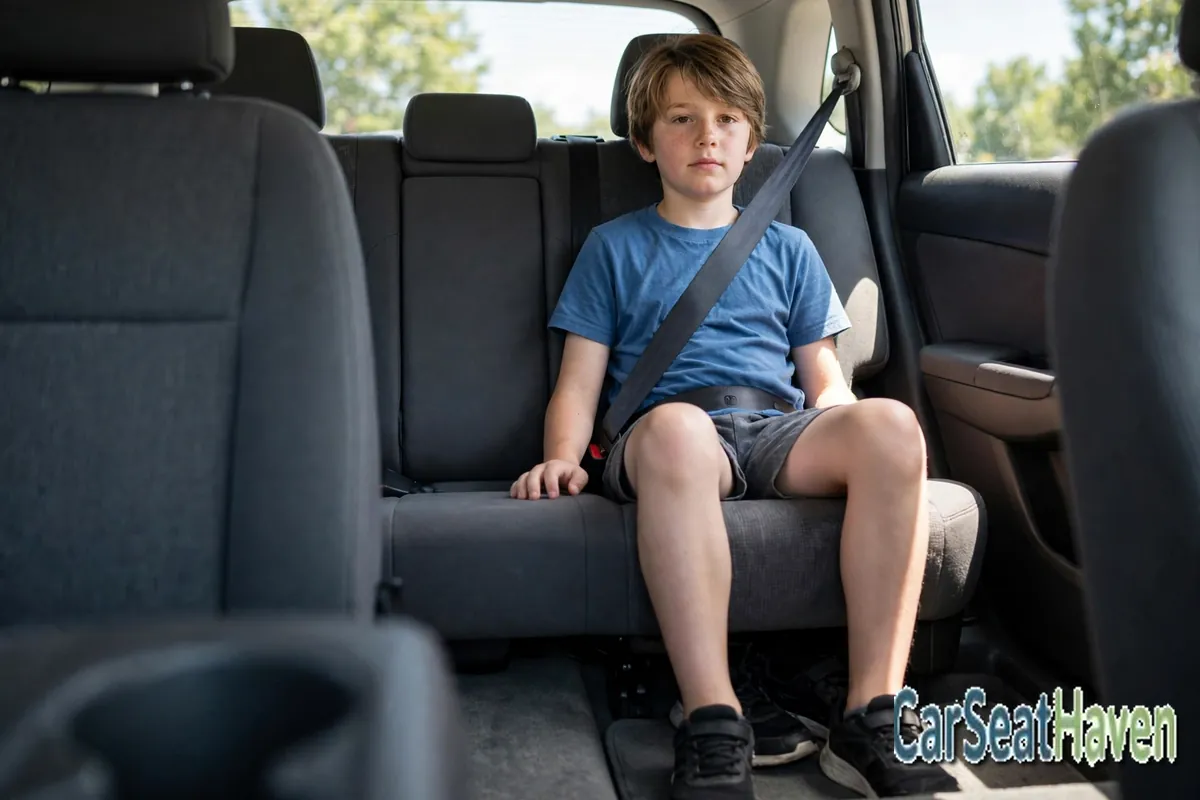
Assembly Bill 435, signed in October 2025, takes effect on January 1, 2027. It does not change the rules for children under 8. What it changes is the move out of a booster for children ages 8 through 15.
Under AB 435, a child ages 8 through 15 is properly restrained by a seat belt alone only if all five of these are true.
- The child sits with the back all the way against the vehicle seat.
- The knees bend comfortably at the edge of the seat cushion.
- The lap belt lies across the upper thighs, not the stomach.
- The shoulder belt crosses the middle of the chest and shoulder, not the neck or face.
- The child can stay seated that way for the entire trip.
If the child fails any one step, the child must stay in a booster, regardless of age or height. There is no new height or weight number in the test, the test replaces the number. For most children, the belt fits somewhere between ages 10 and 12, which is why safety organizations have long said 4 feet 9 inches was too early for many children.
A note on sources: most guides read for this article describe the test for ages 8 through 15. One law firm guide describes it for ages 10 to 15. If your child is 8 or 9, check the current text of AB 435 on the California legislative site before you rely on a single age number, because secondary guides do not agree on that band.
Parents of children between 8 and 12 should run the test now, before the law takes effect. A child who passes today under the old rule may not pass under the new one, and it is better to find that out at home than at a traffic stop.
Front seat rules and exceptions
Children under 8 must ride in the rear seat, with a small set of exceptions in Vehicle Code section 27363. Those exceptions are narrow, and they do not remove the need for a proper restraint.
When a child under 8 may ride in front
A child under 8 may ride in a car seat in the front seat only if one of these applies: the vehicle has no rear seat, the rear seats are side facing jump seats or rear facing seats, the child restraint system cannot be installed properly in the rear seat, all rear seats are already occupied by children under 8, or a physician has determined that a medical reason requires the child to ride in front.
Even when an exception applies, a rear facing seat can never go in front of an active airbag. For children 8 and older, California law sets no front seat age limit in the sections read for this article. Safety agencies recommend the back seat until age 13, but that is guidance, not a statute, and it should not be quoted as law.
Taxis and rideshare vehicles are not exempt from the California child restraint law. That surprises many visitors, because other states do exempt taxis. In California, a child under 8 in a taxi or a rideshare still needs an appropriate restraint in a rear seat, and the exemptions in section 27363 do not cover taxis or rideshare vehicles. Buses and school buses are exempt, and an emergency where no car seat is available is a defense in a specific case, not a blanket exemption.
High back booster vs backless booster
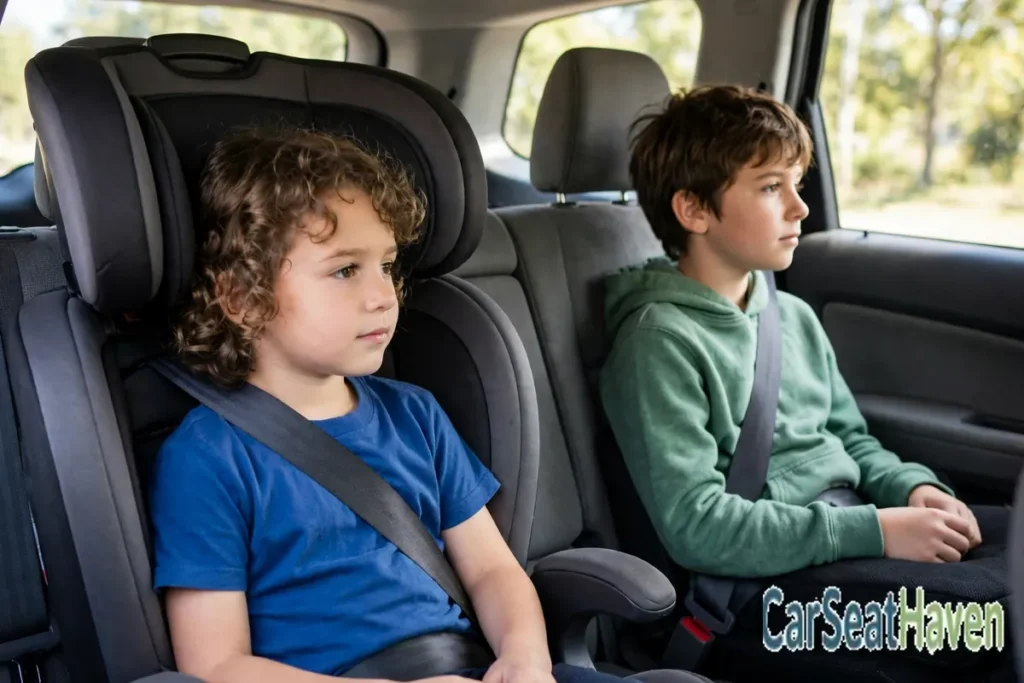
Both types meet the California rule when they fit the child and the car, but they do not do the same job in every car. California car seat law booster rules do not pick one type over the other, they only require a booster that fits the child and the car and positions the belt correctly.
A high back booster adds head and side support, and it guides the shoulder belt into place. It is the better fit for most younger children, and for any car where the vehicle seat back is low or has no headrest behind the child. If the vehicle seat has no head support up to at least the child ear height, a backless booster is not the right choice, because the child head has nothing behind it in a crash.
A backless booster is lighter, cheaper and easier to move between cars, and older children often prefer it because it is less visible. It works when the vehicle seat itself provides adequate head and neck support. It only positions the belt, it does not add head support of its own.
Research from the Childrens Hospital of Philadelphia, cited by law guides on this topic, found that high back boosters reduce injury risk by 70 percent in side impact crashes compared to seat belts alone, while backless boosters showed no statistically significant protection in side impacts in that study. That does not mean a backless booster is useless, it means the car and the child matter. If you use a backless booster, check that the vehicle headrest reaches at least to the child ear height, and check the belt fit in that exact seat.
Installation basics and common mistakes
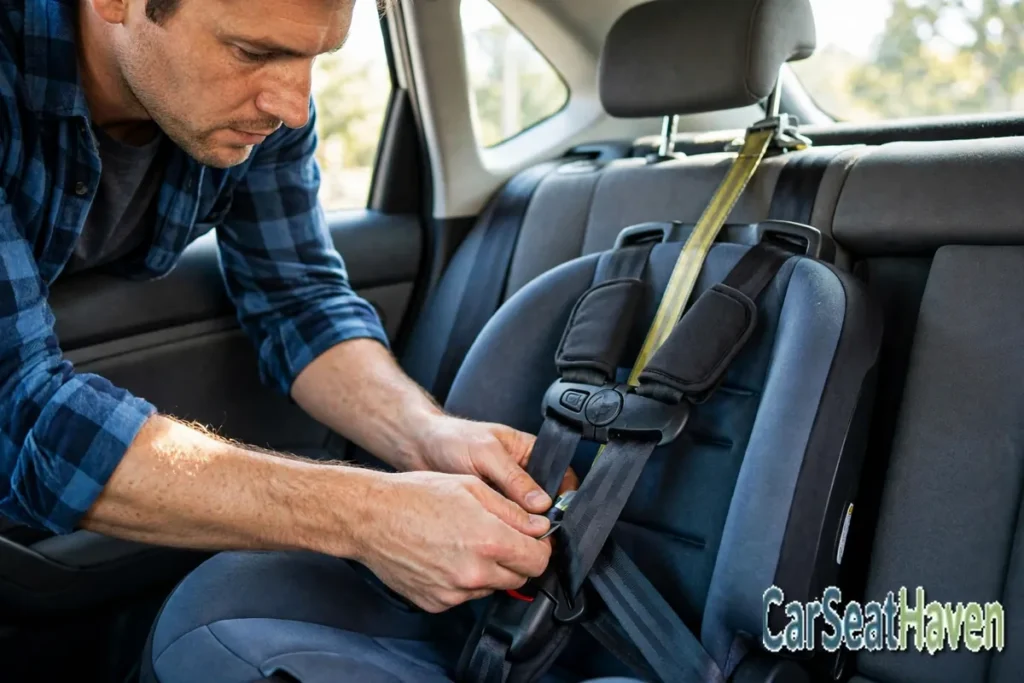
A correct seat type still fails if it is installed wrong. The basic check is simple: grab the seat at the belt path and pull firmly. If it moves more than 1 inch in any direction, it is not secure enough.
Use LATCH or the seat belt, not both at the same time, unless the seat manual specifically permits it. LATCH lower anchors have a combined child plus seat weight limit of 65 pounds. Once the child and seat together exceed that, switch to seat belt installation.
For a rear facing seat, the recline angle should be about 45 degrees for a newborn, adjusted per the manufacturer indicator as the child grows, with harness straps at or below the baby shoulders, and the chest clip at armpit level. For a forward facing seat, always use the top tether in a vehicle with an anchor point, with harness straps at or above the child shoulders, and the chest clip at armpit level. For a booster, the lap belt must lie across the upper thighs, not the stomach, and the shoulder belt must cross the center of the chest, not the neck.
The most common mistakes are loose harness straps that fail the pinch test, a chest clip too low or too high, a forgotten top tether on a forward facing seat, installing in the front seat with an active airbag, and moving to the next stage too early. Free installation checks are available from certified Child Passenger Safety technicians at California Highway Patrol offices, fire stations and childrens hospitals. Search safekids.org or nhtsa.gov to find a nearby inspection station.
Fines and who is responsible
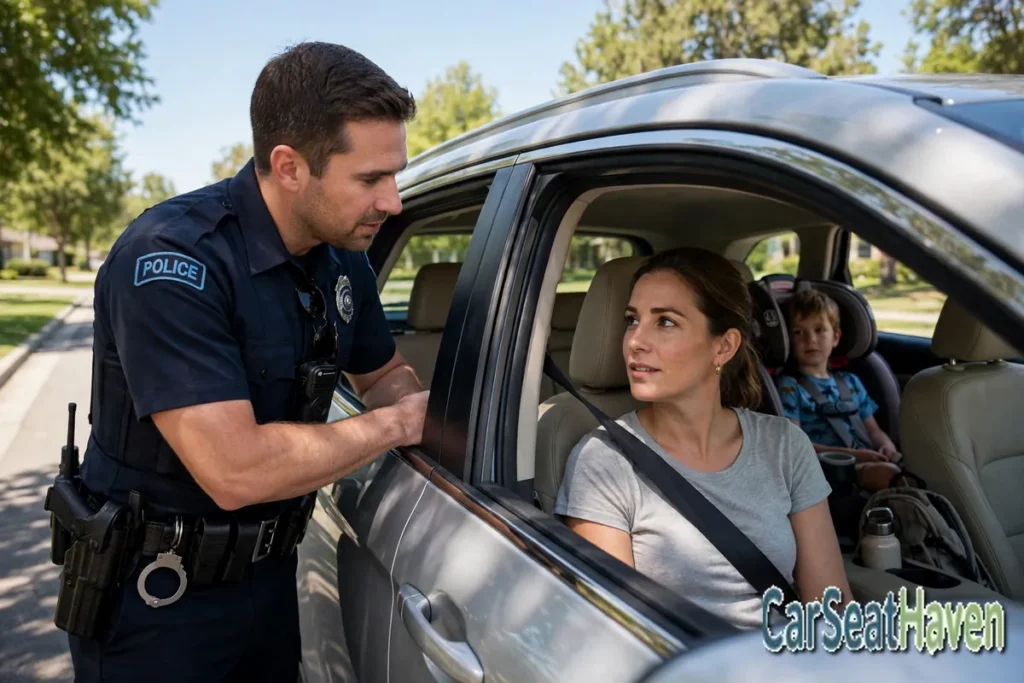
A California Vehicle Code 27360 or 27360.5 violation is an infraction. The base fine is 100 dollars for a first offense and 250 dollars for a second or subsequent offense, plus 1 point on the driver DMV record.
The total you pay is usually higher than the base fine, because California adds state and county penalty assessments, court fees and surcharges. Guides read for this article give different totals, from about 150 dollars to about 500 dollars or more for a first ticket, and over 1,000 dollars for a second ticket in some counties. Do not rely on a single total from a summary page. The base fine and the point are the stable facts, the total varies by county and by court schedule.
For a first offense, the court can reduce or waive the fine when the driver shows proof of obtaining an appropriate child restraint, and in many counties after completing a child passenger safety education class. Ignoring a citation is a separate problem, and can lead to a failure to appear charge, so do not skip a court date.
For children under 8, the driver is responsible, even if the child is not the driver own child. For children ages 8 through 15, the rule is more specific: if the child parent or guardian is riding as a passenger, that parent or guardian bears responsibility instead of the driver, and if no parent is present, responsibility falls back to the driver. A grandparent, babysitter or rideshare driver transporting an unrestrained child under 8 is the one cited.
Parent scenarios
Can a 7 year old use just the seat belt?
Only if the child has reached 4 feet 9 inches and the belt fits properly. A 7 year old under 4 feet 9 inches needs an appropriate child passenger restraint system in the rear seat under California law.
My child just turned 8. Can we remove the booster?
Legally, the under 8 restraint rule no longer applies, but the belt fit test still matters. If the lap belt rides on the stomach, or the shoulder belt crosses the neck, keep using the booster. From January 1, 2027, a child ages 8 through 15 who cannot pass all five steps of the test must stay in a booster, regardless of the birthday.
Does the child have to sit in the back?
For a child under 8, yes, unless one of the Vehicle Code 27363 exceptions applies, and a rear facing seat can never go in front of an active airbag. For a child 8 or older, California law does not set a front seat age limit in the sections read for this article, but safety agencies recommend the back seat until age 13.
What about rideshares and grandparents cars?
Check the same child in the exact vehicle seat. Belt anchor position, seat depth and third row seats change belt fit, so a child who fits in one car may still need a booster in another car. Rideshare vehicles are not exempt in California, so bring your own seat and install it yourself. Grandparents should use the same seat type and the same belt fit check, because the driver is responsible for a child under 8, no matter whose car it is.
Can a 4 year old use a booster seat in California?
No, not as a general rule. A 4 year old must ride in a forward facing seat with a harness, not a booster, because California law requires an appropriate restraint for a child under 8, and a 4 year old has not yet outgrown the forward facing harness stage. A booster is only appropriate when the child has outgrown the harness seat limits.
Before you drive
California law is clear on the main thresholds, and it is the belt fit that decides the real answer for your child. Check age, check height, check the belt in your car, and run the 5 step test before you put the booster away. If the belt does not sit low on the thighs and across the middle of the chest, the booster stays, even if the birthday or the height number says otherwise.
Frequently Asked Questions
Q.1 What is the California booster seat law?
Children under 8 must be secured in an appropriate child passenger restraint system in the rear seat, unless the child is at least 4 feet 9 inches tall and can use a properly fitted safety belt instead.
Q.2 When can a child stop using a booster seat in California?
The legal exception is 4 feet 9 inches for a child under 8, and the under 8 restraint rule ends at the 8th birthday. Check belt fit before removing the booster, because many children still need one after they clear the legal threshold, and from January 1, 2027, a child ages 8 through 15 must pass the 5 step test to ride with a belt alone.
Q.3 Does California require rear facing car seats?
Yes, a child under 2 must ride rear facing, unless the child weighs 40 pounds or more, or is 40 inches or taller.
Q.4 Is there a California adult booster seat law?
No, there is no separate adult booster seat requirement in the California child passenger rule read for this article. The law covers children under 2, children under 8, and children ages 8 through 15. A viral claim about adults under a certain height being required to use booster seats is not the California child passenger law.
Q.5 Is there a new booster seat law in California for 2027?
Yes, Assembly Bill 435 takes effect on January 1, 2027. It does not change the rules for children under 8, it adds a 5 step seat belt fit test for children ages 8 through 15 who ride with a seat belt alone.
Q.6 What is the fine for a California car seat violation?
The base fine is 100 dollars for a first offense and 250 dollars for a second or subsequent offense, plus 1 DMV point. The total paid is higher in most counties because of penalty assessments and fees, and totals vary by county, so check the local court schedule before quoting a total.
Q.7 Where can I get a free car seat installation check in California?
Free checks are available from certified Child Passenger Safety technicians at California Highway Patrol offices, fire stations and childrens hospitals statewide. Search safekids.org or nhtsa.gov to find a nearby inspection station.
Q.8 Can my child ride in the front seat in California?
A child under 8 must ride in the rear seat, unless a Vehicle Code 27363 exception applies, and a rear facing seat can never go in front of an active airbag. A child 8 or older has no front seat age limit in California law as read for this article, though safety agencies recommend the back seat until age 13.

Aiden is the founder and editor of CarSeatHaven. He researches NHTSA safety standards, AAP guidance, manufacturer manuals, and recall notices, and turns them into plain-language car seat guides for parents.
