

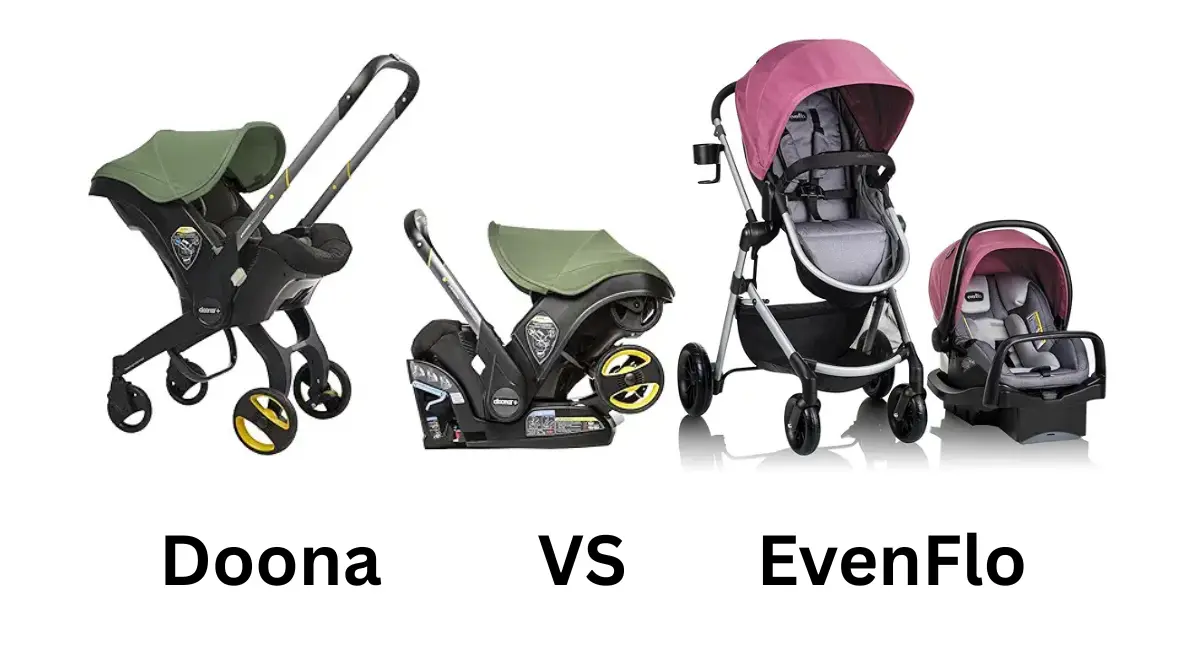
Doona vs Evenflo Shyft is the comparison every parent considering a car seat that turns into a stroller eventually lands on. Both the Doona and the Evenflo Shyft DualRide solve the same problem: getting a sleeping baby from the car to the sidewalk, the grocery store, or the airport gate without waking them, without a separate stroller, and without a wrestling match in the parking lot. Here is the short answer before we get into the details: for most parents, the Evenflo Shyft DualRide is the better value because it costs less at its entry price, lets you leave the heavy wheels in the car and carry just the infant carrier, and includes tech extras like SensorSafe alerts. The Doona still wins on sheer simplicity, with a one-button fold, a permanently attached chassis that never has to be assembled, and a premium build that has made it the best-known name in this category for over a decade. Keep reading for the full head-to-head on specs, conversion, ride quality, weight, safety, price, and travel, so you can pick the right one with confidence.
Why do parents compare these two products so directly? Because they are the only mainstream infant car seats that transform into a stroller with the push of a button or two. Every other “travel system” is a car seat plus a separate stroller frame you have to buy, carry, and assemble. With the Doona and the Shyft DualRide, the stroller is built into the car seat itself. That matters most for families who use rideshares, taxis, or public transit, who fly often, who live in apartments with no garage, or who simply dread the car seat to stroller transfer. Both seats are rear-facing only infant car seats approved for air travel, both hold babies up to around 32 inches tall, and both will carry most babies from birth to roughly 12 months before an upgrade to a convertible seat is needed. The differences are in the conversion mechanism, the weight you actually have to lift, the price, and the extras.
What the Doona Is
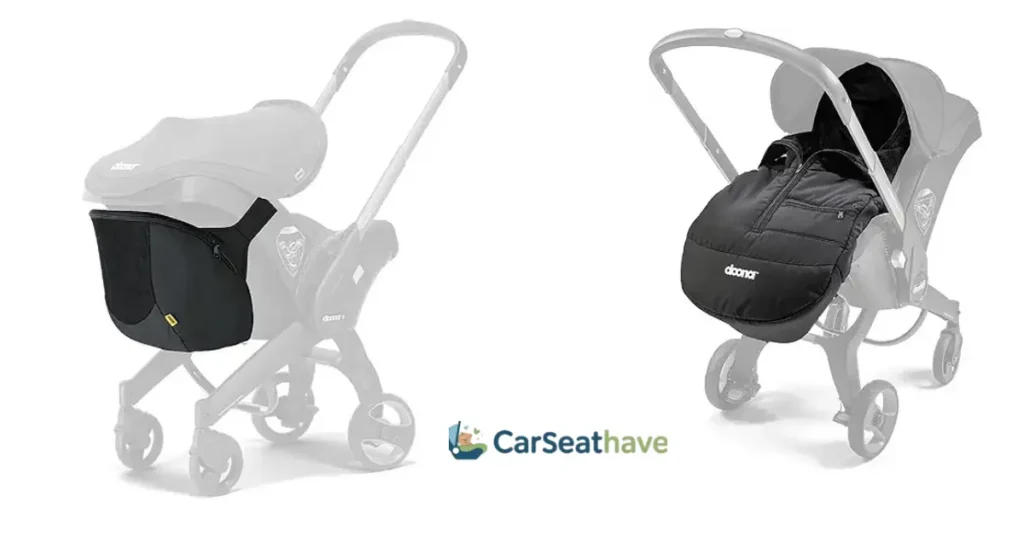
The Doona is the original car seat stroller, and its story explains a lot about how it is built. It was created by Simple Parenting, an Israeli company, and launched in 2014 as the world’s first complete and fully integrated travel system. The idea is simple and unchanged: the stroller wheels fold up into the car seat itself, so one product does both jobs with no separate frame, no click-in adapters, and no assembly. The current version is the Doona+, which updated the fabrics to breathable textiles and refreshed the color lineup, while the core design has stayed the same.
As a car seat, the Doona is a rear-facing only infant seat rated for babies from 4 to 35 pounds and up to 32 inches tall, per the manufacturer. The seat itself weighs about 16.5 to 17.2 pounds depending on the edition, and the included LATCH base adds roughly another 10 pounds. The five-point harness keeps baby secure, and the push handlebar doubles as an anti-rebound bar when the seat is installed in the car, limiting how far the seat can rotate in a frontal impact. The seat is FAA and TUV approved for aircraft use, and it is narrow enough to roll down an airplane aisle in stroller mode. The harness is a traditional rethread style, meaning you have to thread the straps through different slots as your baby grows, which takes a little more work than a no-rethread harness. Textiles are removable and washable.
As a stroller, the Doona deploys its wheels with one button, and the handlebar extends to a 39-inch push height. There is no storage basket, which is one of the most commonly cited tradeoffs: you will need a bag or the accessory Snap On Storage if you want cargo space. The Doona is generally priced around $550 for the Doona+ in standard colors, with special editions like Midnight priced higher, in the $650 to $750 range. Simple Parenting offers a two-year manufacturer’s warranty. The seat is sold as a premium, single-unit product, and it has earned a loyal following among city parents, frequent flyers, and anyone who values a truly one-piece design.
What the Evenflo Shyft DualRide Is
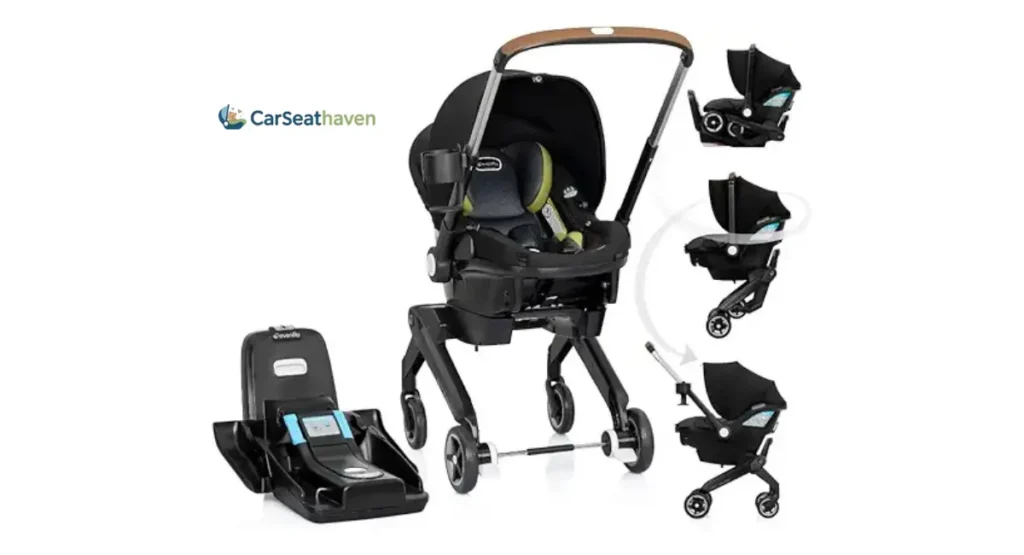
The Evenflo Shyft DualRide is Evenflo’s answer to the Doona, and it arrived years later with the benefit of watching the Doona’s strengths and complaints. Evenflo is one of the oldest and most established American baby brands, and the DualRide is part of its Shyft travel system line. The core pitch is the same: an infant car seat that becomes a stroller in one step. But Evenflo made one big design decision differently. Instead of permanently fusing the wheels to the car seat, the DualRide’s infant carrier can separate from its wheeled stroller frame, which means you can leave the frame and wheels locked in the car and carry only the infant carrier, at about 8 pounds, into a store or appointment.
As a car seat, current manufacturer and retailer listings rate the DualRide for infants from 3 to 35 pounds and from 15.7 to 32 inches tall. This is important: early versions of the seat were listed at 3 to 30 pounds, so the limit printed on your specific unit’s label is the one that counts. The 3-pound lower limit also makes the DualRide a realistic option for preemies, and it fits babies smaller than the Doona’s 4-pound minimum. Installation uses Evenflo’s LockStrong belt-tensioning system plus Quick Connectors for LATCH installs, and the base includes anti-rebound protection to absorb and dissipate crash forces. The standout feature is integrated SensorSafe technology: the chest clip connects over Bluetooth to a phone app and sends real-time alerts for four potentially unsafe conditions, including unexpected chest clip unbuckling, unsafe ambient temperature in the car, the child being left unattended, and the child being buckled in for too long. The harness is a no-rethread design that adjusts through eight positions as your child grows.
As a stroller, the DualRide transitions from wheels up to wheels down in one step with a two-button system. The push handlebar sits at about 41.5 inches, which is taller than the Doona’s and more comfortable for taller parents. Evenflo includes extras the Doona skips: a carryall storage bag, a removable cup holder for the parent, a UPF 50+ full-coverage canopy, and wheels that nest into removable, washable wheel wells in the base so dirt stays off your back seat. The full system (carrier, frame, and base together) weighs about 28 to 29 pounds, but the stroller-mode carry weight is closer to 19 pounds, and the carrier alone is about 8 pounds. Pricing starts around $499.99 for the base model without accessories, about $549.99 with the storage bag and cup holder, and bundles run from roughly $549 to $699. Both models are FAA approved for air travel.
Head-to-Head Comparison Table
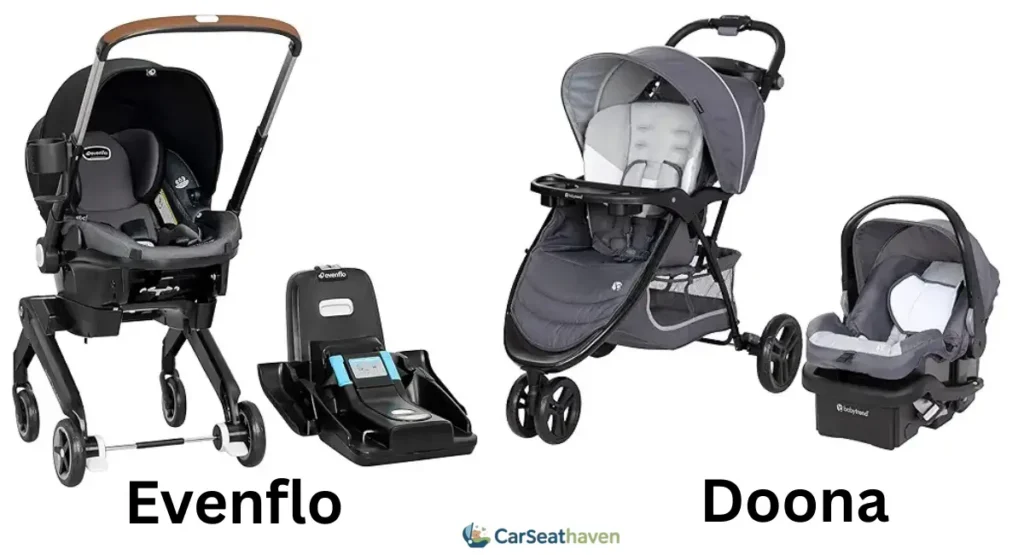
The table below compares the headline specs of both products side by side. Specs are manufacturer or retailer-listed figures; prices are typical 2026 ranges, and you should check the current price before buying since colors, bundles, and sales change often.
| Feature | Doona (Doona+) | Evenflo Shyft DualRide |
|---|---|---|
| Maker | Simple Parenting | Evenflo |
| Weight range | 4 to 35 lbs | 3 to 35 lbs (early units 3 to 30 lbs; check your label) |
| Height limit | Up to 32 in | Up to 32 in |
| Car seat weight | About 16.5 to 17.2 lbs | Carrier alone about 8 lbs |
| Full system weight | About 27 lbs with LATCH base | About 28 to 29 lbs with base and frame |
| Conversion | One-button fold; wheels permanently attached | Two-button fold; wheels detach so carrier can be carried alone |
| Harness | Rethread 5-point | No-rethread, 8 positions, SensorSafe chest clip |
| Anti-rebound | Handlebar doubles as anti-rebound bar | Anti-rebound base |
| Handlebar height | About 39 in | About 41.5 in |
| Storage | None built in | Carryall storage bag, parent cup holder |
| Canopy | UPF 50+ canopy | UPF 50+ full-coverage canopy |
| FAA approved | Yes | Yes |
| Typical 2026 price | About $550; special editions about $650 to $750 | About $500 to $700 depending on bundle |
| Warranty | 2 years | Limited (listed as 90 days at some retailers) |
Neither seat is a long-term stroller, and both are outgrown by height before weight in most cases, which is normal for infant car seats. Babies typically reach the 32-inch height limit before they approach 35 pounds, so expect roughly 9 to 12 months of use for an average-size baby, sometimes longer for smaller babies. Once either limit is hit, the next step is a convertible car seat, and possibly a lightweight everyday stroller if you want one.
Safety Comparison
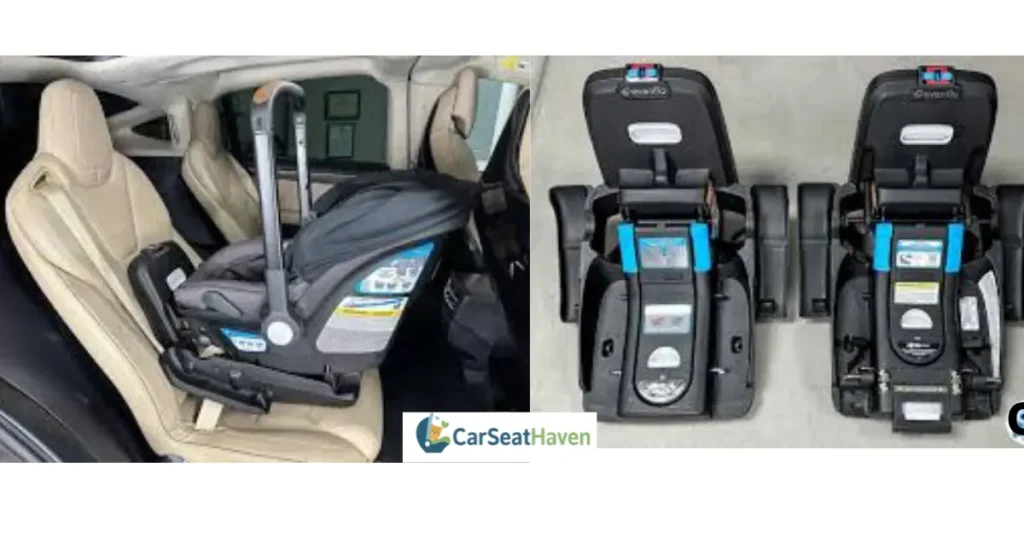
Safety is where parents understandably refuse to compromise, so let us be clear from the start: both the Doona and the Shyft DualRide meet the same U.S. federal safety standard for car seats, FMVSS 213, which requires passing crash testing for frontal impacts and structural integrity. Evenflo additionally notes extra testing for rollover performance, temperature effects, and structural integrity. Meeting the federal standard is the baseline, and both clear it. The differences are in how each seat goes beyond the baseline, in the details of installation, and in the electronics one of them adds on top.
Side-Impact Protection
The Doona leans on a three-layer side-impact structure with memory foam lining built into the shell, designed to absorb and distribute crash energy around the child. Reviewers and the manufacturer emphasize this as the seat’s main passive safety feature, since there are no electronics or sensors involved. The infant insert also helps keep a small newborn positioned correctly, which matters for both safety and comfort.
The Evenflo Shyft DualRide takes a different path. The seat is built on a steel-reinforced frame, and safety features include EPS foam lining and the anti-rebound base. Where it stands out is SensorSafe, the Bluetooth-connected chest clip that alerts your phone in real time if the chest clip is unbuckled unexpectedly, if the car’s ambient temperature becomes unsafe, if the child is left unattended, or if the child has been buckled in too long. No electronics make a crash less severe; what SensorSafe does is help prevent the kinds of real-world mistakes and dangerous situations that crash testing does not cover, such as a child left in a hot car. If you are the parent who replays the harness check in your head at every red light, that layer of reassurance has real value. If you prefer a simpler seat with nothing to charge or pair, the Doona’s passive approach will appeal more.
Anti-Rebound and Rotation Control
In a frontal crash, a rear-facing seat can rotate up and toward the front of the vehicle, and anti-rebound features limit that rotation. The Doona uses its own push handlebar as the anti-rebound bar: when the seat is installed, the handle is rotated into a position that braces against the vehicle seatback. The Evenflo instead builds the anti-rebound protection into the car seat base, which stays in the car and absorbs and dissipates crash forces. Both approaches address the same risk; the Doona’s is integrated into the seat itself so it works with baseless installs too, while Evenflo’s base-based design is part of a larger, heavier base unit.
Installation and Fit
The Doona installs with the included LATCH base or with the vehicle seat belt without the base, which is useful in taxis, rental cars, and grandparents’ cars. Installation is generally reported as straightforward, though the seat’s bulk can make baseless installs a little awkward in small cars. The Evenflo uses LockStrong belt-tensioning and Quick Connectors for LATCH, which parents generally find quick and secure, and the no-rethread harness means the fit stays correct more easily as the baby grows, since there is no need to disassemble and rethread straps. A harness that fits correctly is a safety feature in itself: straps at or below the shoulders for rear-facing, snug with no slack, chest clip at armpit level. Whichever seat you choose, register it with the manufacturer and have the installation checked by a certified child passenger safety technician if you have any doubt.
Conversion Mechanism Compared
The conversion is the whole reason these products exist, so it deserves a close look. Both are fast once you learn them, but they feel different, and the learning curve is not the same.
Doona: One-Button Fold, Wheels Always Attached
The Doona’s signature move is a one-button fold. You press the button, fold the wheels into the seat body, retract the handle, and the stroller becomes a car seat in seconds. Reverse it to go back. Because the wheels are permanently attached, there is nothing to detach, nothing to forget at home, and no separate parts to keep track of. Reviewers consistently describe the Doona’s fold as the smoothest and most natural of the two, and it becomes muscle memory quickly. The price of that simplicity is that the wheels are always with you: every time you lift the seat, you lift the whole stroller, about 17 pounds plus your baby. You also cannot use it like a traditional carrier; the wheels cannot be removed, so fitting it into a shopping cart’s car seat slot or a narrow airplane overhead space is limited by the full unit’s folded size.
DualRide: Two Buttons and a Detachable Carrier
The DualRide converts in one step, wheels up to wheels down, but it uses two buttons: the upper button releases the wheels into stroller mode and separates the carrier from the frame, while the lower button folds the wheels underneath and releases the frame from the base. Several reviewers, including Babylist’s hands-on review, note that the two buttons have a learning curve and that it is easy to press the wrong one at first. After a few weeks of daily use, most parents report that it becomes second nature.
The DualRide’s real trick is the detachable carrier. When the whole system is locked into the base in the car, you can lift the infant carrier off the wheeled frame, leaving the frame and wheels in the vehicle. That drops the carry weight to about 8 pounds plus the baby, which is a genuine relief for grocery runs, doctor visits, stairs, and anyone recovering from a C-section under lifting restrictions. Reviewers call this the deciding feature: pushing the folded Doona while also pushing a shopping cart is awkward, and some carts will not fit the full Doona in the car seat slot at all. With the DualRide, you leave the wheels in the car and carry a normal infant carrier. The catch is that the separation only works when the system is secured in the base, so it is not a free-floating trick you can do anywhere, and the wheels nest into the base to keep dirt off your upholstery.
Ride Quality and Maneuverability
Neither of these is meant to replace a full-size everyday stroller, and reviewers are consistent about that. The Doona’s wheels are small, and while it pushes fine on smooth surfaces, malls, and airports, it is not the stroller you want for gravel paths, snow, or long daily walks over rough sidewalks. Babylist’s review notes that some parents find it not fully featured or maneuverable enough to be their only walking stroller. It shines in the environments it was designed for: airports, stores, rideshares, and city streets.
The DualRide rides a little taller and pushes at a more comfortable height for taller parents, at about 41.5 inches versus the Doona’s 39. It has molded plastic wheels, and reviewers generally find it serviceable on smooth surfaces with similar limitations on rough terrain. The full-coverage canopy gives it a slight edge for sun and weather protection, and the carryall storage bag means you are not hanging a diaper bag off the handlebar, which improves handling and safety. If long walks are a big part of your life, plan on a separate lightweight stroller later and treat either of these as what they are: brilliant car-to-sidewalk machines, not all-terrain cruisers.
Weight and Portability
This category needs careful reading, because “lighter” depends on what you are lifting. The Doona is lighter overall as a single unit: about 16.5 to 17.2 pounds for the seat itself, versus the DualRide’s roughly 19 pounds in stroller mode and 28 to 29 pounds for the full system with base. But the DualRide can feel lighter in daily use, because you can leave the wheeled frame in the car and carry just the 8-pound carrier. That is less than half the Doona’s lift weight, and it is the feature parents recovering from C-sections or dealing with stairs mention most. GoodBuy Gear’s comparison makes the same point: with the Doona, every lift includes the stroller wheels, because they are built in.
Folded size matters too. The Doona+ folds to roughly 17.4 by 26 by 22.4 inches, a compact rectangle that fits most trunks easily. The DualRide folds to roughly 19 by 29.5 by 26 inches in listings, a somewhat larger package. Both are far smaller than a separate car seat plus stroller, which is the real comparison. If trunk space is tight because of twins, another child seat, or a small hatchback, the Doona’s smaller folded footprint is an advantage.
Price and Value
On price, the common belief that the Evenflo is dramatically cheaper is only partly true. The DualRide base model starts around $499.99, and the version with the storage bag and cup holder is about $549.99, while the Doona+ starts around $550 in standard colors. So at entry level, the gap is small, sometimes just a few dollars. Where the DualRide pulls ahead on value is in what comes in the box: the carryall storage bag, the parent cup holder, the SensorSafe chest clip, and the washable wheel wells are included, whereas Doona accessories like storage and bags are sold separately and add up fast. Special-edition Doonas run $650 to $750, while DualRide bundles top out around $699 with accessories included.
Think about total first-year cost, not just the sticker. With the DualRide, what you pay is close to what you get: seat, wheels, storage, cup holder, smart clip. With the Doona, many parents end up adding the Essentials bag (around $65), the Snap On Storage (around $45), and possibly the travel bag, which narrows the price gap in the other direction. Sales also move both: the DualRide has been spotted well under $400 on promotion, and the Doona rarely discounts as deeply. Check the current price before you buy, since bundles and colors change pricing often.
Everyday Usability
Day to day, the differences show up in small moments. Storage is the DualRide’s clear win: the carryall bag holds diapers, wipes, and snacks, and the parent cup holder keeps coffee out of your hand. The Doona has no storage at all, so you are either wearing a backpack or buying the accessory. The DualRide’s no-rethread harness is easier to adjust as the baby grows, while the Doona’s rethread harness means pulling the seat apart to move straps, a minor annoyance that adds up over a year of growth spurts.
The Doona wins on grab-and-go simplicity. One button, no detach decisions, no second button to confuse, nothing left behind. For a sleep-deprived parent juggling a diaper bag and a coffee, fewer decisions is a feature. The DualRide’s two-button system is the most common complaint in reviews, though most owners say it becomes automatic within a couple of weeks. The DualRide’s canopy coverage is better, and its taller handlebar suits taller parents. Both have removable, washable textiles, which you will be grateful for after the first blowout.
Doona Pros and Cons
After a decade on the market and countless reviews, the Doona’s strengths and weaknesses are well documented. Here is the honest accounting.
Doona Pros
- One-button fold is the smoothest and fastest conversion of any car seat stroller, and it becomes muscle memory immediately.
- Truly one-piece design: nothing detaches, nothing to assemble, nothing to forget at home or leave in the car.
- Compact folded size fits small trunks and rolls down airplane aisles in stroller mode.
- Premium build and materials with a two-year manufacturer’s warranty, plus FAA and TUV approval.
- Handlebar doubles as an anti-rebound bar, so the safety feature works in baseless installs too.
- Enormous community and resale market; accessories, spare parts, and how-to videos are everywhere.
Doona Cons
- You always lift the whole stroller: about 17 pounds plus the baby, every single time, which adds up with a growing infant.
- No storage basket or cup holder included; accessories add meaningful cost.
- Rethread harness requires disassembly to adjust as the baby grows.
- Small wheels limit it on rough terrain; it is not a full replacement for an everyday stroller.
- Premium price, with special editions reaching $650 to $750, and accessories sold separately.
- Lower weight minimum (4 lbs) means very small preemies may fit the DualRide sooner.
Evenflo Shyft DualRide Pros and Cons
The DualRide is newer and built specifically to answer the Doona’s weaknesses. It succeeds at several of them, with a few tradeoffs of its own.
Evenflo Shyft DualRide Pros
- Detachable carrier: leave the wheeled frame in the car and carry just an 8-pound carrier, a huge help for stairs, stores, and C-section recovery.
- Lower entry price, and more included in the box: carryall storage bag, parent cup holder, SensorSafe clip, washable wheel wells.
- No-rethread harness with eight positions adjusts easily as the baby grows.
- SensorSafe Bluetooth alerts for unbuckling, unsafe temperature, unattended child, and buckled-too-long warnings.
- Taller 41.5-inch handlebar is more comfortable for taller parents, and the full-coverage UPF 50+ canopy protects better.
- Fits smaller babies: 3-pound minimum versus the Doona’s 4 pounds.
Evenflo Shyft DualRide Cons
- Two-button fold has a learning curve; reviewers report pressing the wrong button often at first.
- Heavier overall system: about 28 to 29 pounds with base, and the folded package is bulkier than the Doona’s.
- Carrier only separates when locked into the base, so the trick does not work everywhere.
- Wheels are molded plastic and ride quality on rough terrain is limited, like the Doona.
- Shorter limited warranty listed at some retailers, and a smaller resale and accessory ecosystem than the Doona.
- SensorSafe needs a phone app and a coin-cell battery; if you never use it, you paid for a feature you ignore.
Who Should Pick the Doona
Pick the Doona if simplicity is your highest value. If you fly constantly, live on rideshares, and want the fastest possible car-to-stroller transfer with zero learning curve, the one-button fold and permanently attached chassis are unbeatable. It is also the better pick if trunk space is tight, since it folds smaller, and if you want the reassurance of a product with a decade of real-world use, a huge owner community, and a strong resale market. Parents who dislike tech in their baby gear, who do not want an app or a Bluetooth clip, will prefer the Doona’s purely mechanical design. And if you are buying secondhand, the Doona’s massive used market is a real advantage.
Who Should Pick the Evenflo Shyft DualRide
Pick the DualRide if the lifting math matters to you. Anyone recovering from a C-section, dealing with stairs daily, or shopping with a cart will feel the difference between lifting 17 pounds and lifting 8 pounds. It is also the pick for taller parents who want the higher handlebar, for preemie parents who need the 3-pound minimum, and for anyone who wants storage, a cup holder, and smart alerts included rather than purchased separately. Budget-conscious buyers get more gear for the money, especially on sale. And if you love the idea of a car seat that can act like a normal carrier when you want it to, the DualRide is the only one of the two that does that.
Safety Notes Every Parent Should Know
Whichever seat you choose, these safety points apply equally to both, and they matter more than any brand comparison.
Stroller Mode Does Not Replace Proper Car Seat Use
These are car seats first. In the car, the seat must be installed rear-facing, either on the base or with the vehicle seat belt, exactly as the manual describes, with the child harnessed snugly every time. Rolling the seat in stroller mode does not change the installation rules, and the anti-rebound features only help when the seat is installed correctly. Never place the car seat on top of a shopping cart, a table, or any elevated surface in carrier mode; falls from height are a real and common injury source.
Do Not Let Babies Sleep in the Car Seat for Long Stretches
This is the safety note most relevant to these products, because their whole appeal is keeping a sleeping baby undisturbed. The American Academy of Pediatrics advises that car seats should be used for travel, not as a substitute for a crib or bassinet, and that a baby who falls asleep in a car seat, stroller, swing, or carrier should be moved to a firm, flat sleep surface as soon as possible. The reason is positional asphyxia: a young infant’s head can slump forward and restrict the airway, especially in the semi-upright position of a car seat.
A study published in Pediatrics analyzed 11,779 infant sleep-related deaths over ten years and found that about 3 percent occurred in sitting devices such as car seats, strollers, and swings. Of those, roughly 63 percent happened in car seats, and in the great majority of cases the seat was not being used for travel; the baby was left to sleep in it at home or elsewhere. The median age of those infants was about two months. The takeaway is not that these seats are dangerous; it is that the convenience of an undisturbed transfer should not turn into hours of unsupervised sleep in the seat. Use the stroller mode for the errand, the walk, or the airport, and move the baby to a crib or bassinet for real sleep.
Harness Fit Matters More Than the Seat Brand
A correctly used mid-range seat protects better than a premium seat used loosely. For rear-facing, the harness straps should be at or below the baby’s shoulders, the chest clip should sit at armpit level, and the straps should be snug enough that you cannot pinch slack at the shoulder. Bulky coats and snowsuits do not belong under the harness; dress the baby in thin layers and put the coat on backward over the harness instead. The DualRide’s no-rethread harness makes correct fit easier to maintain, but the Doona’s rethread harness works just as well if you take the time to adjust it at each growth spurt.
Stay Rear-Facing as Long as Possible
The AAP recommends that children ride in a rear-facing car seat as long as possible, up to the limits of the seat. Both the Doona and the DualRide are rear-facing only, and most babies will outgrow them by height (32 inches) around their first birthday. That is the designed end of the road for these seats, not a flaw. When your baby outgrows the infant seat, the next step is a convertible car seat used rear-facing, and the AAP notes that most children can remain rear-facing until age 2 to 4 in a convertible. Neither a Doona nor a DualRide is a substitute for extended rear-facing; they are the convenient first chapter.
Travel Notes: Airplanes, Rideshares, and Public Transit
Travel is where both seats earn their price. Both are FAA approved, which means you can install them rear-facing in an airplane seat, and both are narrow enough to roll down the aisle in stroller mode, so you avoid gate-checking a stroller entirely. For rideshares and taxis, both can be installed without the base using the vehicle seat belt, which is the scenario these seats were born for: buckle in, arrive, pop the wheels down, and walk away. The Doona’s one-button fold is slightly faster in a chaotic curbside moment, while the DualRide’s detachable carrier is nicer once you are inside the terminal and want a light carrier at the gate.
A few practical travel tips apply to both. Bring the manual or save the manufacturer’s install video on your phone, because flight attendants and rideshare drivers will ask questions. Practice the baseless seat belt install at home before your first trip. Keep the base at home if you are traveling light; you will not need it. And remember that neither seat is meant for long naps on the go; plan breaks on long travel days so the baby gets flat time out of the seat.
Apartment and City Living
City parents without a garage are the core audience for both products, and the comparison tilts slightly toward the Doona for the smallest spaces. Its smaller folded footprint fits in a closet or behind a door more easily, and the one-piece design means no frame leaning against the hallway wall. The DualRide’s larger fold and separate frame need a bit more storage room. On the other hand, if your building has stairs and no elevator, the DualRide’s 8-pound carrier mode is the kinder daily lift. For rideshare-dependent families, both eliminate the need to own a car seat base in every vehicle, and both are faster than assembling a travel system on the curb.
Twins, Multiples, and Grandparents
With twins, everything doubles, and the math changes. Two Doonas fold smaller and are simpler to manage solo, since each is one piece. Two DualRides give you two light carriers for stairs and appointments, but two full systems take up serious trunk and closet space. Either way, budget for the reality that infant car seat strollers are a first-year solution; many twin parents move to a double stroller and convertible seats earlier for comfort.
For grandparents who babysit, the Doona’s simplicity wins: one button, no detach decisions, and installation is easy to learn. The DualRide’s two-button system and carrier separation add steps that can confuse an occasional caregiver. Whichever you choose, walk the grandparents through the fold and the harness a few times, and leave the manual where they can find it.
Cleaning and Accessories
Both seats have removable, washable textiles, which is non-negotiable with an infant. The Doona’s fabrics come off for machine washing, and the frame wipes down. The DualRide’s textiles are also removable and washable, and its wheel wells are removable and washable too, a thoughtful touch since those wells collect the road grime that would otherwise end up on your car’s upholstery.
On accessories, the philosophies differ. Doona sells a full ecosystem separately: the Essentials bag, the Snap On Storage, the rain cover, the travel bag, the seat protector, extra bases. It is well made and widely available, but it adds cost. Evenflo includes the most-wanted accessories in the box with the DualRide: the carryall storage bag, the parent cup holder, and the SensorSafe clip. If you are the kind of buyer who resents nickel-and-dime accessory pricing, the DualRide’s bundle approach will feel better. Check what is included with your specific bundle before buying, since Evenflo sells several trim levels.
Frequently Asked Questions
Which is better, the Doona or the Evenflo Shyft DualRide?
There is no universal winner, but there is a right answer for your situation. For most parents, the Evenflo Shyft DualRide is the better overall value: it costs less at entry level, includes storage and smart safety alerts in the box, has an easier no-rethread harness, and lets you carry just an 8-pound carrier while the wheels stay in the car. The Doona is better for parents who prioritize the absolute simplest fold, the smallest folded size, a one-piece design with nothing to detach, and a proven product with a huge resale market. If you fly constantly and want zero learning curve, get the Doona. If you want the most features for the money, get the DualRide.
Is the Evenflo Shyft DualRide cheaper than the Doona?
Slightly, at the entry level. The DualRide starts around $499.99 for the base model and about $549.99 with the storage bag and cup holder, while the Doona+ starts around $550. The real savings with the DualRide come from included accessories: storage, cup holder, and SensorSafe are in the box, while Doona accessories are sold separately and can add well over $100. On sale, the DualRide has been seen well under $400, which is a bigger discount than the Doona typically gets. Prices change often, so check the current price before buying.
Can you use the Doona or the DualRide on an airplane?
Yes, both are FAA approved for aircraft use. You can install either seat rear-facing in an airplane seat, and both are narrow enough to roll down the aisle in stroller mode, which means no gate-checking a separate stroller. Practice the baseless seat belt installation before your trip, and check with your airline about their child restraint policies, since crew familiarity varies.
What is the weight limit for the Evenflo Shyft DualRide?
Current manufacturer and retailer listings rate the DualRide for infants from 3 to 35 pounds and up to 32 inches tall. However, early versions of the seat were listed at 3 to 30 pounds, and some listings still show the older number. Always go by the limits printed on your specific unit’s label and manual, since that is what governs your seat. Most babies outgrow it by height around 12 months.
Can the Doona be used without its wheels, like a normal carrier?
No. The Doona’s wheels are permanently attached and cannot be removed. Every time you lift it, you lift the whole stroller. This is the single biggest functional difference between the two seats: the DualRide’s carrier separates from its wheeled frame (when locked into the base), dropping the carry weight to about 8 pounds, while the Doona is always one 17-pound unit.
How long can a baby use the Doona or the DualRide?
Both are infant-only seats, rear-facing, up to 32 inches tall and 35 pounds. In practice, babies outgrow them by height first, usually between 9 and 12 months for an average-size baby, sometimes longer for smaller babies. When any limit is reached, move to a convertible car seat used rear-facing, following the AAP guidance to stay rear-facing as long as possible.
Can my baby sleep in the seat while we are out strolling?
Short naps during an outing are a normal part of using any infant car seat, and the whole point of these products is not waking the baby during transfers. But the AAP advises against letting babies sleep in car seats routinely or for long stretches, and recommends moving a sleeping baby to a firm, flat sleep surface such as a crib or bassinet as soon as practical. Research on infant sleep deaths found that deaths in sitting devices, mostly car seats, happened overwhelmingly when the seat was used for sleeping outside of travel. Use stroller mode for the outing, then transfer the baby for real sleep.
Do these seats fit in small cars?
Generally, yes. Both are infant seats with a compact footprint, and both can be installed without the base using the vehicle seat belt, which helps in small or shared cars. The Doona’s folded size is smaller (roughly 17.4 by 26 by 22.4 inches), so it is the easier fit in a tiny trunk. The DualRide folds a bit larger. If you drive a very small car, test the fit or check the folded dimensions against your trunk before buying.
Which one is easier for grandparents or occasional caregivers?
The Doona. One button, one piece, no detach decisions, and a decade of tutorial videos online. The DualRide’s two-button fold and carrier separation are easy once learned, but they add steps that can confuse someone who only uses the seat occasionally. Whoever the caregiver is, do a few practice runs together before the first solo outing.
Do I still need a regular stroller if I buy one of these?
Not in the first year, for most families. Either seat covers the car-to-sidewalk use case that a travel system would handle. But neither is a great long-distance walking stroller: the wheels are small and the ride is best on smooth surfaces. Many parents add an inexpensive lightweight or umbrella stroller for neighborhood walks and travel after the first year, and you will need a convertible car seat once the baby outgrows the 32-inch height limit anyway.
The Bottom Line
Doona vs Evenflo Shyft comes down to what you value most in the chaos of the first year. The Doona is the original for a reason: the one-button fold is still the fastest, the one-piece design is still the simplest, and the compact fold is still the easiest to live with in small spaces. You pay a premium and you lift the whole stroller every time, but you never think about it, which is exactly what exhausted parents want. The Evenflo Shyft DualRide is the smarter buy for most families: it costs less, includes the accessories and smart safety tech the Doona charges extra for, fits smaller babies, and the detachable carrier turns
the daily lift from 17 pounds into 8. Its two-button fold takes practice and the folded package is bulkier, but the value is hard to argue with. Either way, you are getting an FAA-approved, rear-facing infant seat that turns the worst part of leaving the house into the easiest. Pick the one that matches your life, install it correctly, keep the harness snug, and move the baby to a crib for real sleep. That is what actually keeps them safe.
For the parent-feedback version of this comparison, see Doona vs Evenflo Shyft tested by moms.
Read our Evenflo Shyft DualRide overview for the full feature breakdown.

Aiden is the founder and editor of CarSeatHaven. He researches NHTSA safety standards, AAP guidance, manufacturer manuals, and recall notices, and turns them into plain-language car seat guides for parents.
