


A slim fit car seat is a narrow convertible or all-in-one car seat designed to take up as little side-to-side space as possible, usually 16.5 to 17.5 inches wide, while still meeting the exact same federal safety standards as every other car seat sold in the United States. If you drive a small sedan, need to fit three car seats across one row, or simply want an adult passenger to fit comfortably beside your child, a slim fit car seat is the answer. It is not less safe, it is not a lesser seat, and it does not mean your child has less room to sit. It simply means the shell and base were engineered with width in mind.
The name comes from seats like the Graco SlimFit and SlimFit3 LX, which made the category famous, but today “slim fit” describes a whole family of narrow convertibles from Graco, Chicco, Diono, Clek, Evenflo, Cosco, Baby Trend, and Safety 1st. This guide explains what slim fit really means, when you actually need one, how the top slim seats compare on real specs like width, rear-facing limits, and price, how to install them in tight spaces, and who should skip the category entirely.
What Is a Slim Fit Car Seat?
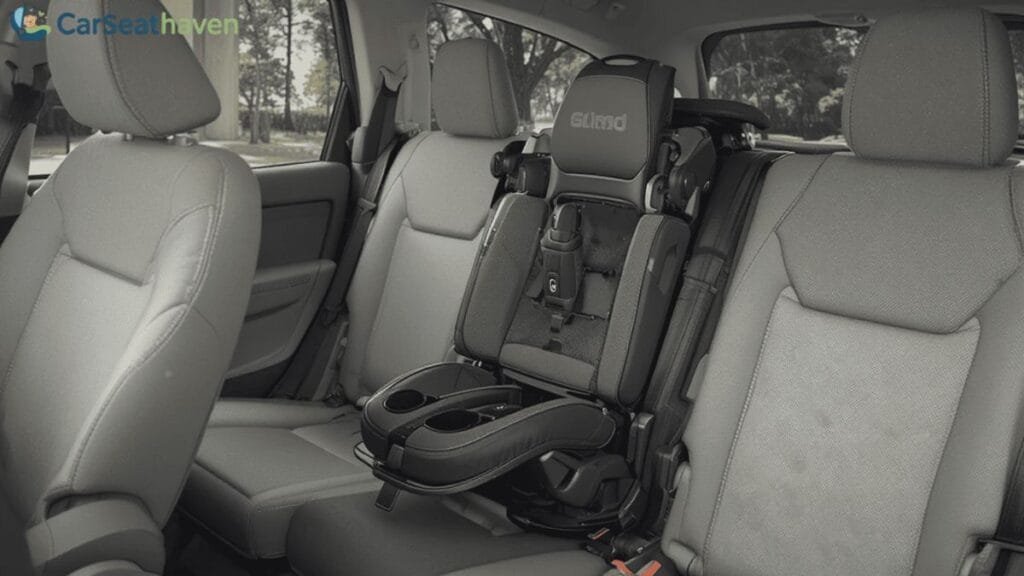
A slim fit car seat is any child restraint whose design prioritizes a narrow external width so it occupies less of your vehicle’s back seat. Most standard convertible car seats measure 19 to 21 inches wide at their widest point, which is usually the base or the cup holders sticking out the sides. Slim fit seats typically measure between 16.5 and 17.5 inches wide. That one to four inch difference sounds small, but it is the difference between fitting two seats plus a passenger and having your back seat feel completely full with one seat installed.
The slimness comes from specific engineering choices. Some seats, like the Graco SlimFit 3-in-1, use rotating cup holders that tuck into the shell when not in use, making the seat about 10 percent slimmer. Others, like the Graco SlimFit3 LX, Diono Radian 3R, and Clek Fllo, were built from the ground up with narrow steel-reinforced frames so the whole shell stays trim. The Evenflo Revolve360 Slim manages to be just 16.7 inches wide even though it rotates 360 degrees, which is a genuine engineering feat for a rotating seat.
What slim fit does not mean is important. It does not mean a narrower seating area for your child. Most slim seats keep the same generous seating width and harness slot heights as their wider siblings, they just waste less of it on the shell edges and external accessories. It also does not mean a lower weight limit or a shorter usable life. The Graco SlimFit3 LX, for example, still handles a child from 5 to 100 pounds across rear-facing, forward-facing, and highback booster modes, exactly like a full-width seat.
Finally, a slim fit car seat is not a separate safety category. Every car seat sold in the United States must pass the same federal crash testing under FMVSS 213. A narrow seat does not get a break on the standard, and a wide seat does not get a gold star. Slim is a fit feature, not a safety feature, which is exactly what makes the category so appealing: you give up nothing on protection to get your space back.
How Slim Fit Seats Differ From Standard Convertibles
Understanding what actually changes between a slim fit car seat and a standard convertible helps you decide whether the tradeoffs matter for your family. Here are the real differences, without the marketing gloss.
Width is the obvious one. A standard convertible like the Graco 4Ever DLX or the Britax One4Life measures roughly 19.5 to 21 inches wide. A slim fit seat measures roughly 16.5 to 17.5 inches. In a midsize sedan with about 52 inches of hip room across the back seat, three standard seats simply cannot fit, while three slim seats at 16.7 inches each total about 50 inches, which often works. Even with one seat, the narrower footprint means your front passenger can slide their seat back a little farther and the middle back seat stays usable for an adult.
The shell design changes too. Slim seats usually have shallower side wings, integrated or rotating cup holders instead of bulky clip-on ones, and a base that sits closer to the seat cushion rather than flaring outward. Some, like the Diono Radian 3R and Clek Fllo, use steel core frames that let the shell stay rigid without thick plastic bolsters. This is why a seat like the Clek Fllo can weigh 25 pounds and still be only 16.9 inches wide: the strength comes from metal, not from plastic bulk.
Front-to-back space is a separate issue. Width is only one dimension. A slim seat can still take up a lot of front-to-back space when rear-facing, which matters if you drive a compact car with a short wheelbase. The Clek Fllo, for example, is 32.5 inches long front to back in rear-facing mode, which can push a front seat uncomfortably far forward in a small sedan. The Diono Radian series has a similar reputation for eating front-to-back room. When shopping, check both the width and the rear-facing depth if your car is small in every direction.
Features sometimes get trimmed. Slim seats are rarely the most feature loaded seats in a lineup. You might give up plush recline padding, oversized cup holders, or a backless booster mode compared with a flagship full-size seat. The Evenflo Revolve360 Slim, for instance, has no booster mode while the regular Revolve360 Extend does. That said, core safety hardware like steel frames, energy absorbing foam, anti-rebound features, and no-rethread harnesses show up on slim seats just as often as on standard ones.
When Do You Actually Need a Slim Fit Car Seat?
Not every family needs a slim fit car seat. But if any of the following situations describes your life, the category deserves your attention.
You drive a small car or compact SUV
This is the most common reason parents start searching for slim seats. If your daily driver is a Honda Civic, Toyota Corolla, Mazda3, or a compact crossover, a standard convertible can swallow most of the back seat. Worse, a wide seat installed behind the driver or passenger can force the front seat forward into an uncomfortable position. A slim fit car seat in the 16.7 to 17.5 inch range can give back two to three inches of hip room, which is often enough for the front passenger to keep their preferred seat position. If you are expecting your first baby and drive a subcompact, going slim from day one saves you from an expensive seat swap six months later.
You need to fit three car seats across
Three across is the headline use case for slim fit car seats. With two kids in seats and a third on the way, or with twins plus a toddler, you need three restraints in one row. Most vehicle back seats give you 48 to 54 inches of usable width. Three seats at 16.7 inches each need about 50 inches, which fits in many midsize vehicles, while three 20 inch seats need 60 inches, which fits in almost nothing outside of a minivan or full-size SUV. Seats marketed specifically for three across include the Graco SlimFit3 LX, the Diono Radian 3R, the Clek Fllo, the Chicco Fit3x, and the Cosco Scenera Next. One practical tip: the middle seat often has a hump or narrower seat cushion, so install the center seat first and then puzzle the two outboard seats around it.
You want a second seat for grandparents’ car or carpools
A slim fit car seat makes an excellent secondary seat because it adapts to whatever vehicle it lands in. Grandparents often drive smaller sedans or older vehicles with narrower back seats, and a slim seat is much more likely to install cleanly there than a bulky full-size convertible. Budget slim seats like the Cosco Scenera Next (around $50 to $70) and the Baby Trend Trooper (around $75 to $100) are popular second seats precisely because they are narrow, light, and cheap enough that you do not hesitate to leave one at grandma’s house permanently. The Scenera Next weighs under 7 pounds, so it is also the easiest slim seat to carry through an airport or hand to a babysitter.
You use ride shares, taxis, or travel often
If you travel by plane or rideshare with your child, a slim seat that is light, narrow, and FAA approved for aircraft use is invaluable. The Cosco Scenera Next is the classic travel seat: narrow, featherweight at 6.8 pounds, FAA approved, and cheap enough that airline damage does not ruin your day. The Diono Radian 3R also folds flat and is FAA approved, though at nearly 26 pounds it is a workout to carry. Slim seats also fit better in the back of taxis and rideshare vehicles, where you are installing quickly and cannot control what car shows up. A narrow footprint means less wrestling with unfamiliar seat cushions and buckles.
How Narrow Is “Slim”? Width Benchmarks
The word slim gets thrown around in car seat marketing, so here is how to translate the claims into real numbers. A truly slim convertible measures 17.5 inches wide or less at its widest point. The narrowest mainstream slim seats right now are the Graco SlimFit3 LX and the Evenflo Revolve360 Slim, both at 16.7 inches, and the Chicco Fit3x, which sits in that same ultra-slim neighborhood. Seats like the Diono Radian 3R (17 inches), Clek Fllo (16.9 inches), Cosco Scenera Next (about 17 inches), Baby Trend Trooper (16.75 to 17.5 inches depending on measurement), Safety 1st Crosstown Slim (17 inches), and Safety 1st EverSlim (17.3 inches without cup holders) all qualify as genuinely slim.
By contrast, the original Graco SlimFit 3-in-1 measures 19.9 inches wide with its cup holders extended, which is honestly more “slimmer than average” than truly slim. It earns the SlimFit name because its rotating cup holders tuck away to reclaim about 10 percent of the width, but in practice it is closer to a midsize seat. This matters if you are buying specifically for three across: a seat that is 19.9 inches wide will behave very differently in a tight row than one that is 16.7 inches wide, even though both carry the word “slim” in the name. Always check the published width in inches rather than trusting the product name alone.
A standard full-size convertible, for reference, usually runs 19.5 to 21 inches wide. So the practical gap between a standard seat and a true slim seat is about two to four inches per seat. Multiplied across three seats, that is six to twelve inches, which is the entire difference between three across working or failing in most vehicles.
Best Slim Fit Car Seats Compared
Below is a side-by-side comparison of the main slim fit car seats on the market, using manufacturer published specs. Widths are in inches, limits are child weight ranges, and prices reflect typical US retail as of 2026, which can vary by color and retailer.
| Seat | Width | Seat weight | Rear-facing | Forward-facing | Booster mode | Typical price |
|---|---|---|---|---|---|---|
| Graco SlimFit3 LX | 16.7 in | 19.2 lb | 5 to 40 lb | 26.5 to 65 lb | Highback, 40 to 100 lb | Around $300 |
| Graco SlimFit 3-in-1 | 19.9 in | 19.5 lb | 5 to 40 lb | 26.5 to 65 lb | Highback, 40 to 100 lb | Around $230 |
| Chicco Fit3x | Ultra slim | Lightweight | 5 to 40 lb | 26.5 to 65 lb | Highback, 40 to 100 lb | Around $229 |
| Diono Radian 3R | 17 in | 25.9 lb | 5 to 50 lb | 22 to 65 lb | Highback, 40 to 120 lb | Around $200 to $300 |
| Clek Fllo | 16.9 in | 25 lb | 14 to 50 lb | 22 to 65 lb | None | Around $400 to $470 |
| Evenflo Revolve360 Slim | 16.7 to 16.9 in | 28 to 29 lb | 4 to 50 lb | 30 to 65 lb | None | Around $380 |
| Safety 1st EverSlim | 17.3 in | 18.7 lb | 5 to 40 lb | 22 to 65 lb | Highback and backless, 40 to 100 lb | Around $184 to $230 |
| Safety 1st Crosstown Slim | 17 in | 14 lb | 5 to 40 lb | 30 to 65 lb | Highback, 40 to 100 lb | Around $100 to $150 |
| Baby Trend Trooper 3-in-1 | 16.75 in | 10.4 lb | 4 to 40 lb | 22 to 65 lb | None | Around $75 to $100 |
| Cosco Scenera Next | 17 in | 6.8 lb | 5 to 40 lb | 22 to 40 lb | None | Around $50 to $70 |
Here is how each seat fits into the picture, so you can match one to your situation rather than just sorting by price.
Graco SlimFit3 LX: the three across specialist
The SlimFit3 LX is Graco’s slimmest design at 16.7 inches wide, built specifically to fit three across in most vehicles. It grows with your child from a rear-facing harness (5 to 40 pounds) to a forward-facing harness (26.5 to 65 pounds, up to 49 inches tall) to a highback booster (40 to 100 pounds, 43 to 57 inches, at least 4 years old). It is relatively light for the category at 19.2 pounds, uses Graco’s no-rethread Simply Safe Adjust harness with 10 headrest positions, and has an integrated belt lock-off that makes forward-facing seat belt installs easier in tight rows. Graco says it tested the seat in multiple three across configurations, and it meets the newer FMVSS 213a side impact standard. The main tradeoff is that this is a purpose built narrow seat, so the seating area feels more compact than a wide Graco seat, and installation has a learning curve if you have never done a tight three across puzzle. Typical retail is around $299.99, though it frequently goes on sale for about $225.
Graco SlimFit 3-in-1: the space saver for everyone else
The original SlimFit 3-in-1 is not the slimmest seat in this guide at 19.9 inches wide, but it deserves its place because it is the seat that made the slim concept mainstream. Its party trick is dual rotating cup holders that fold into the shell when not in use, which Graco says makes it about 10 percent slimmer than it would be otherwise. The limits mirror the SlimFit3 LX: rear-facing 5 to 40 pounds, forward-facing 26.5 to 65 pounds, highback booster 40 to 100 pounds. Choose this one if you want one seat for one child in a smallish car and do not need a true three across setup. At around $229.99 retail, it is also one of the better value all-in-one style seats.
Chicco Fit3x: the new ultra slim challenger
Chicco’s Fit3x ClearTex launched as a direct answer to the SlimFit3 LX, and independent reviewers now rank it among the narrowest seats you can buy. The limits are familiar territory for this class: rear-facing 5 to 40 pounds (up to 43 inches), forward-facing 26.5 to 65 pounds (38 to 54 inches), and highback booster 40 to 100 pounds (44 to 57 inches, age 4 and up). The ClearTex fabric line is Chicco’s flame retardant free fabric treatment, which appeals to parents who want fewer chemical treatments. At an MSRP of $229, it undercuts the SlimFit3 LX while offering nearly identical limits, making it a strong pick for budget conscious three across setups.
Diono Radian 3R: the steel tank
The Diono Radian 3R is the original slim fit icon, famous for a steel core frame, a 17 inch width, and the ability to fold flat for travel. It offers some of the highest limits in the slim category: rear-facing all the way to 50 pounds, forward-facing to 65 pounds, and a highback booster mode that goes to 120 pounds, all with a 10 year expiration date. It is FAA approved for aircraft use, which combined with the fold flat design makes it a favorite travel seat for families who can handle the weight. The catch is exactly that weight: at 25.9 pounds it is one of the heaviest slim seats, so it is not fun to carry through airports or swap between cars daily. It also takes up significant front-to-back space when rear-facing, so test the fit in small cars before committing.
Clek Fllo: the premium narrow pick
The Clek Fllo is the seat parents buy when they want maximum safety engineering in the narrowest possible package. At 16.9 inches wide (13 inches at the base), it has advanced side impact protection with deep side wings, energy absorbing foam, an adjustable structural headrest, and Clek’s EACT energy management system that uses aluminum honeycomb cores in the base to absorb crash forces. A steel anti-rebound bar is included, and rear-facing goes to 50 pounds, which lets most children rear-face close to their fourth birthday. The Fllo has no booster mode, so you will buy a booster later, and it is the most expensive seat in this guide at $399.99 to $469.99 MSRP. It is also heavy at 25 pounds, but for a compact car where three across is non negotiable and budget is flexible, it is the premium choice.
Evenflo Revolve360 Slim: the rotating slim seat
The Revolve360 Slim is the only rotating car seat that qualifies as truly slim, with a 16.7 to 16.9 inch footprint and one hand 360 degree rotation that makes getting a toddler in and out dramatically easier. Limits are strong: rear-facing 4 to 50 pounds (17 to 48 inches) and forward-facing 30 to 65 pounds (35 to 49 inches). It installs once for both rear and forward facing using Evenflo’s Sure360 system with a belt tensioning lock-off, and it meets the newer FMVSS 213a and 213b standards. The tradeoffs are weight (28 to 29 pounds, so this is a seat that lives in one car) and the lack of a booster mode. Also note that Evenflo has issued recalls affecting some Revolve360 Slim units, so always check your model and date of manufacture against Evenflo’s recall information before buying used or continuing to use an existing seat.
Safety 1st EverSlim: the budget all-in-one
The Safety 1st EverSlim packs four modes into a slim 17.3 inch shell (measured without cup holders): rear-facing 5 to 40 pounds, forward-facing 22 to 65 pounds, and both highback and backless booster modes from 40 to 100 pounds, taking a child from birth to about age 10 in one purchase. Its signature feature is the SecureTech chest clip with a red to green indicator that shows whether the chest clip is buckled, a small but genuinely useful detail for tired parents and older caregivers. At 18.66 pounds it is reasonably light for an all-in-one, and at roughly $184 to $230 it is one of the cheapest ways to get a true slim seat that still becomes a booster.
Safety 1st Crosstown Slim: the value slim all-in-one
The Crosstown Slim is Safety 1st’s other slim entry: 17 inches wide, rear-facing 5 to 40 pounds, forward-facing harness 30 to 65 pounds, and a belt positioning booster to 100 pounds, at just 14 pounds of seat weight. It typically sells for around $100 to $150, which makes it one of the best values in the category for a family that wants a full lifespan slim seat without spending $250 or more. Expect simpler fabrics and fewer premium touches than the Graco or Clek options, but the footprint and the booster mode are real.
Baby Trend Trooper 3-in-1: the lightweight budget slim seat
The Baby Trend Trooper is the dark horse of the slim category: 16.75 inches wide, just 10.4 pounds, and usually under $100. It covers rear-facing from 4 to 40 pounds (with a recline flip foot and bubble level indicator for easy angle setup) and forward-facing from 22 to 65 pounds, with deep side wings for side impact protection and a shell that allows LATCH installation up to 55 pounds. It has no booster mode, so like the Clek Fllo you will need a dedicated booster later. For a second car, a grandparent’s car, or a family that moves seats between vehicles weekly, the combination of narrow width and low weight is hard to beat at this price.
Cosco Scenera Next: the ultra budget travel seat
The Cosco Scenera Next is the cheapest slim seat worth buying: about 17 inches wide, 6.8 pounds, rear-facing 5 to 40 pounds, forward-facing 22 to 40 pounds, FAA approved, and usually $50 to $70. It is basic in every way: minimal padding, no EPS foam liner on some versions, a 40 pound forward-facing limit that many kids outgrow around age 3 or 4, and no booster mode. But it meets every federal safety standard, it fits three across in most vehicles, and it is so light and cheap that it is the default choice for travel, taxis, and second cars. Think of it as a tool for a specific job rather than your only seat. Note that Cosco has introduced the Scenera Extend as its successor with a higher forward-facing limit and compliance with the newer side impact standard, so compare both if you like the Scenera formula.
Slim Fit Car Seat Installation Tips for Tight Spaces
A slim seat only helps if it is installed correctly, and tight spaces make installation harder. These tips come straight from what child passenger safety technicians emphasize for narrow seats and three across setups.
Seat belt vs LATCH: know when to switch
LATCH (the lower anchors) is convenient, but it has its own weight limit that is separate from the car seat’s harness limits. Once your child plus the car seat weigh more than 65 pounds combined, you must switch from LATCH to a seat belt installation. For a heavy seat like the Diono Radian 3R (25.9 pounds), that means switching to seat belt around a 39 pound child. For a light seat like the Cosco Scenera Next (6.8 pounds), you can use LATCH longer. In three across setups, seat belt installs are often better anyway, because you can position each seat to maximize space instead of being locked to the fixed anchor points. Neither method is safer when done correctly, so choose whichever gives you the tightest install with less than one inch of movement at the belt path.
Install the center seat first
For three across, always install the middle seat first, get it rock solid, then puzzle the two outboard seats in beside it. The center seat is usually the hardest to install because of the seat cushion hump and because some vehicles do not have dedicated lower anchors in the center, which means a seat belt install there. Once the center seat is tight and correctly reclined, you can angle or rotate the outboard seats slightly to nestle against it. Many parents find that mixing seat types helps: a tall narrow seat in the middle with shorter seats on the sides, or rear-facing seats on the outside with a forward-facing seat in the center, can puzzle together better than three identical seats.
Check independent tightness
This is the step most parents miss. After installing all three seats, remove one seat and check that the remaining two are still tight, then repeat for each seat. If a seat only stays tight because it is wedged against its neighbor, that is not a safe installation. Each seat must pass the one inch test on its own, with less than one inch of movement side to side or front to back at the belt path. If removing one seat makes another loose, you need to reinstall with more space or choose a different combination of seats.
Manage rear-facing space in small cars
Slim width does not solve front-to-back space. If a rear-facing slim seat forces your front seats uncomfortably far forward, try these fixes in order: install the seat in the center position where it can sometimes sit between the front seats, use the most upright recline angle your seat and child allow (check the level indicator), and if your seat allows it, brace the car seat lightly against the front seat only if both the car seat and vehicle manuals permit it. Some seats, like the Clek Fllo with its anti-rebound bar, actually gain one to two inches of legroom for the child while keeping the overall footprint reasonable. If nothing works, a compact specific infant seat for the first year followed by a slim convertible is often the practical answer.
What “Slim” Does NOT Mean: Safety Facts
This section exists because the most common worry parents have about slim seats is also the most unfounded one: that narrower means less safe. It does not.
Narrower is not less safe
Every car seat sold in the United States must pass the same federal crash test standard, FMVSS 213, regardless of width, price, or brand. A $60 Cosco Scenera Next passes the same dynamic crash tests as a $470 Clek Fllo. The newer FMVSS 213a side impact standard, which several slim seats including the Graco SlimFit3 LX and Evenflo Revolve360 Slim are tested to, applies equally across the category. Manufacturers cannot sell a seat that is “a little less safe because it is narrow.” Width is a packaging choice, and the safety engineering inside, steel frames, energy absorbing foam, five point harnesses, is what protects your child.
Slim does not mean less room for your child
Slim seats trim the shell, not the child. Harness slot heights, the measurement that actually determines how long a child fits in the harness, are comparable between slim and standard seats in the same class. The Graco SlimFit3 LX has a 10 position no-rethread harness just like Graco’s wider seats. The Diono Radian 3R has 12 headrest positions. Your child sits in the same width of seating surface either way; the seat just wastes less of your car’s width on its outer edges.
Slim does not mean harder to install
Some slim seats are genuinely easy to install. The Graco seats have push button InRight LATCH connectors and belt lock-offs, the Evenflo Revolve360 Slim has a belt tensioning system, and the Clek Fllo has built-in rear-facing lock-offs. Narrow seats can actually be easier to install in tight rows because you can reach the belt path and connectors without fighting the shell. That said, three across installs are always fiddly regardless of the seats, so budget extra time and read both the car seat manual and your vehicle manual before you start.
Who Should Skip Slim Fit Car Seats
Slim seats are not for everyone. Skip the category, or at least do not pay extra for it, if any of these describe you.
You drive a large vehicle and never need three across. If your daily driver is a minivan, a three row SUV, or a full-size truck with a wide back seat, a slim seat buys you nothing. A standard or wide convertible will give you more padding, bigger cup holders, and often a lower price for equivalent features. The whole point of slim is solving a space problem you do not have.
You want maximum plushness and features. Slim seats prioritize footprint over luxury. If you want the thickest padding, the largest canopy, or the most recline positions, flagship full-size seats usually deliver more comfort features per dollar. A slim seat is an engineering compromise, and while it is a good one, it is still a compromise.
You move the seat between cars every day. Some slim seats are terrible for frequent moves. The Diono Radian 3R and Clek Fllo weigh 25 to 26 pounds, and the Revolve360 Slim is 28 to 29 pounds. If you are hauling the seat in and out daily, a light slim seat like the Cosco Scenera Next (6.8 pounds) or Baby Trend Trooper (10.4 pounds) makes sense, but the heavy premium slim seats do not. Match the seat weight to how often you will carry it.
Your child is close to outgrowing the category’s typical limits. Most slim convertibles top out at 40 pounds rear-facing (the Diono, Clek, and Evenflo are the 50 pound exceptions) and 65 pounds forward-facing. If your 4 year old already weighs 42 pounds, a 40 pound rear-facing limit seat is the wrong buy no matter how slim it is. Always shop by your child’s measurements first and the seat’s width second.
Frequently Asked Questions
What is the narrowest convertible car seat you can buy?
Among mainstream seats, the Graco SlimFit3 LX and the Evenflo Revolve360 Slim are the narrowest at 16.7 inches wide, with the Chicco Fit3x and Clek Fllo (16.9 inches) right behind them. The Baby Trend Trooper measures 16.75 inches at its narrowest. Keep in mind that published widths are measured at the widest point, and cup holders can add width on some models, so check whether the number includes them.
Are slim fit car seats safe?
Yes. All car seats sold in the United States must meet the same federal safety standard, FMVSS 213, and several slim seats are also tested to the newer FMVSS 213a side impact standard. Narrow width does not reduce crash protection. What matters for safety is correct installation, correct harness fit, and using the right mode for your child’s size, not the width of the shell.
Can you fit three slim car seats across in a sedan?
Often, yes. Three seats at 16.7 inches each need about 50 inches of width, which fits many midsize sedans and compact SUVs. Whether it works in your specific car depends on the shape of your back seat, the location of the buckles and seat belts, and the mix of seats. Install the center seat first, verify each seat is independently tight, and remember that the middle seating position sometimes lacks lower anchors, which means a seat belt install there.
What is the difference between the Graco SlimFit and the SlimFit3 LX?
The SlimFit 3-in-1 is 19.9 inches wide and gets its “slim” label from rotating cup holders that tuck away to save about 10 percent of the width. The SlimFit3 LX is a ground up narrow design at 16.7 inches wide, built specifically for three across, with a lighter shell (19.2 pounds), an integrated belt lock-off, and testing to the newer side impact standard. Both cover the same modes and limits: rear-facing 5 to 40 pounds, forward-facing 26.5 to 65 pounds, and highback booster 40 to 100 pounds. If three across is the goal, the LX is the meaningfully narrower seat.
Do slim car seats work for newborns?
Many do, with caveats. The Graco SlimFit3 LX, Safety 1st EverSlim, and Baby Trend Trooper all start at 4 to 5 pounds with infant inserts. The Clek Fllo starts at 14 pounds unless you buy the separate Infant-Thingy insert, which brings it down to 5 pounds. The Evenflo Revolve360 Slim starts at 4 pounds. That said, many parents prefer a dedicated infant bucket seat for the first months because it is easier to carry a sleeping baby, then switch to a slim convertible. Either approach is safe if the seat fits your newborn correctly.
Is a slim fit car seat good for a small car?
Yes, with one thing to check. Slim width solves side-to-side space, which is the main problem in small cars. But also check the seat’s front-to-back depth when rear-facing, because some narrow seats like the Clek Fllo and Diono Radian 3R are long and can push front seats forward. In very small cars, pair a slim seat with the most upright allowed recline angle, or install it in the center position where it can sit between the front seats.
How long do slim fit car seats last?
Expiration dates vary by seat: the Diono Radian 3R lasts 10 years, the Clek Fllo lasts 9 years, the Cosco Scenera Next lasts 8 years, and most Graco, Evenflo, and Safety 1st seats last 7 to 10 years depending on the model. Check the date of manufacture stamped on your specific seat and the expiration stated in its manual. An all-in-one slim seat like the Safety 1st EverSlim or Graco SlimFit3 LX can realistically take one child from birth to booster age, which is about 10 years of use.
Should I buy a slim seat if I only have one child?
It depends on your car. With one child in a midsize or larger vehicle, a standard convertible is usually the better value and often more comfortable. With one child in a small sedan, a slim seat keeps the back seat usable for passengers and cargo, which is a genuine daily quality of life improvement. If you plan to have more children within the seat’s lifespan, buying slim now means you will not need to replace seats when the second or third child arrives.
Do slim car seats have cup holders?
Most do, but the designs differ because cup holders are often the widest part of a seat. The Graco SlimFit 3-in-1 has cup holders that rotate into the shell. The SlimFit3 LX has cup holders designed to work in three across setups. The Cosco Scenera Next has a single removable cup holder. The Diono Radian 3R does not include one in the base model. If cup holders matter to your toddler, check the specific seat, because this is one area where slim engineering shows.
The Bottom Line
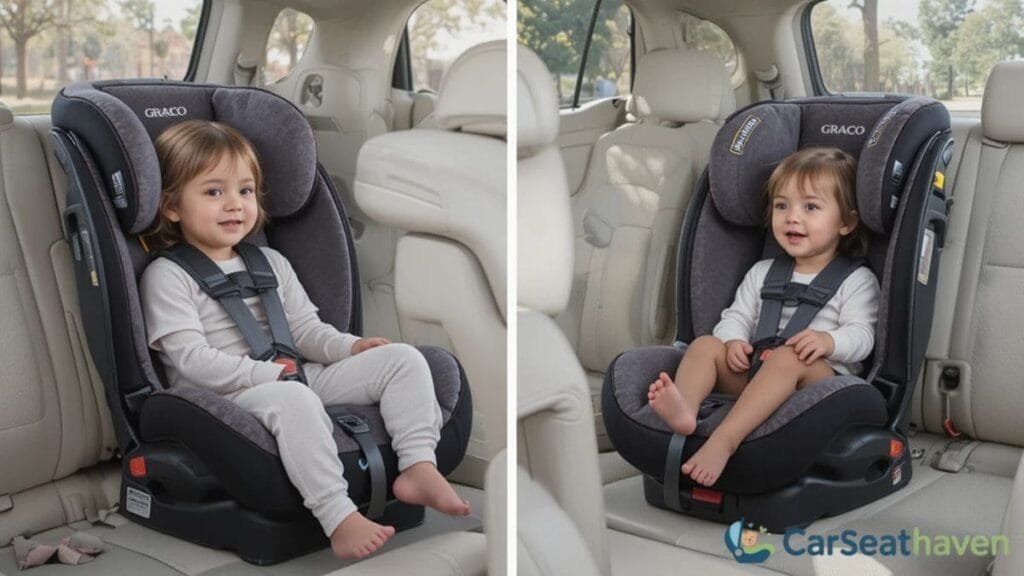
A slim fit car seat is simply a convertible engineered to be narrow, usually 16.5 to 17.5 inches wide, without giving up safety, weight limits, or lifespan. If you drive a small car, need three across, or want a seat that works in any vehicle including grandma’s sedan and the occasional taxi, the category is worth every penny. The Graco SlimFit3 LX and Chicco Fit3x are the value leaders for three across, the Clek Fllo is the premium pick, the Evenflo Revolve360 Slim adds rotation to the mix, and the Cosco Scenera Next and Baby Trend Trooper cover the budget and travel end for under $100.
Shop by your child’s size first and the seat’s width second, verify the fit in your actual vehicle before the return window closes, and remember that the safest seat is the one installed correctly and used correctly on every single ride. Width gets the seat into your car. Correct use is what protects your child once it is there. For official guidance on choosing and using car seats, the National Highway Traffic Safety Administration’s car seat recommendations are the authority worth bookmarking: NHTSA car seats and booster seats.
For specific model picks, see our best skinny car seats for 2026.

Aiden is the founder and editor of CarSeatHaven. He researches NHTSA safety standards, AAP guidance, manufacturer manuals, and recall notices, and turns them into plain-language car seat guides for parents.
