

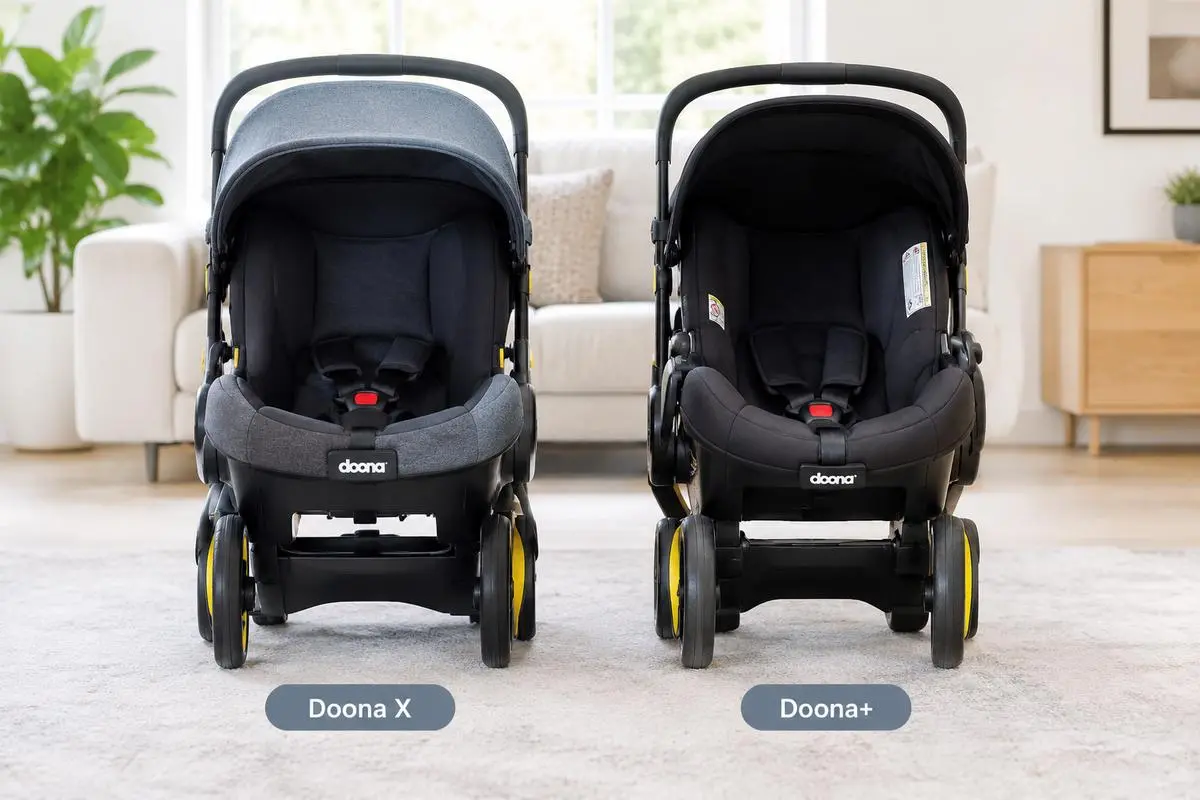
So you have decided a Doona makes sense for your life. Good. Now comes the harder question, the one that costs real money either way: do you buy the original Doona+, the one parents have loved for years at $550, or the new Doona X at $850?
That is a $300 gap between two products that look almost identical at first glance. Same idea, same shape, same one-motion trick that turns a car seat into a stroller. The differences are real, though. Some of them change your daily routine in small ways you will feel every single day. Others only matter for certain families. And one or two of the headline upgrades are not quite what they seem once you read the fine print.
We went through Doona’s official specs, both user guides, and the base manuals line by line to build this comparison. Below you will find the quick verdict first, then the full spec table, then an honest section-by-section breakdown, including the downsides of each seat that most comparison pages skip.
The quick verdict
Short on time? Here is the whole article in a few lines.
Buy the Doona X if you will use it as your main stroller for long stretches most days. The three recline positions, especially the full Lean Back mode, fix the biggest complaint about the original Doona: a baby stuck bolt upright for hours. The no-rethread harness, the step-on brake, the support leg on the base, and the newer FMVSS 213b certification are genuine upgrades, not decoration.
Buy the Doona+ if your Doona will mostly live in the car and come out for quick errands, school runs, and travel days. It does the core job exactly as well, it is 2.4 lbs lighter to carry, its weight limit is actually higher on paper, and you keep $300 in your pocket for the convertible seat you will need in about a year anyway.
Skip both and rethink if your baby is already big for their age or you want one purchase to last well past the first birthday. Both seats stop at 32 inches tall, and no recline feature changes that.
Doona X vs Doona+ at a glance
| Feature | Doona+ (original) | Doona X |
| Price (Doona US store) | $550 | $850 |
| Child weight limit | 4 to 35 lbs | Up to 30 lbs |
| Child height limit | Up to 32 in | 17 to 32 in |
| Carrier weight | 17.2 lbs | 19.6 lbs |
| Recline positions | 1 (fixed angle) | 3 in stroller mode: Sit, Relax, Lean Back (up to 159 degrees) |
| Harness adjustment | Rethread straps through slots by hand | No-rethread, moves with the adjustable headrest |
| Base included | Yes, LATCH base | Yes, new LATCH base |
| Base support leg (load leg) | No | Yes, height-adjustable |
| Base install confirmations | Click in, click out | Leveling system plus color indicators |
| Brake | Two pedals: red to lock, green to release | Step-on, step-off single brake |
| Wheels | Fixed, standard release | Quick-release on all four wheels |
| Safety standard | FMVSS 213 | FMVSS 213a and 213b |
| Airplane use | FAA approved | FAA approved |
| Warranty | 2 years | 2 years |
Prices and specs above come from Doona’s official US store and the product manuals, checked in October 2026. Prices change, so confirm before you buy.
Recline and comfort: the biggest real difference
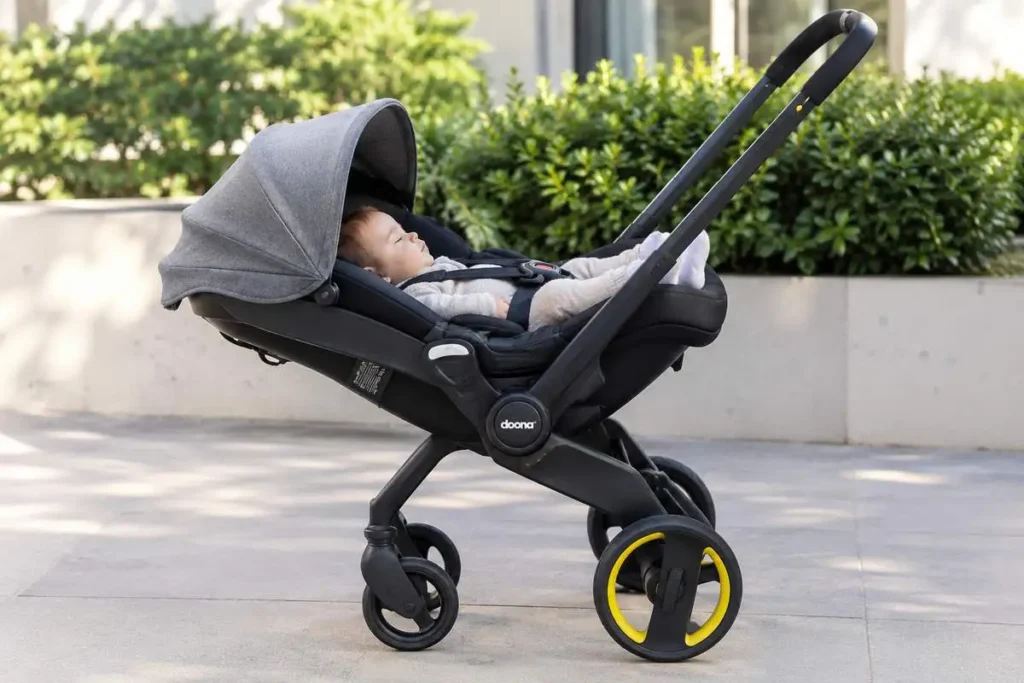
This is the upgrade Doona leads with, and for once the headline is honest. The original Doona+ holds your baby at one fixed, fairly upright angle in stroller mode. Parents have complained about that for years, and they had a point. A car seat angle is designed for crash protection in a moving car. It is not where a baby wants to spend a two-hour walk, a long lunch, or a full airport layover.
The Doona X gives you three positions in stroller mode: Sit, Relax, and Lean Back. Lean Back goes to 159 degrees, which is close to flat. Your baby can actually nap lying back instead of slumped forward with their chin dropping to their chest. If the Doona is going to be your only stroller for the first year, and you take long walks or spend whole afternoons out, this one feature can justify the X on its own.
Now the fine print, because there is some. The X cannot recline in car seat mode. Doona states this plainly on the product page. Once the seat clicks into the base or gets belted into a car or plane, it sits at the same fixed safe angle as any infant seat. So the recline is a stroller comfort feature, not a travel or safety feature. Parents picturing a laid-back baby on a long drive should reset that expectation right now.
The X also gets extra newborn padding and a larger UPF 50+ canopy that zips on instead of clipping. The Doona+ canopy is also UPF 50+ and water repellent, so sun protection is a tie. The X canopy is bigger and easier to remove for washing, which matters more than it sounds after the first blowout.
On the Doona+, comfort add-ons are simpler: the infant insert creates a near-flat ergonomic position for newborns and the head support uses energy-absorbing materials. It works fine. It just never lets the baby stretch out as they grow, and by five or six months many babies actively fight the upright angle when they want to sleep.
The new base and safety features
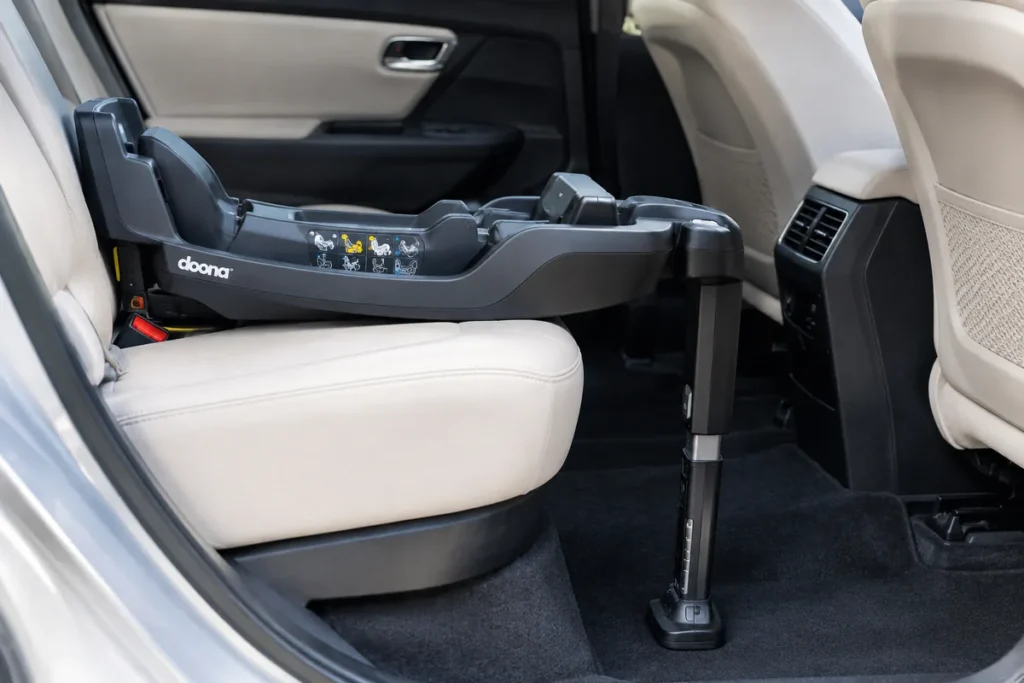
The Doona X ships with a completely new LATCH base, and this is where the safety gap between the two seats is widest.
The headline addition is a height-adjustable support leg, often called a load leg. It extends from the front of the base down to the vehicle floor. In a frontal crash, a load leg braces the base and reduces the downward rotation of the seat, which cuts the forces transferred to the baby. Load legs are common on premium European seats and they are a real safety feature, not a styling touch. The X base also adds a built-in leveling system and color indicators that show you when the install is correct, on top of the click-in, click-out mechanism both generations share. You can read the full base details on Doona’s X base page.
The original Doona+ base is simpler. It installs with LATCH connectors or the vehicle seat belt, the carrier clicks in and out, and that is about it. No support leg, no leveling system. It passed the same federal crash testing required to be sold, and it has been used safely by a huge number of families for years. But if you are comparing feature by feature, the X base is the better piece of engineering.
One warning that will save some readers real money: the bases are not interchangeable. The X base only works with the X carrier, and the old base only works with the Doona+. If you already own a Doona+ with a second base in a grandparent’s car, none of that hardware carries over to an X.
Both carriers keep the same clever trick for baseless installs. The handlebar rotates toward the vehicle seat and works as an anti-rebound bar, bracing the carrier when you install with just a seat belt in a taxi, a rental, or a rideshare. In the car, the two seats are closer than the spec sheets suggest. The honest summary is this: the X pulls ahead when it sits on its base, thanks to the load leg. Belted in without a base, they are near equals.
Then there is the certification line. The Doona+ is certified under FMVSS 213, the federal car seat standard that has been in place for decades and never included a side-impact test. The Doona X is certified under the new rules: FMVSS 213b, the updated core standard, together with FMVSS 213a, the new side-impact standard that puts seats through a side-impact sled test. Does that make your Doona+ unsafe? No. A seat certified to FMVSS 213 is legal, tested, and safe to use until it expires. What the new certification tells you is that the X was designed and tested against the toughest version of the rules, including a side-impact test the older generation never had to take. For safety-focused parents, that is a genuine point in the X column. For everyone else, it is a nice bonus rather than a reason to panic about the older seat.
Harness and daily use
Ask a parent who has owned the original Doona what annoyed them most, and the rethread harness comes up fast. On the Doona+, adjusting the strap height means taking your baby out, going around the back of the seat, unhooking both shoulder straps from a metal plate, threading them through a different set of slots, and reconnecting everything without twisting a strap. The Doona+ manual walks you through it step by step because it is genuinely fiddly. You only do it a handful of times, but you always seem to notice it is needed in a parking lot, in the rain, with a crying baby.
The Doona X fixes this completely. The 5-point harness is integrated with the adjustable headrest. You squeeze, slide the headrest up, and the straps move with it. No rethreading, no metal plate, no parking lot wrestling match. The X also adds self-fastening shoulder pads that stick to the lower part of the headrest, so the straps stay parked open while you load your baby instead of ending up underneath them. Anyone who has dug a strap out from under a squirming newborn will understand why this small thing feels huge.
Day to day, this is the difference you will notice most often after the recline. Babies grow in spurts, grandparents set straps wrong, a thick winter coat changes the fit. On the X, correcting the harness takes three seconds. On the Doona+, it takes a free afternoon and a YouTube video. If you want the full picture of living with the original, our Doona stroller review covers a year of daily use with the Doona+ in detail.
Stroller mode: brakes, wheels, and the push
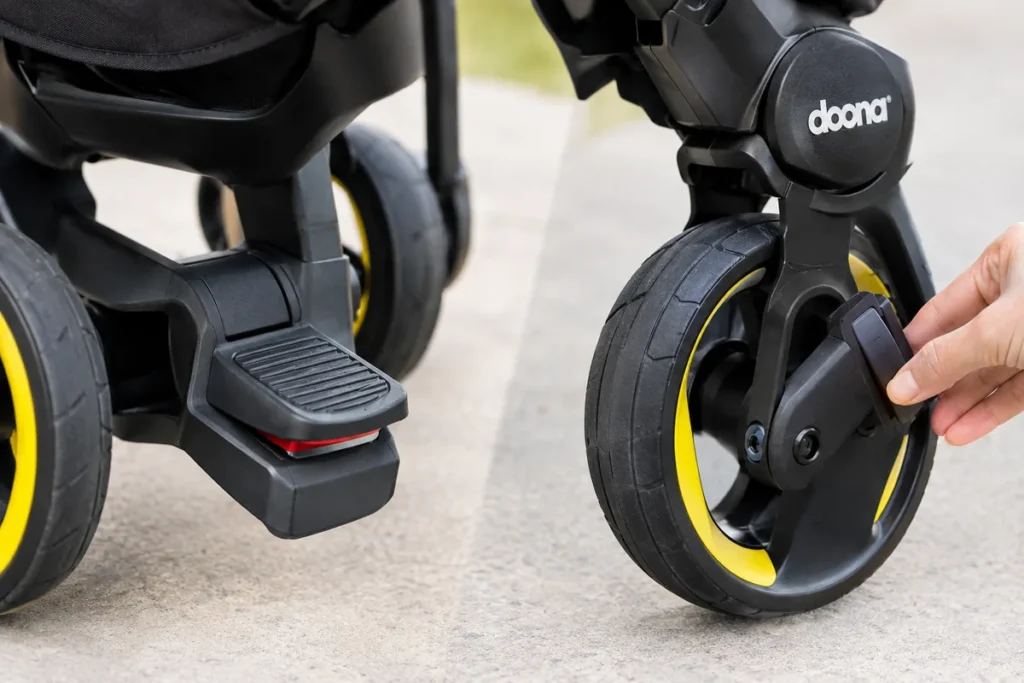
Both seats do the famous trick: click, wheels down, go. The differences show up once you start pushing.
Brakes. The Doona+ uses two pedals between the rear wheels, a red one to lock and a green one to release. It works, but the pedals are small, stiff when new, and murder on bare feet or sandals. The X replaces them with a step-on, step-off brake. You press once to lock, press again to release. It sounds minor until you are holding a coffee, a diaper bag, and a baby’s entire emotional state together at a crosswalk.
Wheels. The X has quick-release wheels on all four corners, so you can pop them off for cleaning or for a truly flat pack in a tight trunk. It also gets Doona’s shock absorber system and a smoother wheel release when you convert from car seat to stroller. The Doona+ wheels are fixed in place and the ride is firmer. On smooth mall floors you will never notice. On cracked sidewalks, the X is calmer and quieter.
Handlebar. The X handlebar gets a faux leather cover and two height positions. The Doona+ handlebar adjusts too, and it has one trick the marketing forgets: a pull-along mode that lets you tow the seat behind you like a rolling suitcase in crowded stations. Both handles rotate into the anti-rebound position for car installs, as covered above.
Size and weight. Here the Doona+ strikes back. At 17.2 lbs, the original carrier is 2.4 lbs lighter than the 19.6 lb X. That gap grows more noticeable every month as your baby gains weight, because you are lifting baby plus carrier into the car, onto a plane seat, and up stairs. Folded, the X is a touch flatter (about 18 inches deep against 22.4 for the Doona+), while unfolded the X is a bit longer because of the recline mechanism. In practice, both fit the same trunks and both squeeze down the same airplane aisles.
Travel and airplane use
If travel is your main reason for buying a Doona at all, you might expect the newer, pricier model to run away with this section. It does not. This round is close to a draw, and the Doona+ even wins a point or two.
Both seats are FAA approved for use on aircraft, installed with the plane’s seat belt and no base. Both are narrow enough, at about 17.3 to 17.4 inches wide, to roll down most airplane aisles and fit on a standard economy seat. Both install with a vehicle belt at your destination, which is the whole magic of a Doona trip: no separate stroller to check, no base to pack, nothing to rent.
Now weigh the two honestly as travel gear:
· Weight in your arms. You cannot wheel the seat down every aisle on every aircraft, so you will carry it at some point, baby included. The Doona+ setup weighs 2.4 lbs less. On a long connection, that difference is not nothing.
· Recline does not fly. Remember, the X only reclines in stroller mode. On the plane it sits at the fixed angle, exactly like the Doona+. The $300 recline buys you nothing at 35,000 feet.
· Damage risk. Checked and gate-checked gear gets thrown around. A travel bag helps either way (Doona’s padded travel bag is $125 and fits both), but if an airline does wreck your seat, replacing a $550 Doona+ hurts less than replacing an $850 X.
· Layovers. Here the X claws one back. A long layover in stroller mode with a baby who can lie flat in Lean Back is noticeably calmer than one spent in the upright Doona+.
Frequent flyers who mostly fly and drive at the other end can save the money and take the Doona+. Families whose trips involve long days on foot at the destination will feel the X earn its keep. If you are still deciding between a Doona and a rotating travel system like the Shyft, our Doona vs Shyft DualRide comparison covers that fight separately.
How long will your baby actually fit? The honest math
Both seats carry the same height limit: 32 inches. That single number decides your ownership period far more than anything else in this article, because most babies hit a height limit long before a weight limit.
Here is what that means in real life. An average baby reaches 32 inches somewhere around 12 to 15 months. A tall baby, the kind tracking in the 90th percentile, can get there at 9 or 10 months. A smaller baby might stretch it to 18 months, but that is the exception, not the plan you should budget around. Also remember the second rule from the manuals: stop using the seat when the top of your baby’s head sits within 1 inch of the top of the shell, whichever comes first.
This is where the spec sheet flips on you. The Doona+ allows up to 35 lbs. The X stops at 30 lbs. On paper, the older, cheaper seat fits a heavier baby. In practice, almost no child reaches 30 lbs while still under 32 inches tall, so the X’s lower weight limit almost never ends the seat’s life early. Almost. If your baby is short and solid, built like a tiny linebacker, the Doona+ genuinely gives you more room to grow.
One small honesty note, because you will run into it while shopping: Doona’s online store currently shows “up to 30 lbs” in the spec box on the Doona+ page, while the US user guide and the labels printed on the seat itself rate it from 4 to 35 lbs. The labels on your seat and the manual are the documents that count. Always follow those.
So plan on either seat lasting roughly a year, give or take a few months based on your baby’s height. Neither is a buy-it-for-three-years product, and any review that pretends otherwise is selling you something.
Price and total cost: the $300 question, answered fully
The sticker prices are $550 for the Doona+ and $850 for the X, both with a LATCH base in the box. But the sticker is not the whole bill. Here is the full picture.
Second base for a second car. One base is included with each seat. A spare costs $180 for the Doona+ base and $230 for the X base. Two-car families should add that to both totals, and remember the bases cannot swap between generations. A household upgrading from a Doona+ to an X for baby number two starts again from zero on bases.
Accessories. Neither seat includes storage, because there is no basket under a Doona. Budget for the add-ons most parents end up buying: snap-on storage runs about $48, an essentials bag about $75, a rain cover $48 to $50, and the X gets its own storage basket options at $75 to $130. Several X accessories are X-only, and prices on the X line run a few dollars higher across the board.
The seat you buy next. Both Doonas retire at 32 inches, and then you are buying a convertible car seat and, if you do not own one, a regular stroller. The $300 saved on a Doona+ covers a solid chunk of that next purchase. This is the strongest financial argument for the original: the Doona year is a short year, and the gear bills keep coming after it.
What the $300 actually buys on the X. A recline your baby will use daily, a load leg base, a no-rethread harness, a better brake, a newer safety certification, and nicer fabrics and finishes. That is a real list. Whether it is a $300 list depends entirely on how many hours your baby will spend in stroller mode, which is why the decision section below matters more than the spec table.
Honest downsides of each
No comparison is worth reading if it only lists brochure points. Here is what owners actually complain about.
Doona+ downsides
· The fixed upright angle. In stroller mode your baby sits at car seat angle all day. Long outings get uncomfortable, and naps are short and slumped.
· The rethread harness. Every strap height change is a small project involving the back of the seat and a metal plate.
· The two-pedal brake. Red to lock, green to release, both stiff, both unfriendly to sandals and bare feet.
· No load leg. The base is safe and legal, but it lacks the support leg and the install indicators the X base adds.
· Older certification. FMVSS 213 is fine and legal, but it is the previous version of the standard, without the side-impact test the new rules require.
Doona X downsides
· The price. $850 for a seat your baby outgrows at 32 inches is a lot, and the accessories and spare base cost more too.
· It is heavier. 19.6 lbs before you add the baby. Parents recovering from a C-section or anyone with a bad back should think hard about lifting it daily.
· Lower weight limit. 30 lbs instead of 35. Rarely the deciding factor, but for short, heavy babies it can end the seat’s run sooner.
· Recline limits. The best feature only works in stroller mode. In the car and on a plane, the X is as upright as the original.
· Nothing carries over. Old bases, and some old accessories, do not fit the X. Upgraders start from scratch.
Which one for which family
Forget the spec sheet for a second. Find your household below.
You drive a small car
Both seats are about the same width, and both can install with a seat belt when space is tight, so neither is a bad pick. The Doona+ gets the nod for one reason: you will be lifting it in and out of a tight back seat at awkward angles, and 2.4 lbs less matters there. If you do choose the X, check that the base’s support leg reaches your floor properly, since some small cars have uneven or sloped footwells.
You fly often
Take the Doona+. It is lighter to carry onto the plane, FAA approved just like the X, and cheaper to replace if an airline damages it. The X’s recline, its best trick, does not work in an aircraft seat. The one exception: if your trips include long sightseeing days after you land, the X earns its price back on the ground.
Your baby is tall or growing fast
Save your money and buy the Doona+, or honestly, question the Doona idea altogether. Both seats end at 32 inches, so a tall baby gets the shortest use out of either one. Between the two, the Doona+ costs less for the same short season, and its 35 lb weight limit gives stocky babies a little more room. Put the $300 toward the convertible seat you will need sooner than you think.
Your budget is tight
Doona+, and it is not close. You give up comfort features, not core safety. The Doona+ passes federal crash standards, works on planes, and does the car seat to stroller trick identically. Watch for sales, and if you shop secondhand, read our guide on how to spot a fake Doona first, because counterfeits and expired seats flood the used market and a used car seat with an unknown crash history is never a bargain.
A second baby is coming
Think in years. Doona rates its seats for 6 years of use from the date of manufacture, printed on the label under the seat. A seat bought new for baby one can usually serve baby two if the gap is a few years. That long lifespan makes the X’s higher price easier to spread across two kids, and its recline and harness upgrades are the kind you appreciate more the second time around. Just remember the base rule: an old Doona+ base in storage will not work with a new X carrier.
You walk everywhere and rarely drive
You are the exact family the X was built for. If the Doona will be your daily stroller for hours at a time, the recline, the better brake, the smoother wheels, and the easy harness stop being luxury extras. They are your everyday quality of life. Buy the X.
Resale value and expiration: the part nobody mentions
Doonas hold their value better than almost any other baby gear. Baby Bargains, which tracks resale prices, estimates used Doonas sell for roughly 39% to 52% of their retail price after three years, assuming normal wear. A clean Doona+ with its base, bought at $550, can realistically return a couple of hundred dollars when your baby outgrows it. Expect the X to follow the same pattern, helped by its newer certification.
Two rules protect that value. First, the 6 year lifespan from the manufacture date: a seat near the end of that window is worth far less, and an expired seat is worth nothing, because it should not be used at all. Buyers check the label, so check it before you list. Second, crash history. Any Doona that has been in a crash, even a minor one, should be replaced and never resold. When you buy used, you are trusting a stranger on both points, which is why the safest deals are seats from people you know, with the labels, manual, and base all present.
Netting it out: the resale value narrows the real price gap between these seats. If both return about half their value, the X costs you roughly $425 to own for its life and the Doona+ roughly $275. The gap shrinks from $300 to about $150. That does not make the X cheap. It does make the decision less dramatic than the sticker shock suggests.
Frequently Asked Questions
Is the Doona X worth $300 more than the Doona+?
If the Doona will be your main stroller for long daily outings, yes. The full recline, no-rethread harness, step-on brake, and load leg base are upgrades you feel every day. If it will mostly ride in the car and pop out for quick errands and flights, no. The Doona+ does that job just as well for $300 less.
Can I use my Doona+ base with a Doona X?
No. The bases are generation-specific. The X base, with its support leg, only accepts the X carrier, and the original LATCH base only accepts the Doona+. The same goes for a second base in another car: you need the matching one, at $180 for the Doona+ base or $230 for the X base.
Does the Doona X recline while installed in the car?
No. The three recline positions work in stroller mode only. Installed on its base or with a seat belt, in a car or on a plane, the X sits at the standard fixed car seat angle, the same as the Doona+.
Which seat will my baby fit in longer, the Doona X or the Doona+?
Practically the same time. Both stop at 32 inches tall, and height is the limit most babies reach first, usually around their first birthday. The Doona+ has a higher weight limit (35 lbs vs 30 lbs), which only matters for shorter, heavier babies.
Is the Doona+ still safe if the X meets a newer standard?
Yes. The Doona+ is certified under FMVSS 213, fully legal, and safe to use until its expiration date. The X is certified under FMVSS 213b and meets the new FMVSS 213a side-impact standard. Newer is a genuine plus, but it does not make the older seat unsafe.
Can both seats be used on an airplane?
Yes. Both are FAA approved for aircraft use, installed with the airplane seat belt and without the base. You will need a paid seat for your baby to use it in the cabin; otherwise it travels as checked or gate-checked baggage, ideally in a padded travel bag.

Aiden is the founder and editor of CarSeatHaven. He researches NHTSA safety standards, AAP guidance, manufacturer manuals, and recall notices, and turns them into plain-language car seat guides for parents.
