

Table of Contents
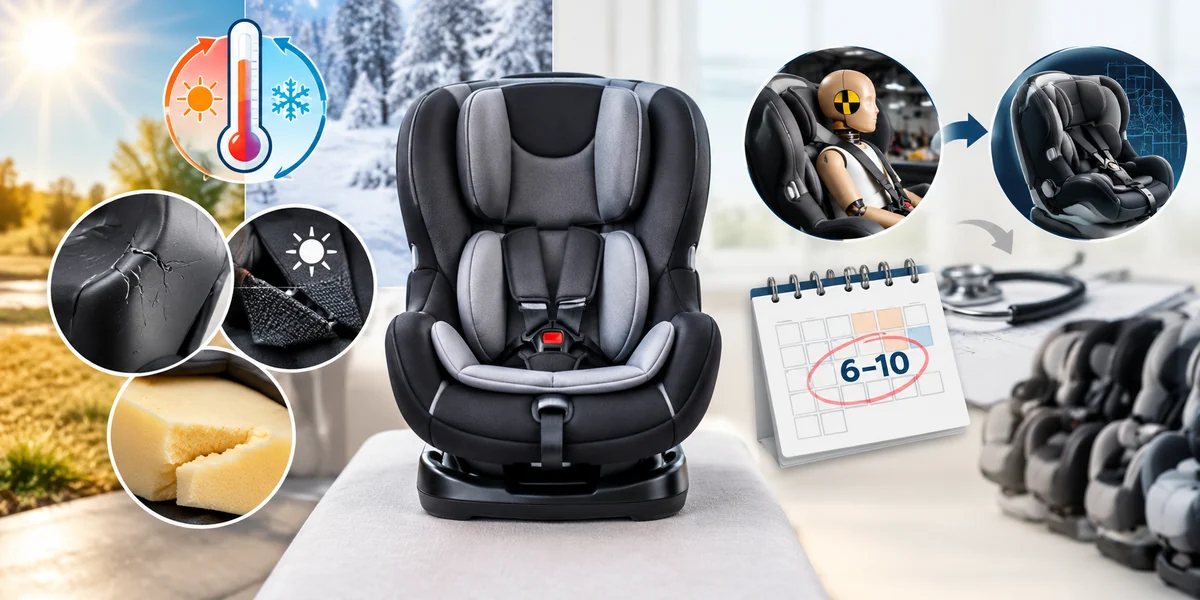
Car seats expire because the materials that make them wear out over time and because safety rules get better not because manufacturers want to sell you another seat. A car seat shell is mostly plastic and years of hot summer heat and cold winter nights make that plastic brittle through a process called cycling.
UV light breaks down straps and fabrics harness webbing loses strength and the energy‑absorbing foam inside compresses a little more each year. On top of that knowledge, from crash tests grows over time. A seat made ten years ago does not match the knowledge of engineers today. Manufacturers set lifespans of six to ten years from the date the seat was made with a minimum of six years and pediatric experts say to respect those dates.
Key Takeaways
- Car seats expire because heat, cold, UV light, and time weaken the plastic shell, the harness straps, and the energy absorbing foam. It is materials science, not marketing.
- A parked car can top 140 degrees on a summer day, and years of freeze-thaw cycling make plastic brittle from the inside out.
- Manufacturers set the expiration dates, usually 6 to 10 years from the date of manufacture. NHTSA does not set them.
- “Looks perfect” means nothing. The damage happens inside the materials, where your eyes cannot check it.
- Find your seat’s manufacture date on the white sticker, and destroy expired seats so no other child ends up riding in one.
Why Car Seats Expire
If you only read one section, read this one. A car seat expires for two big reasons: the physical materials wear out, and the science behind what keeps your child safe moves forward. Neither reason is marketing.
Reason one is materials. A car seat lives in one of the most punishing environments in your home. Your car is basically a greenhouse with wheels. Parked in the sun on a 90-degree day, the cabin can top 140 degrees. That same seat might sit through a night that drops below freezing. Do that cycle hundreds of times over several years and the plastic shell gets brittle, the harness straps get weaker, and the energy absorbing foam inside gets tired. All of this happens invisibly. The seat looks the same in year eight as it did in year one. The date on the sticker is the manufacturer’s best estimate of how long the materials will perform the way crash tests require.
Reason two is knowledge. The federal standard for child restraints, FMVSS 213, keeps evolving as engineers learn more about how crashes hurt kids. Side impact protection has become a much bigger focus than it was fifteen years ago. A seat built to the standards of a decade ago misses everything learned since. The expiration date quietly retires old designs and moves kids into seats built with newer knowledge. That is not a sales trick. It is how safety engineering works.
What Extreme Heat and Cold Do to Car Seat Plastic
Let us begin with the biggest enemy of a car seat shell: temperature swings.
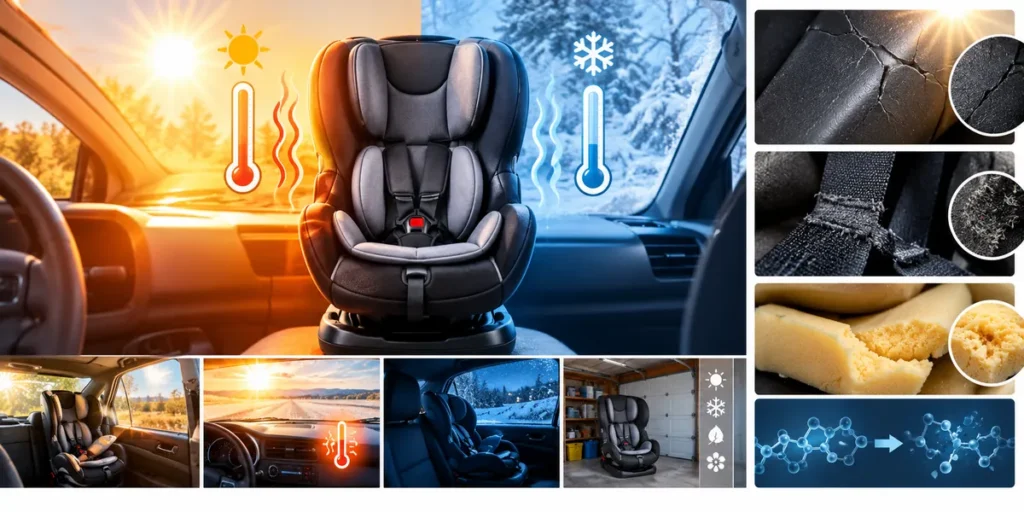
On a summer day when the outside air reaches 90 degrees, the inside of a parked car can rise above 140 degrees. Dashboards become even hotter. Car seat shell sits in that oven for hours absorbing heat through every layer of fabric and into the plastic shell underneath. Then the sun goes down. Winter arrives and car seat shell freezes overnight. Spring and fall add their daily swings of 40 or 50 degrees.
Engineers call this process thermal cycling and plastics do not handle it gracefully. Every heat up and cool down causes plastic to expand and contract a tiny bit each time. Over hundreds or thousands of cycles that constant movement changes the material at a level. The long chain molecules that give plastic its toughness start to break down. Car seat shell becomes less flexible and more brittle. Of flexing and absorbing crash energy the way it did when new brittle plastic is more likely to crack or shatter under sudden force.
This is not theoretical. Ask anyone who has kept a toy or an old plastic bucket outside for a few years. It fades, it. One day it snaps in your hands with almost no pressure. A car seat shell is made from better plastic than a bucket and it is engineered to a strict standard but the same chemistry applies. The difference is that nobodys life depends on the bucket. I have seen parents worry about this.
Here is the part that matters most for parents: you cannot see damage. Car seat shell becomes brittle. Does not look brittle. Car seat shell keeps its shape its color and its texture. There is no warning crack, no sagging, no smell. The degradation happens inside the material at a level your eyes cannot check. That is why the expiration date exists. It replaces your eyes with the manufacturers engineering judgment.
One more detail worth knowing. No car seat shell position pauses the clock. Car seat shell near a window takes the worst UV car seat shell in the middle takes the heat and even car seat shell stored in the garage still cycles through the seasons. There is no spot in or, around your car where aging stops..
Sunlight’s Quiet Damage: UV Degradation
Heat gets most of the blame. Ultraviolet light is quietly causing its own harm every single day your car sits in the sun. UV radiation breaks the chemical bonds in plastics and in the woven fibers of harness webbing and seat covers. On the shell it makes the surface look chalky and more likely to crack. On fabrics and straps it fades the color. Weakens the fibers. Have you ever noticed how the side of the car seat near the window looks more faded than the rest? That is UV damage you can actually see. What worries engineers is the part you cannot see: the loss of strength in the harness webbing the very straps that hold your child in a crash. Car seat manufacturers do add UV stabilizers to their plastics similar to what goes into furniture.. Stabilizers get used up. They are a budget, not a shield. Over years of exposure they run out. Degradation speeds up. A seat parked in a driveway in Arizona ages faster than one parked in a shaded garage in Oregon. The expiration date does not know where you parked so it assumes a worst case. This is also why “I kept it in the garage” is not the defense parents think it is. Storage helps,. Unless your garage is climate controlled and dark the seat still cycles through the seasons.. If you stored it in the attic or the shed you may have actually made things worse since attics swing hotter, than the car itself.
The Parts You Cannot See Aging
The shell gets all the attention, but a car seat is a system. The straps, the buckles, the foam, and the adjusters all age on their own schedules, and every one of them matters in a crash.
Harness Webbing Loses Strength
Harness webbing is the strong woven strap that holds your child in the seat. It is made from polyester fibers woven tight enough to survive enormous forces. But fibers age. Years of UV exposure, thousands of tightening and loosening cycles, spilled milk soaking in, and the simple stress of holding a squirming toddler all take tiny amounts of strength out of the webbing.
The scary part is that worn webbing does not announce itself. It does not fray the way an old rope does, at least not at first. It just gets a little weaker, year after year, in a way you can only measure with lab equipment. In a crash, the harness has to hold your child against forces many times their body weight. The safety margin built into new webbing shrinks as the material ages. That margin is the whole reason the webbing is as strong as it is, and the expiration date protects it.
Buckles and Adjusters Wear Out
Every time you buckle your child in, metal and plastic parts grind against each other. The buckle tongues slide in and out. The harness adjuster clicks through its positions. The chest clip snaps shut. Over thousands of uses, these parts wear down.
Then add real life. Goldfish crumbs pack into the buckle. Juice dries sticky inside the release mechanism. Sunscreen and lotion coat the adjuster. Parents clean these parts with whatever is handy, and some cleaners weaken the plastic or leave residue that gums up the works. A buckle that sticks, a release button that needs two tries, an adjuster that slips, any of these can mean the harness is not as tight as you think. A loose harness in a crash lets a child move too far, and too far is where injuries happen.
EPS Foam Compresses Like a Bike Helmet
Inside the shell of most car seats sits a layer of EPS foam, expanded polystyrene, the same stiff white foam inside a bike helmet. Its job is to crush on impact, soaking up crash energy before it reaches your child. It is a one-way shock absorber. It gives up its structure to save the rider.
Here is the bike helmet connection, and it is the best way to understand what happens over time. Nobody questions replacing a bike helmet every few years or after any hard hit. The foam does its job by compressing, and every compression, big or small, leaves it a little less able to compress again. A car seat’s foam goes through years of small compressions: potholes, speed bumps, sudden stops, the daily jolt of a toddler climbing in. It never gets a rest.
Aged foam also gets brittle, just like the shell. In a crash, fresh foam crushes in a controlled way and spreads the force out. Old, tired foam may crack instead of crushing, which means the energy goes straight through to the child. You cannot open up the seat and check the foam’s condition. It is buried under the cover, and even if you could see it, the damage is at a level your eyes cannot measure.
Safety Standards Keep Moving: FMVSS 213 and the Side Impact Shift
Now the second big reason seats expire, and the one most articles gloss over. A car seat is engineered to the knowledge of its time, and the knowledge keeps growing.
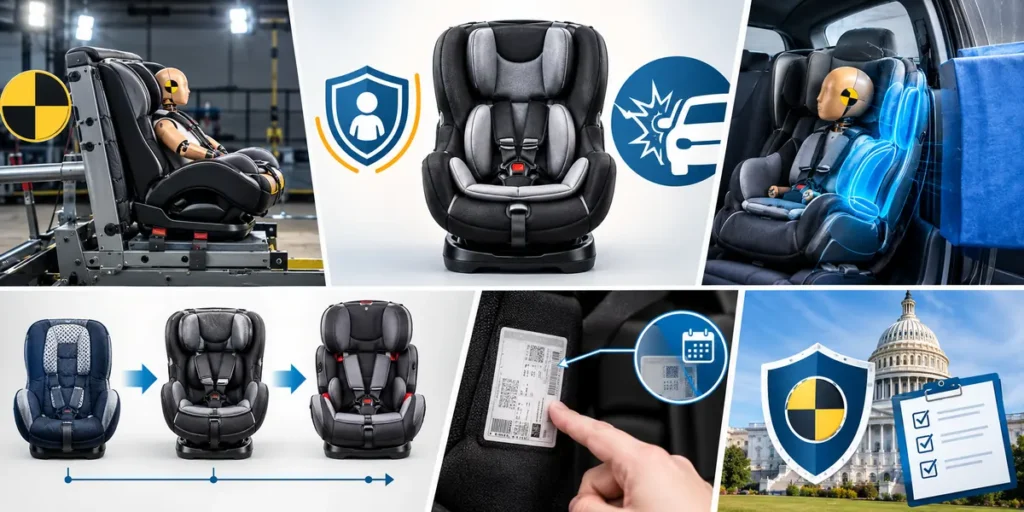
In the United States, child restraints must meet FMVSS 213, the Federal Motor Vehicle Safety Standard for child restraints. This is the federal rule that says what a car seat has to survive in testing before it can be sold. But the standard is not frozen. Federal standards get updated as research reveals new information about how children are injured in crashes, and testing methods improve.
The biggest shift in recent years has been side impact protection. For a long time, federal testing focused mainly on frontal crashes. But real world crash data kept showing that side impacts are a serious threat to children, and researchers kept learning more about how a child’s body, especially the head and neck, moves in a side impact. Manufacturers responded with deeper side wings, energy absorbing headrests, and better structural designs. A seat designed fifteen years ago was tested against the knowledge of fifteen years ago. It does not have the benefit of what engineers learned since.
This is worth sitting with for a moment. Even if we could freeze a car seat in perfect condition, never letting the plastic age a single day, an old design would still fall behind. The expiration date does two jobs at once: it retires aging materials, and it retires aging designs. Both matter.
One clarification, because it comes up constantly: NHTSA does not set expiration dates. The National Highway Traffic Safety Administration writes the standards and runs the tests, but it leaves the lifespan decision to the manufacturers, who know their materials and designs best. What NHTSA does do is expect you to respect those dates. Its used car seat safety checklist requires the date of manufacture and model number labels to be present and readable, which tells you everything about how seriously the government takes the age of a seat.
Why Replacement Parts Eventually Disappear
Here is the practical reason for expiration dates that nobody talks about, and it has nothing to do with chemistry.
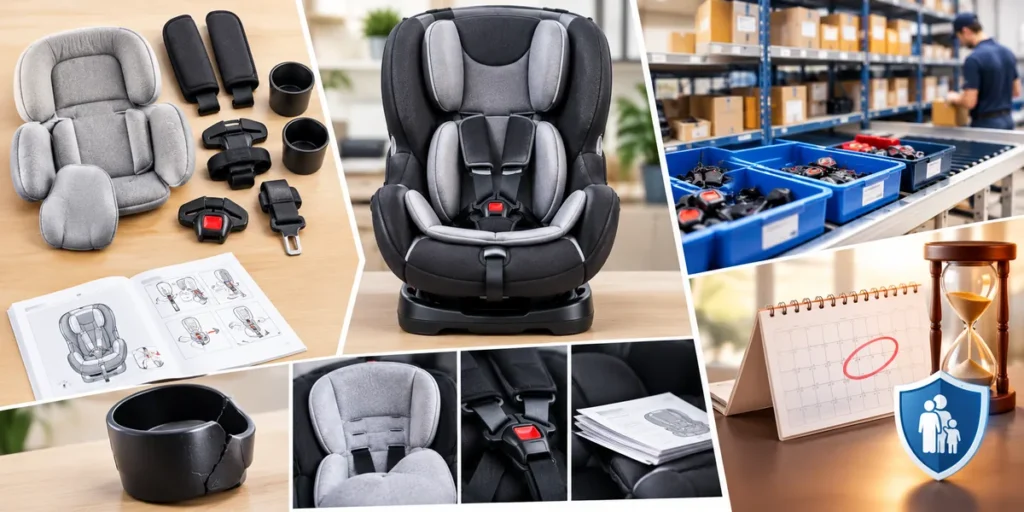
A car seat is sold with a support system: replacement harness pads, infant inserts, cup holders, buckle parts, and instruction manuals. The manufacturer keeps making those parts for a while after the seat leaves production. But factories move on. Tooling gets retired. Suppliers stop making that specific buckle. After enough years, the parts simply do not exist anymore.
A seat missing a part is a seat that cannot be used correctly. Lose the infant insert on a seat your newborn still needs, and the harness will not fit right. Crack a cup holder and it seems minor, but some cup holders are part of the tested design. Lose the manual and you are guessing at installation and guessing is how seats end up installed wrong.
Safe Kids Worldwide notes that manufacturers set expiration dates for their restraints, with a minimum useful life of 6 years from the date of manufacture. That lifespan roughly tracks with how long the company will stand behind the product with parts, manuals, and customer support. Past the date, you are on your own. With safety equipment, being on your own is not where you want to be.
So when you look at the expiration date, think of it as the end of a promise. The manufacturer promised the materials, the design, and the support for that many years. After that, the promise is over.
“It Is Just a Marketing Trick to Sell More Seats.” Let Us Answer That.
This is the objection every parent forum has and it deserves a straight answer, because it sounds so reasonable. Car seat companies make money selling car seats. Giving their products a death date looks like a perfect way to sell more of them. Right?
Here is the problem with that theory.
Science does not care about anyone’s profit margin. Thermal cycling embrittles plastic whether the manufacturer wants it to or not. UV light breaks down webbing fibers on its own schedule. EPS foam compresses because physics says so. If expiration dates were pure marketing, the materials science would have to be fake too, and it is not. You can watch the same degradation happen in any plastic left outside. The chemistry does not know what brand it is.
Consumer Reports’ auto safety experts have used a homely analogy that nails it: the old plastic lawn chair. Everyone has owned one. It sits on the patio for years, and it looks fine. Then someone sits down and a leg snaps clean off. The chair looked perfect right up until the moment it failed, because the damage was inside the material, not on the surface. A car seat shell is a far better engineered piece of plastic than a lawn chair and it is held to a far higher standard. But the lesson is identical. “Looks perfect” tells you nothing about what is happening inside the material.
Consider the incentives too. If a manufacturer wanted to sell more seats, the easiest path would be shorter lifespans across the board. Instead, lifespans have stayed stable or grown as materials improved, with many seats now lasting 9 or 10 years. And here is the detail the marketing theory cannot explain: Diono counts its lifespan from the date of purchase, not manufacture, voluntarily giving customers more usable life. Graco gives 10 years to seats with steel reinforced belt paths because the engineering supports it. These are engineering decisions, not sales decisions.
Finally, think about who agrees on this. It is not just the manufacturers. The American Academy of Pediatrics advises parents not to use a seat past its expiration date. Safe Kids Worldwide backs the manufacturer dates. Child passenger safety technicians treat them as hard stops. For the marketing theory to be true, all of these independent groups would have to be in on it. They are not. They are reading the same materials science.
Skepticism is healthy. But aim it at the right target. The expiration date is not the industry tricking you. It is the industry telling you the truth about plastic, and the truth has a time limit.
Who Decides When a Seat Expires?
Since we are on the subject of trust, let us be precise about who actually sets these dates, because a lot of parents assume it is the government.
It is not. NHTSA, the federal agency behind car seat standards, does not set expiration dates for child restraints. The manufacturers do. Each company tests its materials, studies how its designs age, and sets a useful life for each model, usually somewhere between 6 and 10 years from the date of manufacture.
That surprises some parents, and a few get suspicious. But think about who has the information. The manufacturer knows the exact plastic blend in the shell, the weave of the webbing, the density of the foam, and how all of it performs after simulated aging in the lab. NHTSA writes the pass fail standard. The manufacturer knows the product. The division of labor makes sense.
There is also a floor that keeps everyone honest. Safe Kids Worldwide, one of the most trusted child safety organizations in the country, notes that manufacturers set expiration dates for their restraints with a minimum of 6 years from the date of manufacture. Start at safekids.org if you ever want to read their guidance directly. As of 2027, no legitimate seat in the US expires faster than 6 years, and most last longer.
And the pediatricians agree. The American Academy of Pediatrics advises parents not to use a car seat past its expiration date, or 6 years from manufacture if no date is printed. When the people who make the seats, the people who study child safety, and the people who treat injured children all point the same direction, that is about as close to settled as parenting advice gets.
How to Find Your Seat’s Expiration Date
All this science is useful, but it only matters if you know your own seat’s date. Here is how to find it.
Check the White Sticker First
Almost every seat has a white label with the date of manufacture, often shortened to DOM. On infant carriers, check the bottom of the carrier or the base. On convertibles, look at the back of the shell or underneath near the belt path. You may need to peel back the fabric cover, which is fine. It is designed to come off.
Some brands print a “Do Not Use After” date right on the sticker. If yours has one, that is your answer. If it only shows the manufacture date, add the lifespan for your brand and model, or skip the math entirely with our free expiration checker, which walks you through it in about 30 seconds.
Look for Dates Stamped in the Plastic
No sticker? Some manufacturers emboss the date right into the plastic shell, often on the back or bottom edge. It is the same color as the plastic, so it hides in plain sight. Run your fingers along the back of the shell or shine your phone flashlight across the surface at an angle. The shadows will reveal raised numbers you would never spot head-on.
What If the Date Is Gone?
Stickers fade and peel. If yours is unreadable, check your manual for the lifespan of your exact model. Lost the manual? Every major brand posts free PDFs on its website. If you truly cannot determine the age of the seat, treat it as expired. That is what child passenger safety technicians recommend, and it is the right call. And if cost is the worry, our main expiration guide covers free and low cost seat programs that can help.
What to Do When Your Seat Expires
So the date has passed. Do not panic, but do act. An expired seat should not carry your child, and it should not carry anyone else’s child either.
Trade It In
Twice a year, Target runs a car seat trade-in event where you bring any old seat and get a discount, usually 20 percent, toward a new one. The old seats get recycled, not resold. Our complete guide to car seat expiration dates has the full details on when these events run and how they work.
Recycle It
Car seats are mostly plastic and metal, so they are technically recyclable, but curbside programs almost never take them. Look for dedicated car seat recycling drop-offs in your area, often run around Earth Day, or check whether your local waste authority accepts disassembled seats.
Destroy It Before You Toss It
If trade-in and recycling are not options, make the seat unusable before it leaves your hands. Cut every harness strap. Remove the cover and padding. Write EXPIRED, DO NOT USE on the shell in permanent marker. Bag the pieces so a curbside picker cannot spot a free car seat and grab it. An intact expired seat in the trash is a hazard to some other family’s child.
The Bottom Line
Car seats expire because plastic ages, straps weaken, foam tires, and safety knowledge grows. It is materials science and engineering progress, not a sales trick. The date on your sticker is the manufacturer’s promise about how long the seat will protect your child the way it was designed to. Respecting it is one of the simplest safety decisions you will ever make.
If you have not checked your seat yet, do it today. Find the white sticker, do the math, and confirm the lifespan for your exact model. For the full picture, brand by brand lifespans, sticker locations, secondhand buying rules, and disposal options, our complete guide to car seat expiration has you covered.
FAQs
Q.1 Do car seats really expire, or is it just marketing?
They really expire. Years of heat and cold cycles make the plastic shell brittle, UV light weakens the harness webbing, the energy absorbing foam compresses over time, and safety standards keep improving. Manufacturers set lifespans of 6 to 10 years based on how their materials age, and independent groups like the American Academy of Pediatrics and Safe Kids Worldwide back those dates. No marketing department can repeal materials science.
Q.2 Why do car seats expire after 6 to 10 years specifically?
That range reflects how long the materials hold up under real world conditions. Manufacturers test their plastics, webbing, and foam through simulated aging, heat cycling, UV exposure, and mechanical wear, and the 6 to 10 year window is where the safety margins stay intact. The minimum of 6 years is the industry floor noted by Safe Kids Worldwide. Better materials and construction, like steel reinforced belt paths, earn longer lifespans.
Q.3 My seat looks brand new. Can I keep using it past the date?
No. This is the most dangerous misunderstanding about expiration. Thermal and UV damage happens inside the materials, where your eyes cannot check it. Consumer Reports compares it to an old plastic lawn chair that looks fine until someone sits down and a leg snaps. A car seat that looks perfect can still have a brittle shell, weakened webbing, and tired foam. The date is the test your eyes cannot perform.
Q.4 Does the expiration date start when I buy the seat?
No. The clock starts on the date of manufacture, not the purchase date. A seat that sat in a warehouse for a year before you bought it has already used a year of its life. The one exception is Diono, which uniquely counts from the date of purchase. Check the white manufacture sticker on your seat to see where your clock started.
Q.5 Do car seat bases and booster seats expire too?
Yes. Infant seat bases have their own expiration dates, which can differ from the carrier that clicks into them, so check both pieces. Booster seats expire as well, typically in the same 6 to 10 year range depending on the brand. Every separate component with its own sticker gets its own date.
Q.6 What should I do with an expired car seat?
Do not sell it, donate it, or leave it intact on the curb. The best option is a trade-in event, where retailers give you a discount on a new seat and recycle the old one. Second best is a dedicated recycling program. Last resort: cut the straps, remove the cover, mark the shell EXPIRED, and bag it before disposal so no other child ends up riding in it.

Aiden is the founder and editor of CarSeatHaven. He researches NHTSA safety standards, AAP guidance, manufacturer manuals, and recall notices, and turns them into plain-language car seat guides for parents.
