


Yes, car seats expire. Every car seat sold in the United States has a defined useful life, usually 6 to 10 years from the date it was manufactured, not the date you bought it. When do car seats expire exactly? It depends on the brand and model: a Graco 4Ever lasts 10 years, a Chicco KeyFit lasts 6, and a Clek Foonf lasts 9. Expiration is not a marketing trick. The plastic shell slowly weakens from years of heat and cold inside your car, the harness webbing wears, and safety standards keep improving. If you are staring at a white sticker under your seat wondering whether it is still safe, this guide covers everything: how long each major brand lasts, where to find the date, what to do with an expired seat, and how to check yours in seconds with our free tool.
Key Takeaways
- Yes, car seats expire, usually 6 to 10 years after the date of manufacture.
- The countdown starts on the manufacture date, not the day you bought the seat.
- Find the date on the white sticker under or behind your seat, or check yours with our free car seat expiration checker.
- Never use an expired seat, and never sell or give one away.
- Trade it in, recycle it, or destroy it so nobody else can use it.
Quick Answer: Yes, Car Seats Expire
Let us get the big question out of the way first. Car seats really do expire, and it is not a scheme to sell more seats. Every major manufacturer prints a useful life on their seats, and child passenger safety technicians treat those dates as hard stops. The American Academy of Pediatrics advises parents not to use a car seat past its expiration date, and if a seat has no printed expiration date, the guidance is six years from the date of manufacture.
So why does a hunk of plastic and fabric have a shelf life at all? Think about where your car seat lives. In summer, the inside of a parked car can top 140 degrees. In winter, it can drop below freezing overnight. That cycle repeats hundreds of times over the life of a seat. Plastic does not love that. It slowly becomes more brittle, harness webbing loses strength, and the energy-absorbing foam compresses a little more each year. None of this is visible to the naked eye, which is exactly why the date matters more than how the seat looks.
There is a second reason too. Safety standards and crash test knowledge keep moving forward. A seat designed ten years ago was tested against the knowledge of ten years ago. Manufacturers certify their seats for a defined useful life, and after that date, they no longer stand behind the seat’s performance in a crash.
When Do Car Seats Expire?
When do car seats expire? Most expire 6 to 10 years after the date of manufacture. That range is wide because every brand sets its own lifespan, and many brands set different lifespans for different models. An infant seat from one brand might last 6 years while that same brand’s all-in-one seat lasts 10.
Here is the part that trips up almost every parent: the clock starts on the manufacture date, not the purchase date. If you buy a seat that sat in a warehouse for 18 months before you brought it home, you have already used 18 months of its life. We will talk more about this below, because it is one of the least known facts in car seat safety, and it can cost you real time.
The exact expiration for your seat depends on three things: the brand, the model, and the date it was made. The table in the next section covers every major brand, and a quick check of your brand’s lifespan plus your sticker date gives you the answer in under a minute.
How Long Do Car Seats Last?
There is no single answer, because each manufacturer sets its own lifespan. Below is every major brand’s stated useful life, taken from the manufacturers’ own official pages and manuals. When a brand gives a range, it is because different models have different lifespans, so always confirm your exact model.
| Brand | Typical Lifespan | Details |
|---|---|---|
| Graco | 7 or 10 years | Depends on construction: seats with a steel-reinforced belt path last 10 years, seats with a plastic-reinforced belt path last 7 years. The popular 4Ever DLX is a 10-year seat. |
| Chicco | 6 to 10 years | Infant seats last 6 years. Rotating convertibles last 8 years. All-in-one seats last 8 or 10 years depending on the model. |
| Britax | 6 to 10 years | Infant seats last 6 years. ClickTight convertibles and the One4Life all-in-one last 10 years. The Grow With You harness-to-booster lasts 9 years. (Britax’s official guide) |
| Evenflo | 6 to 10 years | Varies widely by model. The Tribute convertible lasts 6 years, while the Revolve360 Slim and LiteMax NXT last 10 years. |
| Clek | 9 years | Flat 9 years across every model: Foonf, Fllo, Oobr, and Liing. The simplest rule in the industry. |
| Diono | 8 to 10 years | Convertible seats like the Radian last 10 years, boosters last 8. Uniquely, Diono counts from the date of purchase, not manufacture. |
| Safety 1st | 8 to 10 years | Depends on the model. Check your manual, because Dorel seats vary more than most parents expect. |
| Maxi-Cosi | 8 to 12 years | US models range from 8 years (Mico Max 30 infant) to 10 years (Pria Max 3-in-1) depending on the product. |
A quick note on reading this table: these are the manufacturers’ official figures for the US market, current as of 2027. Brands occasionally update lifespans for new models, so the sticker on your specific seat always wins. If the table and your sticker disagree, trust the sticker.
Does the Seat Type Matter?
Yes, and this surprises a lot of parents. Infant seats tend to have the shortest lifespans, often 6 years, because they are smaller, lighter, and built with less material. Convertible and all-in-one seats usually last longer, often 8 to 10 years, because they are built to handle bigger kids over more years. Booster seats vary: some last 6 years, others stretch to 10.
Here is what catches families off guard. You buy an infant seat for baby number one, use it for a year, store it carefully in the garage, and pull it out three years later for baby number two. That seat has now burned through four of its six years while sitting in storage. It still has life left, but less than you think. This is why checking the manufacture date matters even for seats that look brand new.
Infant seat bases deserve their own mention. The base can have a different expiration date than the carrier that clicks into it. If you are reusing a travel system, check both pieces, not just the part the baby sits in.
Why Do Car Seats Expire?
Four real things happen to a car seat over time. Understanding them makes the expiration date feel less arbitrary and a lot more important.
Plastic Breaks Down in Heat and Cold
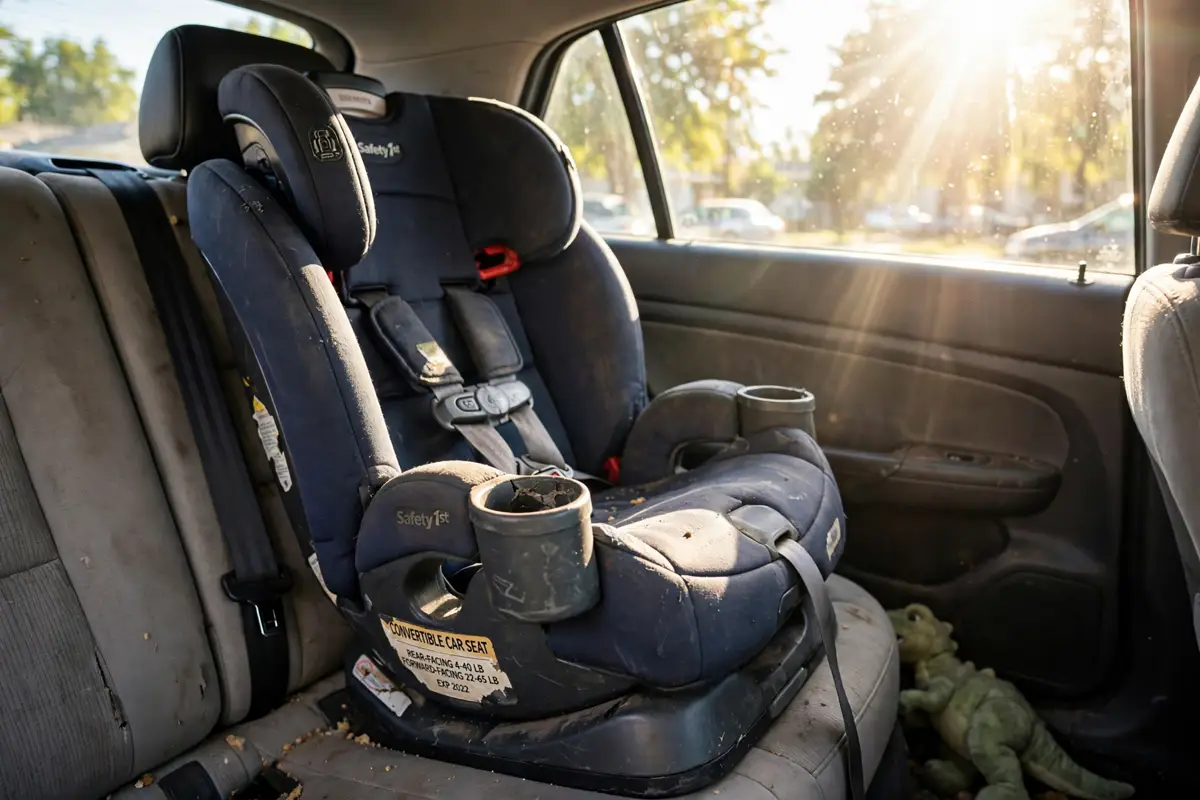
Your car is one of the harshest environments in your daily life. On a sunny 90-degree day, the inside of a parked car can reach 140 degrees or more. On a cold January night, it can sit below freezing for hours. Your car seat absorbs every bit of that, day after day, year after year.
Plastic does not handle thermal cycling gracefully. Repeated expansion and contraction slowly changes the material at a structural level, making it more brittle over time. Consumer Reports’ auto test experts have compared it to an old plastic lawn chair: it looks fine sitting there, but put real stress on it and it can crack instead of flexing. A car seat shell needs to flex and absorb energy in a crash. A brittle shell may not do that job the way it did when it was new.
Sunlight adds its own damage. UV exposure breaks down plastics and fades fabrics, and the parts of the seat near the windows take the worst of it. You cannot see this degradation happening, which is why “but it looks perfect” is never a good reason to ignore the date.
Straps, Buckles, and Foam Wear Out
The shell gets most of the attention, but the soft parts age too. Harness webbing, the strong woven straps that hold your child, slowly loses strength from UV exposure, repeated tightening, and the general stress of holding a wiggly toddler. Buckles and adjusters collect crumbs, juice, and goldfish dust, and a sticky buckle that does not latch cleanly is a safety problem.
Inside the shell sits energy-absorbing foam, usually EPS foam similar to what is in a bike helmet. That foam compresses a tiny amount with every bump, every pothole, every sudden stop. Over years, it does not spring back the way it used to. Like a bike helmet, the foam is a one-way shock absorber, and age alone reduces what it has left to give.
None of these parts are designed to be replaced on a schedule. The manufacturer certifies the whole system, shell plus straps plus foam plus buckles, for a defined number of years. After that, they cannot promise the system works as designed.
Safety Standards Keep Improving
Car seat regulation in the United States centers on FMVSS 213, the Federal Motor Vehicle Safety Standard for child restraints. That standard does not stand still. Testing methods improve, researchers learn more about how children’s bodies move in crashes, and expectations rise. Side-impact protection, for example, has become a much bigger focus than it was fifteen years ago.
A seat engineered a decade ago was a good seat for a decade ago. It was tested against the knowledge and standards of its time. But it does not benefit from everything learned since. Expiration dates quietly move families into seats built with newer knowledge, which is a genuine safety upgrade, not just a sales tactic.
This is also why NHTSA, the National Highway Traffic Safety Administration, tells parents to check the date of manufacture and model number on any used seat. Those two pieces of information let you look up recalls and figure out whether the seat is simply too old. NHTSA itself does not set expiration dates. The manufacturers do. But the government absolutely expects you to respect them.
Replacement Parts Disappear
Here is the practical reason nobody talks about. After a seat has been out of production for a few years, the manufacturer stops making parts for it. Lose a harness pad, crack a cup holder, need a new instruction manual, and you may find the parts simply do not exist anymore.
A seat with missing parts is a seat that cannot be used correctly, and a seat that cannot be used correctly cannot protect your child. The expiration date roughly tracks with how long the manufacturer will support the seat. Past that point, you are on your own, and that is not where you want to be with safety equipment.
Where to Find Your Car Seat Expiration Date
Finding the date is genuinely annoying, and every parent who has flipped a car seat upside down on the living room floor knows it. Here is exactly where to look.
The White Manufacture Sticker
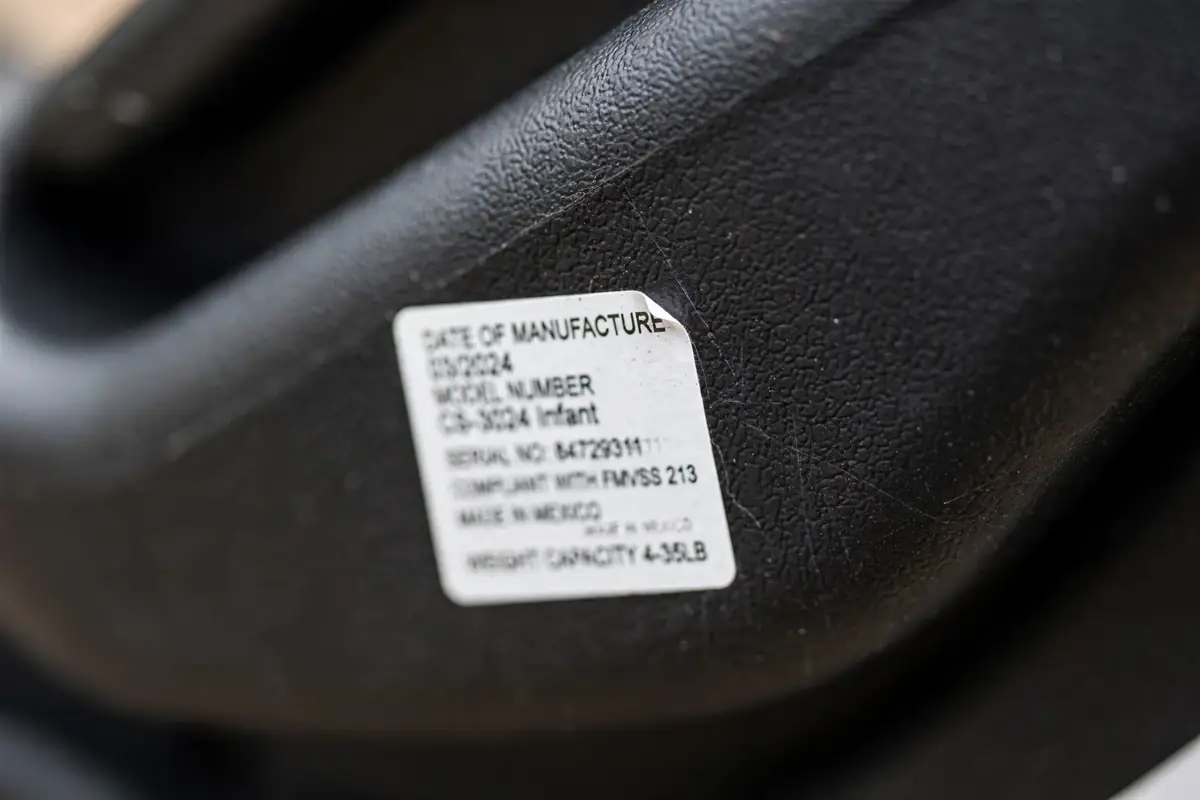
Almost every car seat has a white label with its date of manufacture, often shortened to DOM. This is the single most important thing on the seat. The expiration date is counted from this day.
Where the sticker lives depends on the seat. On most infant carriers, check the bottom of the carrier or the bottom of the base. On convertible and all-in-one seats, look at the back of the shell or underneath the seat near the belt path. On boosters, it is usually on the bottom or the back. You may need to peel back the fabric cover to see it, which feels wrong the first time but is completely fine. The cover is designed to come off for washing.
Some brands make your life easier by printing a “Do Not Use After” date right on the same sticker. If yours has one, that is your answer, no math required. If it only shows the manufacture date, add the lifespan for your brand and model from the table above, and you have your expiration date.
Stamped Into the Plastic Shell
No sticker? Look for a date molded directly into the plastic. Manufacturers sometimes emboss the manufacture date into the shell itself, often on the back or bottom edge. It can be hard to spot because it is the same color as the plastic. Try running your fingers along the back of the shell, or shine your phone flashlight across the surface at an angle. The shadows will reveal raised numbers you would never see head-on.
Graco seats are famous for this. Many have the date embossed near the bottom of the shell, sometimes under where the cover wraps around. It takes some hunting, but it is there.
What If the Sticker Is Missing or Unreadable?
Stickers fade. They peel. They get scratched by years of installations. If yours is gone or unreadable, do not guess.
First, check your manual. Many manuals list the lifespan for your exact model, and some even explain where the date markings are. Lost the manual? Every major manufacturer posts manuals as free PDFs on their website. Search for your brand, model name, and the word “manual.”
Second, call the manufacturer. Have your model number ready, which is usually on a separate label or stamped into the shell near where the sticker was. The customer service team can tell you the lifespan for your exact seat and help you estimate the manufacture date from the model number and serial number.
Third, if you truly cannot determine the age of the seat, treat it as expired. This is the guidance child passenger safety technicians give, and it is the right call. A seat of unknown age is a seat you cannot trust, no matter how nice it looks. If money is tight, skip ahead to the section on free and low-cost options below, because there are real programs that help.
Check Your Seat With Our Free Expiration Checker
Reading about expiration dates is useful. Knowing your own seat’s date is better. Our free car seat expiration checker does the math for you: pick your brand, pick your model, enter the manufacture date from the sticker, and you will see your exact expiration date plus how much safe use you have left. It takes about 30 seconds, it runs entirely in your browser, and nothing you enter is uploaded anywhere.
If your model is not listed, choose “Other / not sure” and the checker will use the typical range and remind you to confirm with your manual. Either way, you will walk away knowing where you stand instead of wondering.
Is It Safe to Use an Expired Car Seat?
No. An expired car seat should not be used, and every major safety organization agrees on this. The American Academy of Pediatrics advises parents not to use a car seat past its expiration date. Safe Kids Worldwide notes that manufacturers set expiration dates for their restraints, with a minimum of six years from the date of manufacture. Child passenger safety technicians will tell you the same thing: the date is a hard stop.
To be clear about what “unsafe” means here: an expired seat will still buckle, still look normal, and still hold your child in everyday driving. The problem is what happens in a crash. The weakened plastic, tired webbing, and compressed foam may not absorb and distribute crash forces the way they were designed to. You would never know until the moment it matters most, and by then it is too late.
Parents sometimes ask whether an expired seat is “a little unsafe” or “very unsafe.” Honestly, nobody can give you a precise number, because manufacturers do not publish failure rates for expired seats, and crash testing expired seats is not something labs do routinely. What we know is the materials science, and the materials science says the protection degrades. That is enough.
There is one more wrinkle worth knowing. Expiration and crash damage are two separate rules, and either one retires a seat. A seat that is well within its expiration date but was in a moderate or severe crash must be replaced. A seat that was never in a crash but is past its date must also be replaced. Think of it as a double lock: both conditions have to be fine for the seat to be safe. We cover this in more detail in the fresh angles section below, because parents mix these two rules up constantly.
Is It Illegal to Use an Expired Car Seat?
This is one of the most searched questions on the topic, so let us answer it plainly: there is no federal law in the United States that bans using an expired car seat. NHTSA has confirmed that federal standards apply to new child restraints, and federal law does not regulate the resale or continued use of older seats.
But “not federally illegal” is not the same as “fine.” Most states have child restraint laws with “proper use” clauses, which generally mean the seat must be used according to the manufacturer’s instructions. Using a seat past the manufacturer’s expiration date is, by definition, not using it according to the manufacturer’s instructions. Whether any officer or court has ever pursued this specific angle is unclear, but the legal gray area is real.
There is also the question nobody can answer with certainty: insurance. We could not find any documented case of an insurance claim being denied specifically because a car seat was expired. It is the kind of thing people warn about online, but as of 2027 there is no verified case to point to. We mention it only so you know the rumor exists and the evidence does not.
The honest bottom line: you are very unlikely to get a ticket for an expired seat, but legality was never the point. The point is that the manufacturer, the pediatricians, and the safety technicians all say the same thing. Follow the date.
Can You Use a Secondhand Car Seat?
Hand-me-down seats are a fact of parenting life. Sisters share them, neighbors offer them, and Facebook Marketplace is full of them. The official guidance is cautious: NHTSA says a used seat is only acceptable if it meets a strict safety checklist, and Graco’s global engineering director Drew Kitchens puts it bluntly: “Unless you know the complete history of a seat and that it’s never been involved in even the most minor of crashes, it’s safest to purchase a new car seat.”
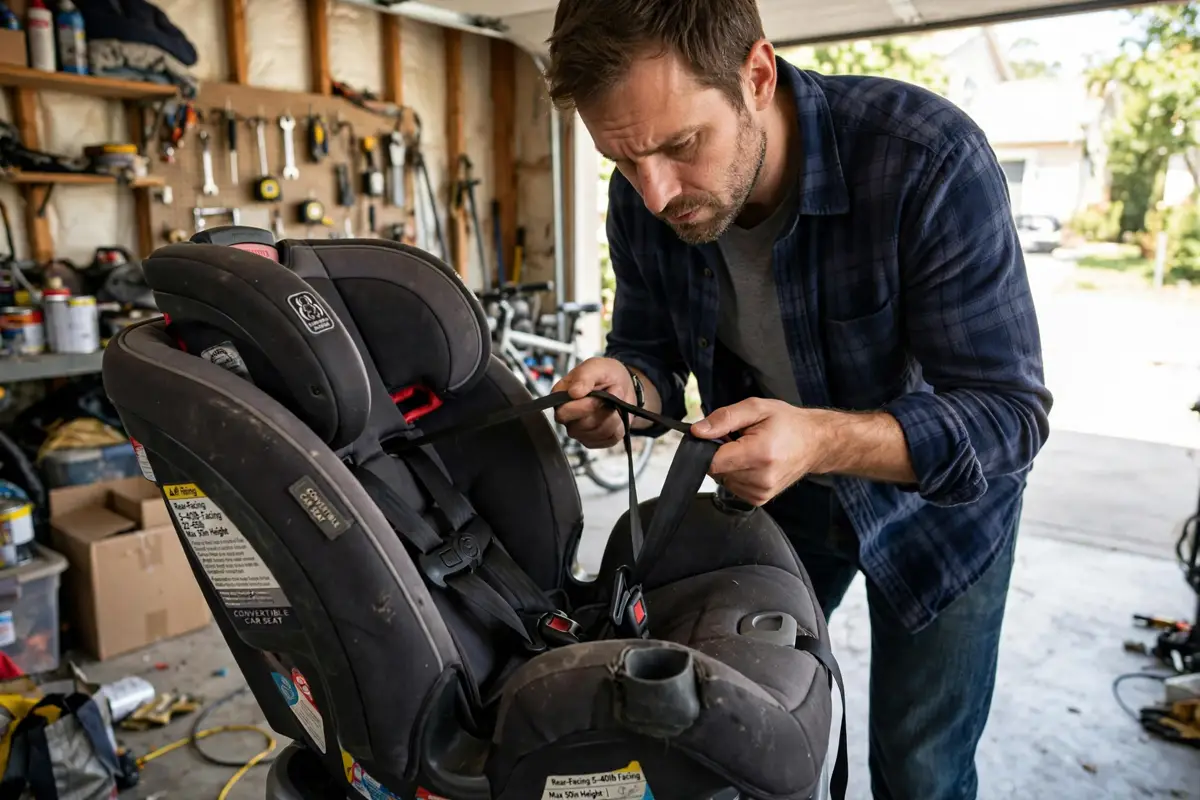
That said, real life is real life. If you are considering a used seat, run it through this checklist. If it fails any single item, walk away.
Secondhand Car Seat Safety Checklist
- Check the expiration date. Find the manufacture date on the sticker and confirm the seat is within its lifespan using the brand table above. If you cannot find or read the date, the seat fails.
- Confirm no crash history. The seat must never have been in anything more than a minor crash. NHTSA’s definition of minor is strict: the vehicle was drivable afterward, the door nearest the seat was undamaged, nobody was injured, the airbags did not deploy, and there is no visible damage to the seat. If the seller cannot answer these questions confidently, walk away.
- Check for recalls. Look up the model number and manufacture date on NHTSA’s recall database. An unaddressed recall is an automatic no. For a walkthrough of how recalls work, see our guide to checking car seat recalls.
- Verify all parts are present. Harness pads, infant inserts, cup holders, the manual. Compare against the manufacturer’s parts list for your model. Missing parts are not just inconvenient, they can make the seat unsafe.
- Inspect the labels. The date of manufacture and model number labels must be present and readable. NHTSA specifically requires these labels on any acceptable used seat.
- Get the manual. You need the instruction book for your exact model. If the seller does not have it, download the PDF from the manufacturer’s website before you even pick up the seat, and read the installation section.
A note on trust: most parents offering a used seat are honest people who genuinely believe it is fine. But “never in a crash” is easy to say and hard to verify, and many people do not realize that even a fender bender counts. If the seat comes from someone you trust completely, like your sister, and it passes every item above, many technicians consider that acceptable. If it comes from a stranger online, the risk calculus is very different.
One more scenario: grandparents’ seats. The seat at grandma’s house that she used for your kids’ cousins twelve years ago is the single most common expired seat in America. It sat in a garage, it looks fine, and nobody thought about the date. Check it before your child rides in it, and read the section below on how to bring this up without starting a family argument.
What to Do With an Expired Car Seat
So the date has passed. Now what? Whatever you do, do not just put the seat on the curb. An expired seat left out for trash can easily be picked up by someone who does not know it is unsafe, and then a child is riding in a seat that should have been retired. Here are your options, from best to last resort.

Trade It In
Twice a year, Target runs its car seat trade-in event, usually once in the spring and once in the fall. Bring any expired, damaged, or old car seat to a participating store and you get a discount, typically 20 percent off, toward a new car seat, stroller, or other baby gear. The program has collected more than 3.8 million car seats since 2016, diverting over 63 million pounds of material from landfills. The materials get recycled into new products.
Walmart has run similar trade-in events in the past, and some local baby stores do their own versions. These programs are the single best option for most families: the old seat is destroyed responsibly, and you save real money on the replacement. For dates, rules, and how the bonus works, see our full guide to car seat trade-in events.
If no trade-in event is running right now, hold onto the seat until the next one. Cut the straps immediately so nobody can use it in the meantime, and store it somewhere out of reach.
Recycle It
Car seats are mostly plastic and metal, which means they are technically recyclable, but curbside programs almost never take them. The straps, mixed materials, and size make them a problem for standard recycling trucks.
Your options: some cities have special car seat recycling drop-offs, often run around Earth Day or during trade-in season. Organizations like TerraCycle have offered car seat recycling in the past. And some local waste authorities accept disassembled seats if you strip them down to clean plastic and metal. It takes effort, so call your local program first and ask exactly what they accept. A quick search for “car seat recycling near me” plus your city name usually turns up current options.
Dispose of It Safely
If trade-in and recycling are not available, dispose of the seat so it can never be used again. This is the part most guides gloss over, but it matters.
- Cut the harness straps. This is the single most important step. Cut every strap on the seat so it is visibly, obviously unusable.
- Remove the cover and padding. Take off anything that makes the seat look complete or appealing.
- Write on the shell. Use a permanent marker to write “EXPIRED, DO NOT USE” in big letters on the plastic.
- Bag it. Put the pieces in a dark trash bag so a curbside picker cannot spot a “free car seat” and grab it.
It feels wasteful, and it is, a little. But an intact expired seat in the trash is a hazard to some other family’s child. Destroying it is the responsible choice.
5 Things Nobody Tells You About Car Seat Expiration
You have the basics now. Here are five things even experienced parents usually do not know, and no competitor article we found covers all of them.
1. Your “Brand New” Seat Might Already Be 2 Years Old
Remember: the clock starts on the manufacture date, not the purchase date. Seats can sit in warehouses and on store shelves for months or even years before someone buys them. Buy a seat that was manufactured 18 months ago and you have lost 18 months of its useful life before your child ever sits in it.
The fix is simple and almost nobody does it. Before you buy, especially online, check the date of manufacture on the box. Most boxes have it printed on a label. If you are buying in a store, ask an employee to check, or look for the box with the newest date. For a seat with a 6-year lifespan, the difference between a fresh box and an 18-month-old box is a quarter of its entire life. That is worth two minutes of checking.
2. What If You Cannot Afford a New Seat?
Let us talk about the question that makes parenting forums heated. New car seats cost real money, and not every family has it when the expiration date arrives. Telling a struggling parent to “just buy a new one” is not advice, it is a lecture. So here are real options.
Safe Kids coalitions across the country run programs that provide free or low-cost car seats to families who need them. Start at safekids.org and find your local coalition. Many hospitals give car seats to families at discharge when there is a demonstrated need, so ask the social worker before you leave the hospital, not after. Target’s trade-in events, covered above, turn your expired seat into a 20 percent discount on the replacement, which can make a mid-range seat genuinely affordable.
What you should not do is keep using the expired seat and hope for the best. If money is the barrier, work the resources above first. And if someone offers you a used seat, run it through the secondhand checklist earlier in this article before you accept it.
3. Two Manufacturer Quirks Worth Knowing
First quirk: Diono counts lifespan from the date of purchase, not the date of manufacture. Every other major brand starts the clock at manufacture. Diono’s approach is unique in the industry, and it is genuinely consumer friendly: if you can prove when you bought the seat, you get the full lifespan from that day. Keep your receipt.
Second quirk: Graco’s lifespan rule is not really about seat type at all. It is about the belt path construction. Seats with a steel-reinforced belt path get 10 years. Seats with a plastic-reinforced belt path get 7 years. Two Graco seats sitting side by side on the shelf can have different lifespans for a reason that has nothing to do with their size or price. No competitor article we found explains this, and it is exactly the kind of detail that matters when you are choosing between models.
4. Expiration and Crash Damage: The Double Rule
Parents constantly mix up these two rules, so let us separate them clearly. Rule one: a seat expires on its expiration date, crash or no crash. Rule two: a seat that has been in a moderate or severe crash must be replaced immediately, expiration date or no expiration date. Either condition retires the seat. Both conditions must be fine for the seat to be safe.
NHTSA does allow one narrow exception to the crash rule. After a minor crash, you may keep using the seat only if all five of these are true: the vehicle was drivable afterward, the door nearest the seat was undamaged, nobody was injured, the airbags did not deploy, and there is no visible damage to the seat. If even one is not true, replace the seat.
Here is the stricter wrinkle: Dorel, the company behind Safety 1st and Maxi-Cosi, goes further than NHTSA and recommends replacing the seat even after a minor crash. When the manufacturer is stricter than the government, follow the manufacturer. Their engineers know their seats best.
5. Grandparents and Daycare Seats: The Hidden Expired Fleet
The expired seats most likely to hold your child are the ones you do not control. Grandma’s spare seat from twelve years ago. The daycare’s field trip seat. The backup seat at your ex’s house. These seats live outside your attention, which is exactly why their dates slip by.
For grandparents, lead with love, not lectures. Try this: “Mom, I just learned car seats expire, and I checked ours. Can we check yours together? I will help find the sticker.” Make it a team project, not an accusation. Offer to split the cost of a replacement, or point them to a trade-in event. Most grandparents want to help, they just do not know the date exists.
For daycare, you have every right to ask. A simple “Can you tell me the manufacture dates on the car seats you use for field trips?” is a reasonable parent question. Licensed facilities should be able to answer it. If they cannot, or if the answer makes you uncomfortable, that tells you something important about the program.
Car Seat Expiration in Special Situations
Expiration rules do not change with the situation, but the situations themselves raise questions the basic guides never answer. Here are the ones parents ask about most.
Flying With a Car Seat
Can you use an expired seat just for the airplane? Parents ask this hoping for a loophole, since a plane feels different from a road. There is no loophole. Turbulence can throw an unrestrained child with real force, and a weakened seat performs no better at 35,000 feet than it does on the highway. The FAA does not publish a separate expiration rule, which means nobody at the gate will check your date. That puts the responsibility entirely on you, and the right call is the same as on the ground: do not fly with an expired seat.
One related tip: if you check a good, unexpired seat as baggage, it can take hard knocks in the cargo hold. Gate-checking is gentler, and a padded travel bag helps. A seat that takes a serious hit in transit should be treated like a seat in a crash: when in doubt, replace it.
Gifting a Car Seat
Car seats are popular baby shower gifts, and a gifted seat follows all the same rules. If you are buying new as a gift, check the date of manufacture on the box before you wrap it, using the warehouse-stock advice from above. Nobody wants to gift a seat that lost a year of life sitting in storage.
If you receive a seat as a gift, check the date before your baby’s first ride, even if the box looks brand new. And never gift a used seat unless it passes every item on the secondhand checklist earlier in this article. A well-meaning gift that turns out to be expired helps no one.
Foster and Adoptive Parents
Agencies sometimes hand foster parents a car seat with the placement, and that seat’s history can be a complete mystery. Check the date the day you receive it. If the sticker is missing or unreadable, treat the seat as expired and ask the agency for a replacement or for help getting one. Do not feel awkward about asking. The agency’s job is the child’s safety, and an unverifiable seat does not meet that bar.
Ask the caseworker for the seat’s manual too, since proper installation matters as much as the date. If the agency cannot provide a safe seat quickly, a local Safe Kids coalition can often bridge the gap with a free or low-cost seat while the paperwork catches up.
Rental Cars and Rented Car Seats
Rental companies will rent you a car seat with the car, and this is one of the riskiest seats your child will ever sit in. You know nothing about it: not its age, not its crash history, not whether all its parts are present, not whether it was ever cleaned with harsh chemicals that weakened the straps. Rental seats live hard lives.
The safest move is to bring your own seat. Most airlines let you check a car seat for free, and many parents gate-check theirs. If bringing your own is truly impossible, inspect the rental seat with the secondhand checklist from this article before your child rides in it, and reject anything you cannot verify. A vacation is not worth a questionable seat.
Expired vs Outgrown: Know the Difference
Parents mix these up constantly, so let us draw a clean line. A seat is expired when it passes its expiration date, regardless of the child’s size. A seat is outgrown when the child exceeds its height or weight limits, regardless of the date. Either condition retires the seat on its own.
The combinations matter. A seat can be outgrown but unexpired: your toddler hit the height limit with three years left on the clock. Time for the next seat type, and the old one may still have life for a younger sibling. A seat can also be expired but not outgrown: the baby still fits, but the date passed. That seat is done even though it looks perfectly usable. Check both the limits in your manual and the date on your sticker, because passing one test does not excuse failing the other.
FAQs
Do car seats really expire?
Yes. The plastic shell weakens from years of heat and cold cycles, the harness webbing and foam wear out, safety standards improve, and manufacturers stop making replacement parts. Every major brand sets a lifespan of 6 to 12 years depending on the model, and safety organizations including the American Academy of Pediatrics say to respect those dates.
Where is the expiration date on a car seat?
Check the white manufacture date sticker on the bottom, back, or side of the seat, sometimes under the fabric cover. Some brands print a “Do Not Use After” date right on the sticker. Others stamp the date into the plastic shell. If you find the manufacture date but no expiration date, add your brand’s lifespan from the table above, or skip the math and use our free expiration checker.
How long are car seats good for?
Most car seats are good for 6 to 10 years from the date of manufacture, depending on the brand and model. Clek seats last a flat 9 years. Graco seats last 7 or 10 years depending on construction. Diono convertibles last 10 years from the date of purchase. Always check your specific seat’s sticker, because the model-level details matter.
How do I know if my car seat is expired?
Find the date of manufacture on the seat’s sticker, add the manufacturer’s stated lifespan for your model, and compare the result to today’s date. If the sticker is missing or unreadable, contact the manufacturer with your model number. When in doubt, assume it is expired and replace it.
What happens if you use an expired car seat?
The seat may not protect your child properly in a crash. Years of heat, cold, and UV exposure weaken the plastic shell, the harness webbing loses strength, and the energy-absorbing foam compresses. None of this is visible, so an expired seat looks fine right up until the moment it has to perform. There are no published statistics on injury rates in expired seats specifically, but the materials science is clear enough that every safety authority treats the date as a hard stop.
Is it illegal to use an expired car seat?
There is no federal law banning the use of an expired car seat. However, most states require seats to be used according to the manufacturer’s instructions, and using a seat past its expiration date violates those instructions. The legal risk is unclear, but the safety risk is not. Replace the seat.
Can I use a car seat after it expires?
No. Replace it as soon as you can. In the meantime, do not let anyone else use it either. Cut the straps so it cannot end up back in circulation, and look into trade-in events or assistance programs to make the replacement affordable.
Do car seat bases expire too?
Yes. Infant seat bases have their own expiration dates, which can differ from the carrier that clicks into them. Britax, for example, gives its infant bases a 6-year lifespan. When you are checking a travel system, check both pieces.
What should I do with an expired car seat?
The best option is a trade-in event, where retailers give you a discount on a new seat and recycle the old one. Second best is a dedicated car seat recycling program. Last resort: destroy the seat so it can never be used again by cutting the straps, removing the cover, marking it “EXPIRED,” and bagging it before disposal.
Can you sell or donate an expired car seat?
Please do not. Selling or donating an expired seat puts another family’s child at risk, and the buyer will have no idea the seat is unsafe. The same goes for leaving it intact on the curb. Destroy it first, always.
How long do Graco car seats last?
Graco seats last 7 or 10 years depending on construction. Seats with a steel-reinforced belt path, including the popular 4Ever DLX, last 10 years. Seats with a plastic-reinforced belt path last 7 years. Check your specific model’s sticker or Graco’s official expiration page at gracobaby.com to be sure.
Why do car seats have expiration dates?
Four reasons: the plastic shell degrades from heat and cold cycling, the straps and foam wear out, safety standards and testing keep improving, and manufacturers eventually stop making replacement parts. The date is the manufacturer’s promise about how long the seat will perform as designed. After that, the promise expires.
Related Guides
- Free Car Seat Expiration Checker: Check Your Seat in 30 Seconds
- Car Seat Trade-In Events: How They Work
- How to Check Car Seat Recalls

Aiden is the founder and editor of CarSeatHaven. He researches NHTSA safety standards, AAP guidance, manufacturer manuals, and recall notices, and turns them into plain-language car seat guides for parents.
