

Table of Contents
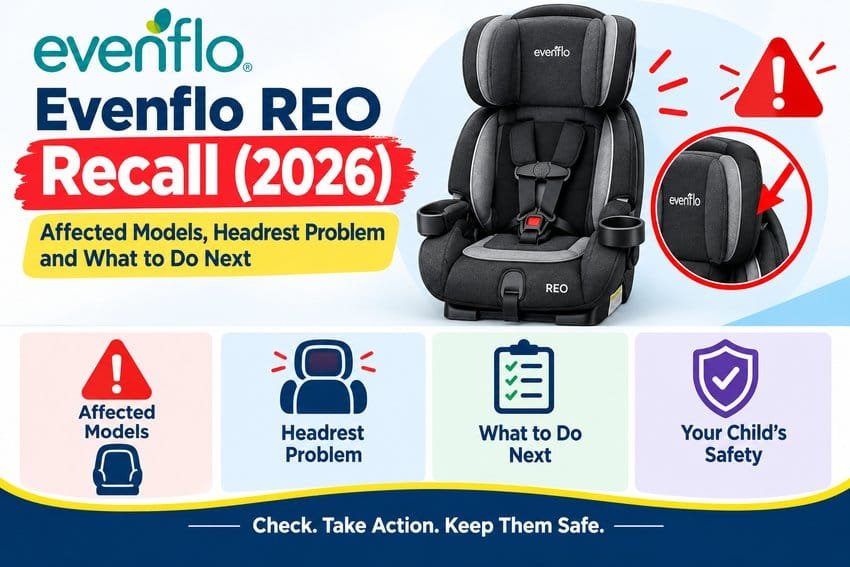
If you own an Evenflo REO, the rotating car seat sold under the Revolve360 name, you have probably seen the recall headlines by now. Take a breath. This guide gives you the three answers you came for, right up front, and then walks through every detail in plain language.
Is my seat affected? Possibly. Evenflo recalled REO seats with model numbers starting with CS26021, built between March 2025 and June 2026 and sold in the United States and Canada. Six US models and two Canadian models are on the list. You will find your model number on the white label on the back of the headrest, and the full list is in a table further down this page.
Can I keep using it? In most cases, yes. Evenflo and the National Highway Traffic Safety Administration (NHTSA) say you can keep using the seat as long as the headrest stays in the lower positions: positions 1 through 10 rear-facing, or positions 1 through 9 forward-facing. The problem only shows up at the very top settings. If your child is tall enough to need one of those top settings, call Evenflo before your next trip, because they will tell you exactly what to do in your situation.
How do I get the fix? The remedy is free, and Evenflo is still building it. The company is developing a fix that reinforces the headrest so it cannot shift. Once it is ready, registered owners get notified and told how to claim it. If your seat is not registered yet, registering it now is the single most useful thing you can do today. It takes a few minutes and it puts you at the front of the line.
Nobody wants to read a recall notice about the seat their child rides in every day. So let us go step by step, with no jargon and no panic, until you know exactly where your family stands.
The Evenflo REO Recall at a Glance
Here are the key facts, all taken from Evenflo’s official recall notice and NHTSA’s recall record.
| Detail | What you need to know |
| Recall name | Evenflo REO recall (REO by Revolve360) |
| NHTSA campaign number | 26C004 |
| The defect | The headrest can shift to a lower position during a crash when set at the highest positions |
| US units affected | 59,661 |
| Canadian units affected | 6,223 |
| Model numbers | Start with CS26021 (full list below) |
| Build dates | March 2025 through June 2026 |
| Injuries reported | None |
| Can you keep using it? | Yes, in headrest positions 1 to 10 rear-facing or 1 to 9 forward-facing |
| The remedy | A free headrest reinforcement fix, still in development |
| Owner letters | Interim letters expected to be mailed starting August 17, 2026 |
| Evenflo US phone | 1-800-233-5921 |
| Evenflo Canada phone | 1-800-265-0749 |
The official record is on NHTSA’s recall page for campaign 26C004, and Evenflo’s own notice is on the REO recall page at evenflo.com. Keep both bookmarked, because those two pages are where any update will appear first.
What Is Actually Wrong With the REO Headrest?
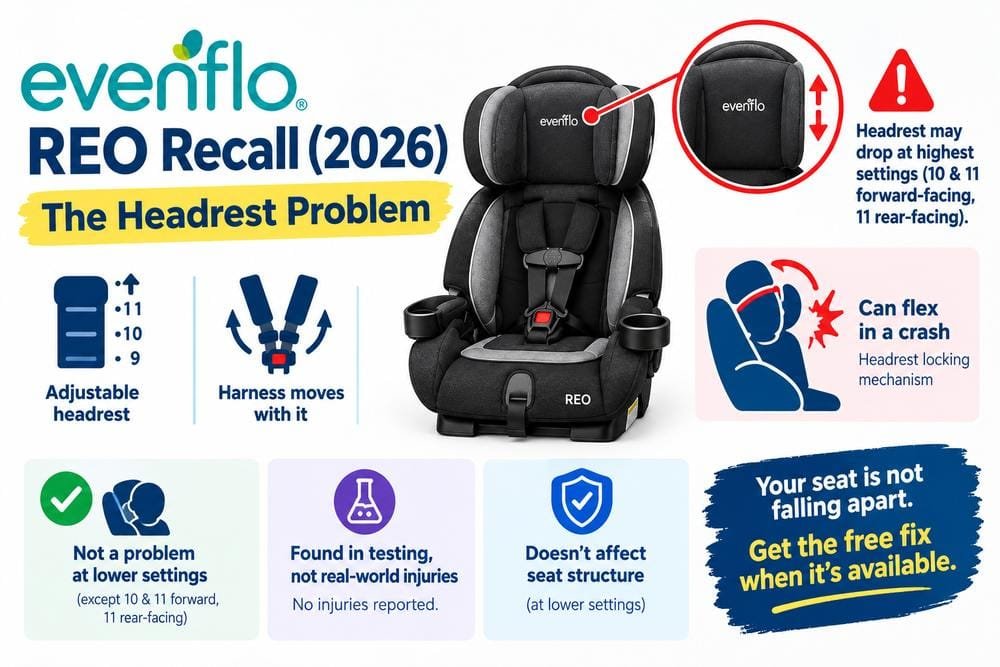
The REO has an adjustable headrest that moves up as your child grows. It clicks through 11 numbered positions, and the harness moves with it, so the straps stay at the right height without any rethreading. That design is convenient, and it is also where the problem lives.
During crash testing, the headrest did not always stay where it was set. When the headrest was raised to its highest settings, the forces in a crash could flex the seat enough for the headrest locking mechanism to let go, and the headrest dropped down into a lower position. NHTSA’s recall record lists the component plainly: the headrest locking mechanism.
Why does a moving headrest matter? Because the headrest and harness work as a team. The harness straps come through the headrest at a height matched to your child’s shoulders, and the headrest itself supports and positions your child’s head. If the headrest suddenly drops in a crash, the harness geometry changes at the exact moment the seat is supposed to be doing its most important job. NHTSA puts the consequence in one short sentence: a headrest that shifts unexpectedly may increase the risk of injury in a crash.
A few things worth knowing so this does not sound scarier than it is:
· The shift was seen only at the top of the range. In forward-facing mode the concern is positions 10 and 11. In rear-facing mode it is position 11 only. At every lower position, Evenflo says the condition does not affect the safety or the structural integrity of the seat.
· This is a compliance failure found in a lab, not a string of real world injuries. The seats fail to meet Federal Motor Vehicle Safety Standard 213, the rule that covers child restraint systems, because of what happened in testing. Evenflo states that no injuries have been reported in connection with this issue.
· The problem was caught by testing, not by parents. NHTSA ran the REO through its compliance testing program, and Evenflo ran its own follow up tests. That is the system working the way it is supposed to work, even if the result is unsettling to read about.
So the honest summary is this: your seat is not falling apart, and it is not dangerous in the settings most families use every day. But at the tallest headrest settings it did not hold its position in a crash test, and that is a real defect that needs the free fix once the fix exists.
Exactly Which REO Seats Are Affected
The recall covers REO seats built from March 2025 through June 2026. Every affected model number starts with CS26021. Color names differ, but the number on your label is what counts, not the color name on the box.
Affected US models
| Model number | Color name | Units |
| CS260212521 | Brookline | 14,622 |
| CS260212522 | Lenox | 14,712 |
| CS260212536 | Holden | 14,215 |
| CS260212537 | Nantucket | 1,710 |
| CS260212538 | Danvers | 12,855 |
| CS260212539 | Chelsea | 1,547 |
Affected Canadian models
| Model number | Color name |
| CS260212521C | Brookline |
| CS260212538C | Danvers |
Canada accounts for another 6,223 seats, bringing the total to just under 66,000 seats across both countries.
Seats that are NOT part of this recall
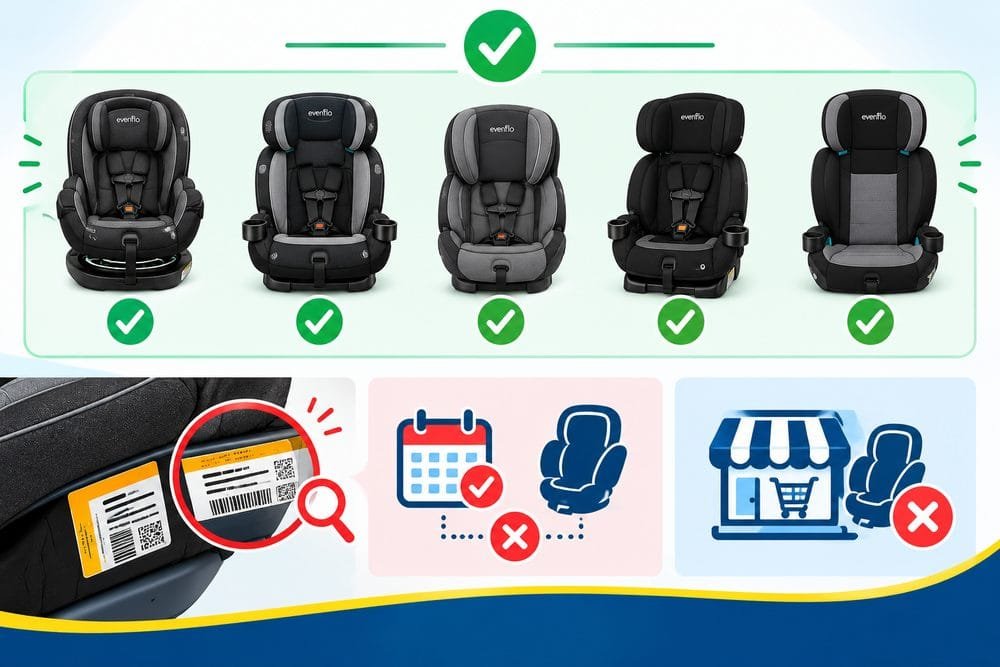
Evenflo is clear that this recall touches the REO and nothing else. The following seats are not included:
· Revolve360 (the original)
· Revolve360 Extend
· Revolve360 Slim
· Revolve180
· Every other Evenflo car seat
If your rotating Evenflo has a different name on it, this is not your recall. Those seats have had their own separate notices in the past, and we have covered two of them here: the Evenflo All4One recall and the Revolve360 Slim foam issue, which we explain inside our Evenflo Revolve360 models comparison. Each recall has its own model list, so always check the number on your own seat rather than going by headlines.
One more point that trips parents up: a seat built inside the date range is only recalled if its model number is on the list above. And a seat with a listed model number is recalled even if you bought it recently, because stores were still selling existing stock when the recall was announced. When in doubt, check the label. The next section shows you how, and it takes about two minutes.
How to Check Your REO, Step by Step
You do not need tools, and you do not need to uninstall the seat for the first check. Here is the whole process.
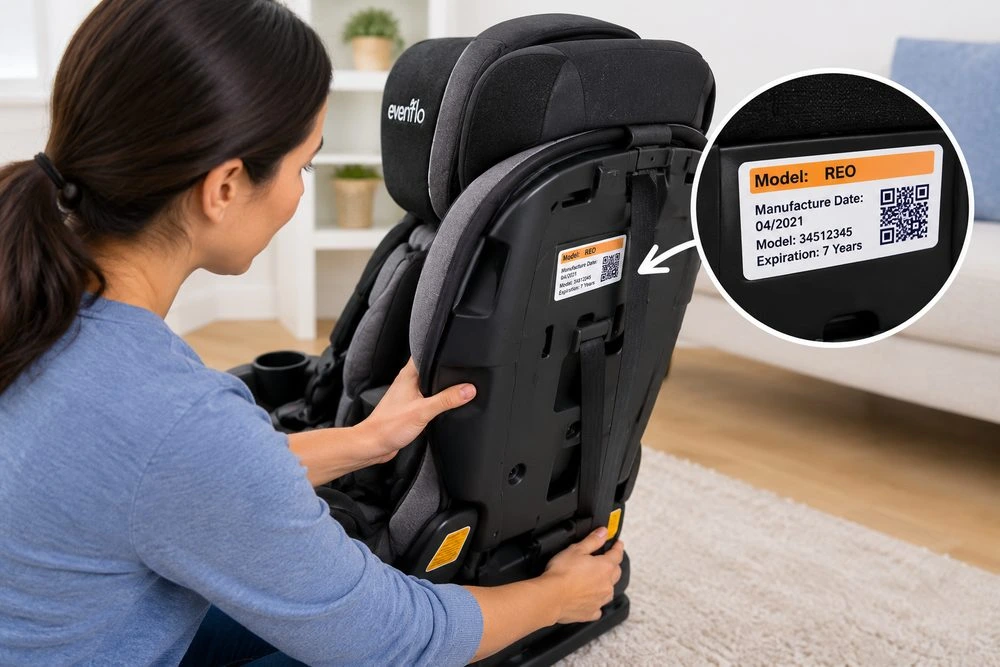
Step 1: Find the white label. The model number and the manufacture date are printed on a white label on the back of the headrest. Raise the headrest, rotate the seat to its side-facing loading position, and look at the back of the shell. Evenflo’s instructions point to the label on the back of the headrest itself, which is why raising it first helps.
Step 2: Read the model number. You are looking for a number that starts with CS26021. If your number starts with anything else, your seat is not in this recall and you can stop here. If it does start with CS26021, compare the full number against the tables above. Canadian models end with the letter C.
Step 3: Check the manufacture date. The same label shows when your seat was built. The recalled run covers March 2025 through June 2026. If your model number matches the list, treat the seat as recalled even if the date is hard to read, and let Evenflo confirm it.
Step 4: Note which headrest position you use. This decides whether you can keep driving with the seat today or need to call Evenflo first. The positions are numbered on the seat itself. Lift the seatback pad and look at the plastic shell: the numbers 1 through 11 are printed on either side of the headrest adjustment panel, and arrows on the headrest panel point to the position currently in use. Write the number down, along with whether you ride rear-facing or forward-facing.
Step 5: Register the seat if you have not already. Registration is how Evenflo knows you exist. Owners who never sent in the registration card and never registered online are the ones who miss recall letters. You can register a US seat at Evenflo’s registration page. Canadian owners register through the ParentLink resource center links on Evenflo’s site. You will need the model number and manufacture date from step 2, which is another reason to do the label check first.
Step 6: Save your proof somewhere. Take a phone photo of the label and keep it. If you ever need to talk to Evenflo, a retailer, or a future buyer about this seat, that one photo answers most questions.
The 2-minute self-check checklist
Short on time? Run through this list and you will know where you stand.
☐ My model number starts with CS26021 (or ends in C for Canada).
☐ My manufacture date falls between March 2025 and June 2026.
☐ I know my current headrest position number.
☐ My headrest is at position 10 or lower rear-facing, or position 9 or lower forward-facing.
☐ My seat is registered with Evenflo under my current address and email.
☐ I saved a photo of the label on my phone.
If every box is ticked, you are in good shape: keep using the seat within the safe positions and wait for the remedy notice. If one of the first two boxes is unticked, your seat is not recalled. If the headrest position box is the problem, read the next two sections carefully before your next drive.
Can You Keep Using a Recalled REO?
For most families, yes. This is the part of the Evenflo REO recall that headlines tend to blur, so here is the precise guidance from Evenflo’s notice.
Rear-facing: you may continue using the seat with the headrest in positions 1 through 10. Only position 11, the very top setting, is off limits.
Forward-facing: you may continue using the seat with the headrest in positions 1 through 9. Positions 10 and 11 are off limits.
Read that again and notice what it means in practice. Babies and toddlers ride low in the seat, so their headrest sits in the lower half of the range. Most preschoolers do too. The families affected by the restriction are the ones with a tall child who has nearly outgrown the seat, because those are the kids using positions 10 and 11.
If your child needs one of the restricted positions, do not just lower the headrest and carry on. A headrest set too low is its own safety problem: the harness straps need to sit at or just below the shoulders for a rear-facing child, and at or above the shoulders for a forward-facing child. Forcing the headrest down to dodge the recall can put the straps in the wrong place. Evenflo’s instruction for this exact situation is to contact ParentLink, their consumer care team, for support. Call 1-800-233-5921 in the US or 1-800-265-0749 in Canada, Monday to Friday, 8 a.m. to 5 p.m. Eastern, or email parentlink@evenflo.com. Tell them your child’s height and weight and the position you need, and let them walk you through your options.
A couple of habits are worth adopting while your seat is under recall:
· Recheck the headrest position after anyone else uses the car. Grandparents, babysitters, and even a helpful partner can raise the headrest while cleaning or adjusting the seat without realizing it matters now.
· Do not lend the seat or pass it on until the remedy is done, and if you do hand it to another caregiver for a day, tell them about the position limit in plain words.
· Keep the seat installed and harnessed exactly as the manual describes. A recall does not change the basics: tight install, snug harness, chest clip at armpit level.
What to Do Next, Step by Step
Once you know your seat is on the list, work through these steps in order.
1. Register the seat today. This is the step that decides whether the free remedy finds you. Go to Evenflo’s car seat registration for US seats, or call ParentLink if the online form gives you trouble. If you registered years ago under an old address or an email you no longer check, register again or call and update it. Evenflo sends recall mail to the address it has, and interim letters for this recall are expected to start going out on August 17, 2026.
2. Set the headrest inside the safe range and confirm the fit. Use the numbered scale under the seatback pad. Then check the harness against your child: straps at or below the shoulders rear-facing, at or above forward-facing, and snug enough that you cannot pinch a fold of webbing at the shoulder. If you cannot get a correct fit inside the allowed positions, stop and call Evenflo instead of improvising.
3. Watch for two letters, not one. The first letter explains the safety risk. A second letter will follow once the remedy is ready, with instructions for getting it. Do not throw the first letter away thinking it is the fix announcement; it is not.
4. When the remedy arrives, follow Evenflo’s instructions to the letter. The fix involves reinforcing the headrest to stop the shift. Evenflo has not yet published the final remedy steps, because the remedy is still in development, and that is normal at this stage of a recall. Whatever form it takes, it will be free. Never pay for a recall remedy, and be wary of anyone who offers to sell you one.
5. Ask about reimbursement if you already paid for a headrest repair. According to the recall reporting, Evenflo will reimburse owners who paid out of pocket to repair the recalled headrest issue between January 1, 2025 and August 1, 2026. If that is you, dig out the receipt and raise it with ParentLink when you call.
6. Do not return the seat to the store. Evenflo’s notice says this directly. Retailers cannot fix it, and handing the seat back can actually slow down your remedy. The store is not part of this process; Evenflo is.
7. Keep your own paper trail. Save the label photo, your registration confirmation, and any letters. If you sell or give away the seat years from now, that folder proves the recall was handled.
If anything about your seat does not match the descriptions here, or you are simply not sure, the NHTSA Vehicle Safety Hotline is 1-888-327-4236 (TTY 1-888-275-9171), and the full official filing is in NHTSA’s acknowledgement letter for campaign 26C004.
What to Do While You Wait for the Fix
Waiting is the frustrating part of this recall. The remedy does not exist yet, and Evenflo has not announced a date for it. Here is how to make the in-between months uneventful.
Do a monthly 30-second check. Once a month, glance at the arrows on the headrest panel and confirm the position has not crept up. Headrests get bumped during cleaning and when kids climb in and out. Thirty seconds, once a month, and you never have to wonder.
Keep your contact details current. If you move house or change email while waiting, update Evenflo. Recall remedies go to the address on file, and a remedy kit sent to an old apartment helps nobody.
Leave the seat installed correctly and resist DIY fixes. You may see social media posts suggesting tape, straps, or aftermarket parts to pin the headrest in place. Do not do it. Anything that changes how the seat is built can change how it behaves in a crash, and no homemade fix has been crash tested. The only remedy that counts is the one Evenflo ships with instructions.
Keep using the seat normally within the allowed positions. There is no need to limit trips, avoid highways, or borrow a different seat for everyday driving if your headrest is in the safe range. Evenflo and NHTSA both describe continued use in those positions as acceptable while the remedy is developed.
Put a note where future-you will see it. A sticky note on the fridge or a calendar reminder in three months is a low effort way to make sure the remedy letter, when it comes, gets actioned instead of buried under school forms and grocery lists. Recall completion rates are low across the whole industry mostly because letters get lost, not because parents do not care.
Bought Your REO Second-Hand, Got It as a Gift, or Lost the Receipt?
Plenty of REO seats did not reach their current owner through a store checkout, and recall coverage does not depend on how the seat came to you. Here is how the common situations play out.
You bought it used or received it from a friend. You still qualify for the free remedy. What matters is the seat itself: the model number and build date on the label. Register the seat under your name now, because the original owner may be the one on Evenflo’s list, and remedy notices go to the registered owner. When you register, you become the contact.
You have no receipt. That is fine for the remedy itself. Registration asks for the model number and manufacture date from the label, not proof of purchase. A receipt only comes into the picture if you are claiming reimbursement for a repair you already paid for, where Evenflo will want some record of what you spent. A card statement showing the repair charge is a reasonable substitute to offer if the paper receipt is gone; ask ParentLink what they will accept.
It was a baby shower or hand-me-down gift. Same process. Check the label, register it in your name, and follow the headrest position guidance. And a gentle safety note that applies to any second-hand seat, recall or not: only use a used seat if you know its full history, it has never been in a crash, it is not expired, and all its parts and labels are present. If you cannot say yes to all four, the seat should not carry your child, and this recall does not change that rule.
You are thinking of selling or donating your REO. Please do not pass on a recalled seat without telling the next family exactly what is going on, and ideally wait until the remedy is installed. A recalled seat with an uncompleted remedy is a problem handed to a parent who may never hear about it. If the seat is expired or has been in a crash, it should be destroyed rather than donated, recall or no recall.
You moved to a different country with the seat. The recall covers seats sold in the US and Canada, and the model lists differ slightly between the two. If your seat was bought in one country and you now live in the other, call the ParentLink line for the country where the seat was sold and explain; they handle cross-border cases regularly.
Already Stopped Using It, or You Need a Working Seat Today?
Some parents read about a crash test failure and simply do not want their child in the seat until it is fixed. That reaction is understandable, and nobody here will argue with it. Here is how to handle the gap safely.
Check the headrest position first. Before you spend money, confirm whether your child actually rides in a restricted position. Most do not. If your child fits correctly in positions 1 to 10 rear-facing or 1 to 9 forward-facing, Evenflo’s guidance is that the seat may keep being used, and replacing it is a choice, not a necessity.
If your child needs position 10 or 11, call Evenflo before buying anything. This is the one group the recall genuinely inconveniences, and Evenflo’s notice specifically invites these families to contact ParentLink for support. Make that call first. It costs nothing, and you will hear your options from the people running the remedy.
If you do buy a replacement, keep the REO and your paperwork. The remedy will still be free when it arrives, and a fixed REO can serve as a second seat for a grandparent’s car later. Store it somewhere dry, keep the label photo, and do not throw away the registration confirmation.
Borrow carefully, if you borrow at all. A loaner seat from a trusted friend is fine if you know its history, it is not expired, it has never been crashed, and it fits your child and your car. Avoid seats from strangers, marketplace listings with no history, and anything with missing labels, because a missing label also means no way to check that seat for recalls.
Do not buy another recalled seat by accident. Whatever you look at, new or used, run its model number through NHTSA’s recall lookup before money changes hands. And if you are shopping for a rotating seat as a replacement, our rotating car seats comparison walks through the main options side by side so you can see how the REO stacks up against the rest of the Revolve360 family and its rivals.
How This Recall Happened: A Short Timeline
Understanding the sequence helps explain why the remedy is not ready yet, and why the letters arrive in two waves.
· March 2025: Production of the seats that would later be recalled begins, and REO seats from this run go on sale in the US and Canada.
· June 15, 2026: During NHTSA compliance testing with a three-year-old crash test dummy, the REO headrest is observed shifting from a higher position to a lower one in testing. The agency’s test program is what surfaces the problem.
· July 12, 2026: After its own investigation, Evenflo decides to recall the seat because of the potential for the headrest latch to disengage when the seat flexes.
· July 17, 2026: Evenflo files its recall report with NHTSA. The campaign is logged as 26C004, covering 59,661 US seats. You can read the filing summary in NHTSA’s acknowledgement letter.
· July 2026: Evenflo publishes its owner notice and confirms that, as of July 23, it knows of no injuries connected to the issue. Canadian models are listed separately, at 6,223 units.
· August 17, 2026: Interim owner letters explaining the risk are expected to begin mailing to registered owners.
· Still to come: Evenflo announces the finished remedy, mails a second round of letters with claim instructions, and ships the free fix to registered owners.
That gap between the recall announcement and the remedy is normal, even though it feels long when it is your seat. The fix has to be designed, tested, and approved before it can go into 66,000 cars, and a rushed remedy that fails its own testing helps no one.
What This Recall Says About Rotating Seats in General
If this is your first rotating seat, the recall might have you wondering whether the whole category is suspect. It is a fair question, so let us answer it plainly.
The REO’s problem is not the rotation. Nothing in the NHTSA filing or Evenflo’s notice criticizes the swivel mechanism, the base, or the install. The failure sits in one specific part, the headrest locking mechanism, on one specific model, at the top of its height range. The other Revolve360 seats, including the original, the Extend, and the Slim, are explicitly excluded from this recall, and rotating seats from other brands are not implicated by it at all.
What the recall does show is something broader and, honestly, reassuring. Federal testers bought or pulled a seat, crash tested it the way they test every seat, found a result they did not like, and the manufacturer recalled nearly 66,000 seats before a single injury was reported. That is the recall system doing its job in public. Every major car seat brand has recalls in its history, including the two other Evenflo recalls we have covered on this site, the All4One recall and the Revolve360 Slim recall. A brand with a recall is not automatically a brand to avoid; what matters is how a company responds, and whether you hear about it in time to act.
Which brings us to the real lesson of the Evenflo REO recall, and it is not about headrests. It is about registration. Evenflo can only write to owners it knows about. Seats bought with cash, received as gifts, or passed between siblings often never get registered, and those are exactly the families who find out about recalls from a headline months later, or never. Whatever seat your child rides in, whatever the brand, register it. It takes minutes, it costs nothing, and it is the difference between a letter in your mailbox and a problem you never hear about.
We will update this article when Evenflo announces the remedy, so check back, and if your seat is affected, complete the steps above today while it is fresh in your mind.
Official sources for this article
· NHTSA recall page, campaign 26C004: https://www.nhtsa.gov/recalls?nhtsaId=26C004000
· NHTSA acknowledgement letter (PDF): https://static.nhtsa.gov/odi/rcl/2026/RCAK-26C004-0949.pdf
· Evenflo’s official REO recall notice: https://www.evenflo.com/pages/reo%E2%84%A2-car-seat-voluntary-safety-recall
· Evenflo car seat registration (US): https://registration.evenflo.com/evenflo/us/carseats
Frequently Asked Questions
Is the Evenflo REO recall the same as the Revolve360 recall I heard about before?
No. They are separate recalls covering different seats and different problems. This one covers only the REO by Revolve360, model numbers starting with CS26021, built from March 2025 to June 2026, and it is about the headrest shifting in a crash. Evenflo’s earlier Revolve360 Slim recall was about headrest foam a child could pick at, and the original Revolve360 and Revolve360 Extend are not part of the REO recall at all. Always go by the model number on your own seat’s label.
Can I still use my REO while I wait for the remedy?
Yes, as long as the headrest stays in the positions Evenflo lists as unaffected: positions 1 through 10 rear-facing, or positions 1 through 9 forward-facing. The defect was only observed at position 11 rear-facing and positions 10 and 11 forward-facing. If your child needs one of those top positions to get a correct harness fit, do not use the seat in a lower position as a workaround. Call Evenflo ParentLink at 1-800-233-5921 (US) or 1-800-265-0749 (Canada) and ask them what to do in your case.
How do I find my REO model number and manufacture date?
Both are printed on the white label on the back of the headrest. Raise the headrest, rotate the seat to the side-facing position, and look at the back of the shell. The label shows the model number and the date the seat was built. Take a photo of it while you are there; you will need those details to register the seat and to confirm whether it falls in the March 2025 to June 2026 build window.
What is the remedy, and when will it be available?
The remedy is a free fix that reinforces the headrest so it cannot shift position during a crash. Evenflo is still developing it, and no release date has been announced yet. Interim letters explaining the risk were expected to start mailing to registered owners on August 17, 2026, and a second letter with claim instructions will follow once the remedy is ready. If your seat is registered with a current address and email, you will hear about it directly. The remedy will not cost you anything; recall remedies never do.
I bought my REO second-hand and have no receipt. Am I covered?
Yes. Recall coverage follows the seat, not the receipt. Check the label for a model number starting with CS26021 and a build date between March 2025 and June 2026, then register the seat in your own name so the remedy notices come to you instead of the previous owner. The only time paperwork matters is if you are claiming reimbursement for a repair you already paid for, where Evenflo may ask for proof of what you spent.
Should I return my REO to Walmart or the store where I bought it?
No. Evenflo’s recall notice tells owners not to return the seat to a retailer. Stores cannot repair it, and the remedy will be handled by Evenflo directly. Keep the seat, keep it registered, use it within the allowed headrest positions, and wait for Evenflo’s remedy letter. If you need help at any point, ParentLink is the right call: 1-800-233-5921 in the US, 1-800-265-0749 in Canada, or parentlink@evenflo.com by email.

Aiden is the founder and editor of CarSeatHaven. He researches NHTSA safety standards, AAP guidance, manufacturer manuals, and recall notices, and turns them into plain-language car seat guides for parents.
