

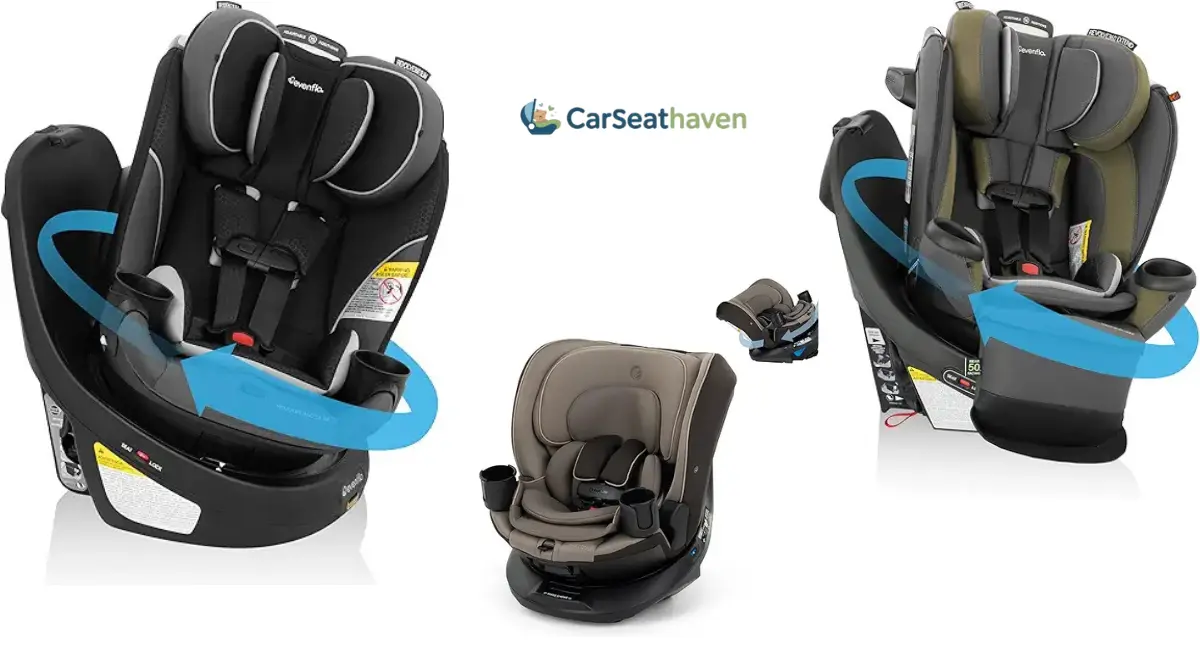
If you are shopping for a rotating car seat in 2026, here is the short answer: the Evenflo Revolve360 Extend is the best rotating car seat for most families. It is the rare affordable seat that combines true 360-degree rotation in both rear-facing and forward-facing modes with a 50-pound rear-facing limit, and the base installs once and never needs to be reinstalled as your child grows. If you drive a small car or need to fit three seats across the back, the Revolve360 Slim gives you the same full rotation and the same 50-pound rear-facing limit in a 16.7-inch-wide body. What matters most in a swivel seat is not the logo on the box. It is the rear-facing weight limit, whether the seat rotates in both modes or only rear-facing, how easy the installation truly is, and whether the seat fits your vehicle. This guide compares every major rotating seat sold in the United States for 2026 with real specs, honest drawbacks, and price ranges, so you can buy with confidence.
What Is a Rotating Car Seat and Who Should Consider One
A rotating car seat, also called a swivel car seat, sits on a base that lets the seat turn toward the car door so you can buckle your child while they face you. When you are done, you spin the seat back into the rear-facing or forward-facing travel position and it locks with an audible click. The idea is simple: loading a baby into a car seat is a twisting, back-straining job, especially in a two-door car, a sedan with a low roofline, or any vehicle where the door opening is tight.
The parents who benefit most are easy to spot. If you have back pain or a C-section recovery, a swivel seat genuinely changes your day. If your garage or parking spot is tight and you cannot open the door all the way, turning the seat toward you is a real help. Grandparents and taller caregivers also tend to love rotation, because the reaching and twisting are what wear people down over months of daily use. If your child is already buckling themselves in forward-facing mode, usually around age five or six, rotation stops mattering much, because you are no longer lifting anyone. And if you plan to move the seat between cars often, most rotating seats are heavy and the rotation mechanism adds bulk, so they are happiest installed in one vehicle and left there.
One thing to get straight early: a rotating seat is not automatically safer than a regular seat. Every car seat sold in the United States must pass the same federal crash standards. Rotation is a convenience feature, and the safety of the seat comes from how it is installed, how the child fits in it, and how long the child stays rear-facing. A correctly installed basic convertible used rear-facing to its limits beats a poorly installed premium swivel seat every time.
How 360-Degree Rotation Mechanisms Actually Work
Not all rotation is the same, and the differences matter more than marketing names suggest. The first thing to check is whether a seat rotates a full 360 degrees in both modes, or whether the rotation is limited to rear-facing mode only. Evenflo’s Revolve360 line, the Safety 1st Turn & Go 360 DLX, and the CYBEX Sirona S rotate fully in both rear-facing and forward-facing modes. The Baby Jogger City Turn and the Evenflo Revolve180 rotate only when rear-facing, which is fine while your child is a baby or toddler but means the feature disappears the day you turn the seat forward.
Each brand engineers the spin differently. Evenflo uses its Sure360 Safety Installation System on the Revolve360 seats: the base installs once with the vehicle belt or LATCH, a LockStrong belt tensioner helps you get it tight, and the seat shell rotates on the base without disturbing the install. A Tether360 top tether is part of the system. Safety 1st uses SafetySwivel 360 on the Turn & Go 360 DLX, with soft locks in the base that hold the seat steady while you buckle, a one-hand release to spin it, and SecureTech red-to-green indicators on the base that show when the belt has proper tension. An attached connection cord means the seat and base must be used together, which is a built-in anti-misuse feature.
Baby Jogger takes a different approach with the City Turn. Its patented 180-degree rotation only works in rear-facing mode, and it is designed to bring the child about ten inches closer to you as it turns, which helps you keep a more upright posture instead of leaning deep into the car. The RAPIDLOCK belt-tensioning base is genuinely quick to install, but you do have to reinstall the seat when you switch from rear-facing to forward-facing. CYBEX’s Sirona S uses an EasyLock bar that reduces the force needed to tighten the vehicle belt up to four times, a load leg that braces against the vehicle floor, and a one-time vehicle belt installation that covers both modes. CYBEX also adds an anti-rebound base and SensorSafe chest clip alerts.
The Evenflo Revolve180 LiteMax NXT sits in its own category. It is a rear-facing-only infant seat with 180-degree rotation on its base, so it competes with infant bucket seats rather than convertibles. It is a good illustration of an important point: rotation mechanisms come in two families, the 360-degree convertible style and the 180-degree infant style, and they serve different stages of your child’s life.
Rotating Car Seats Compared: Head-to-Head Spec Chart
Before the detailed reviews, here is every major rotating seat on the US market for 2026 side by side. Limits are manufacturer ratings, so treat them as maximums, not targets. Prices are approximate ranges at major US retailers, and they move around, so check the current price before you buy.
| Seat | Rotation | Rear-facing limit | Forward-facing limit | Booster mode | Width | Approx. price |
| Evenflo Revolve360 Extend | 360 degrees, both modes | 4 to 50 lb, up to 48 in | 22 to 65 lb, up to 49 in | Yes, 40 to 120 lb | About 19.5 in | About $300 to $400 |
| Evenflo Revolve360 Slim | 360 degrees, both modes | 4 to 50 lb, up to 48 in | 22 to 65 lb, up to 49 in | No | About 16.7 in | Mid $300s to low $400s |
| Evenflo Revolve180 LiteMax NXT | 180 degrees, rear-facing only | 3 to 30 lb, 15.7 to 32 in | Not applicable | No | About 17.8 in | Mid $300s |
| Safety 1st Turn & Go 360 DLX | 360 degrees, both modes | 5 to 40 lb, 19 to 40 in | 22 to 65 lb, 29 to 49 in | Yes, 40 to 100 lb | About 22 to 23 in | About $300 to $350 |
| CYBEX Sirona S 360 | 360 degrees, both modes | 4 to 50 lb | 22 to 65 lb | No | About 20 in | Mid $500s |
| Baby Jogger City Turn | 180 degrees, rear-facing only | 4 to 50 lb | 22 to 65 lb | No | About 19 in | About $550 to $630 |
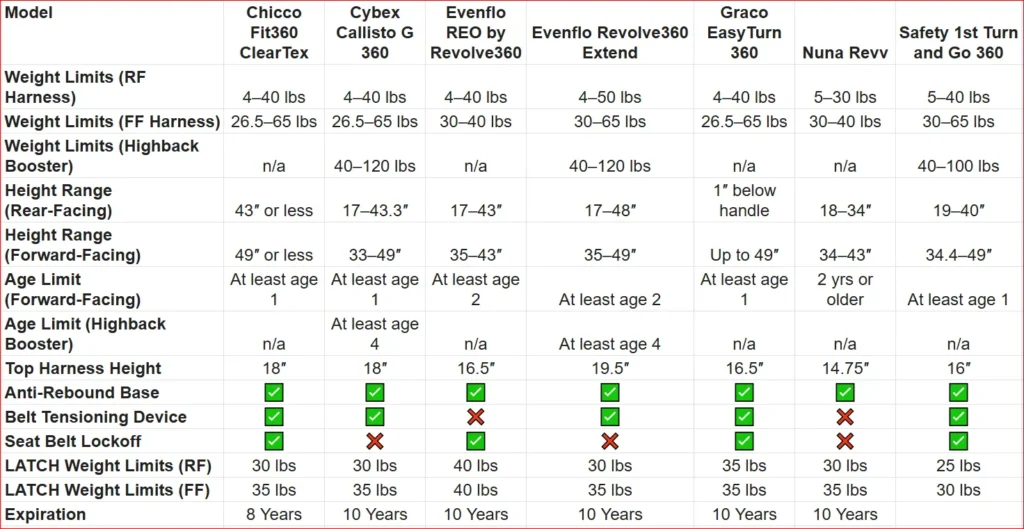
A note on the CYBEX names you may see: in the United States the rotating convertible is sold as the Sirona S 360. In Europe the same family appears as the Sirona T and the newer Sirona G i-Size seats, which use a separate Base G or Base T and are rated for children up to about four years old under European standards. If you are shopping in the US, the Sirona S 360 is the model to compare.
A Quick Word on the Graco SnugRide Turn & Slide Recall
Before the reviews, an accuracy note, because you will see this model mentioned in older comparisons. In April 2026 Graco issued a voluntary recall of select SnugRide Turn & Slide rotating infant seats after a structural issue was found in post-production laboratory testing. According to the National Highway Traffic Safety Administration, about 5,126 seats were affected, and the concern was that the infant carrier could detach from the base in a crash. This was a structural issue, not a choking hazard, despite some sloppy reporting that said otherwise.
The recall covered SnugRide Turn & Slide products manufactured between December 2025 and March 2026 and sold from January through March 2026 at Amazon, Babylist, Target, Walmart, and GracoBaby.com. Graco offered a free replacement seat to affected owners, and the seat could still be used safely in the meantime if installed with the vehicle seat belt without the base. No other Graco rotating seats were affected, including the Turn2Me and EasyTurn models, and no other SnugRide models were included. If you already own a Turn & Slide, check the model and serial numbers on the label against Graco’s recall page before continuing to use it.
The Best Rotating Car Seats of 2026, Reviewed in Detail
Each review below covers real specs, what the seat does well, and where it falls short. No seat is perfect, and the honest drawbacks matter more than the marketing bullet points when you are spending this much money.
Evenflo Revolve360 Extend: The Best Rotating Car Seat for Most Families
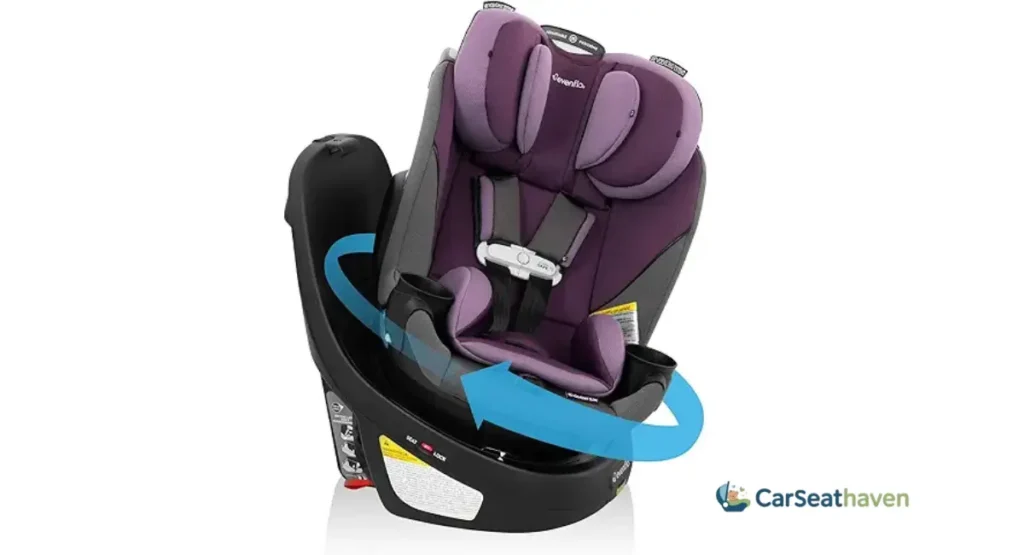
The Revolve360 Extend is the seat that made rotation mainstream, and it remains the best all-around pick in 2026. It supports rear-facing from 4 to 50 pounds and up to 48 inches, forward-facing from 22 to 65 pounds, and then converts to a high-back booster from 40 to 120 pounds. That is a full decade of use in one seat, and the 50-pound rear-facing limit is rare among rotating seats. It rotates a full 360 degrees in both rear-facing and forward-facing modes, so the feature you paid for does not vanish when you turn the seat around.
Installation is one of the Extend’s strongest points. The Sure360 base installs once, with either the vehicle belt (the LockStrong tensioner does most of the work) or LATCH, and you never reinstall it when changing modes. An anti-rebound bar is included, the seat is FAA approved for aircraft use in harness mode, and Gold trims add SensorSafe chest clip alerts plus machine-washable quick-clean covers. It weighs about 29.5 pounds and measures about 19.5 inches wide.
The honest drawbacks: it is bulky. At nearly 20 inches wide and fairly deep front-to-back, it can eat into front passenger legroom in small cars and it is not a 3-across seat. It is heavy enough that you will not want to move it between vehicles regularly. And the LATCH weight limits are lower than some parents expect, so many families will need to switch to a vehicle belt install earlier than they assumed. Check the manual and do the math with your child’s weight.
If you want the full breakdown of how the Extend differs from the Slim and the older models, we have a dedicated Evenflo Revolve360 models comparison that walks through every trim.
Evenflo Revolve360 Slim: Best for Small Cars and 3-Across
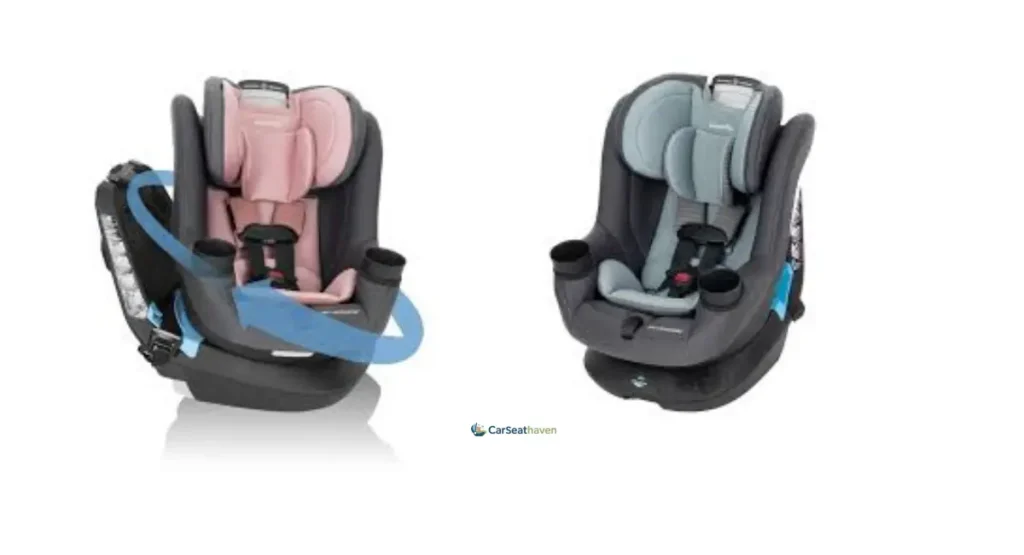
The Revolve360 Slim is the answer to the Extend’s biggest weakness. It keeps the full 360-degree rotation in both modes and the same 50-pound rear-facing limit, but the body is trimmed to about 16.7 inches wide. That makes it one of the few rotating seats that can realistically work in tight backseats and in three-across setups. It covers rear-facing from 4 to 50 pounds and forward-facing from 22 to 65 pounds, with the same install-once Sure360 base, LockStrong tensioner, anti-rebound bar, and FAA approval as its bigger sibling.
What you give up: there is no booster mode, so the seat maxes out at 65 pounds forward-facing and you will need a separate booster later. The narrower shell also means slightly less side room for broad-shouldered toddlers, and some parents find the harness adjustment a little fussier than on the Extend. But for families with compact cars, multiple children, or a second vehicle that is on the small side, the Slim is often the only rotating seat that actually fits.
A recall note for buyers: in September 2025, NHTSA recall 25C010 covered certain Revolve360 Slim and Gold Revolve360 Slim seats manufactured between December 1, 2022 and December 8, 2024 (model numbers beginning 3681), because a child could pick loose pieces of headrest foam, creating a choking hazard. Evenflo provided free repair kits to block access to the foam. The issue does not affect crash performance, and it does not affect the Revolve360, the Revolve360 Extend, or new Slim models with numbers beginning CS2601 or 3682. If you buy used, check the model number and manufacture date on the seat label first.
Evenflo Revolve180 LiteMax NXT: Best Rotating Infant Seat
The Revolve180 LiteMax NXT plays a different game. Instead of a convertible that lasts for years, it is a rear-facing-only infant seat with 180-degree rotation on its base, rated for babies from 3 to 30 pounds and 15.7 to 32 inches tall. The one-hand spin makes getting a newborn in and out far easier, and the seat itself is light at about 8.6 pounds, so it works the way a traditional infant bucket seat does.
It is loaded with Evenflo’s newer tech: SensorySoothe lights, music, and sounds built into the handle to help calm babies, SensorSafe alerts for temperature and unbuckling, the LockStrong belt tensioning system for a secure base install, and GREENGUARD Gold certified fabrics with no added flame retardants. An optional SafeZone load leg can be added for extra stability. The trade-off is the short lifespan. Most babies outgrow 30 pounds well before their first birthday ends, so you will be buying a convertible seat within a year. It also does not attach to a stroller as a travel system in the usual way, so check compatibility with your stroller before assuming it will.
A recall note for buyers: in August 2026, Evenflo recalled about 22,981 Revolve180 LiteMax NXT seats because the level indicator on the rotating base could show an acceptable recline when the seat was actually positioned more upright than intended. Only the rotating base is affected, and only on units manufactured before April 1, 2025; the infant carrier itself is not part of the recall. Evenflo is providing a free repair kit. If you buy new stock, confirm the manufacture date on the base label.
Safety 1st Turn & Go 360 DLX: Best Budget Rotating All-in-One
The Turn & Go 360 DLX is the value play in this category, and it is more capable than its price suggests. It rotates a full 360 degrees in all three modes: rear-facing from 5 to 40 pounds, forward-facing from 22 to 65 pounds, and belt-positioning booster from 40 to 100 pounds. One base install covers all three modes, the SafetySwivel mechanism has a simple one-hand release, and the SecureTech red-to-green tension indicators take guesswork out of the belt install. The DLX trim adds a magnetic chest clip, a 10-position headrest, and machine-washable dryer-safe fabrics.
The honest drawbacks start with the 40-pound rear-facing limit. That is a real step down from the 50-pound limits on the Evenflo and CYBEX seats, and for a tall toddler it can mean turning forward months earlier than you would with a 50-pound seat. It is also wide, roughly 22 to 23 inches, and heavy at around 38 pounds, so forget 3-across and forget moving it between cars. The fabrics and padding feel a step below the premium brands, which is fair at this price, but worth knowing. Still, if your budget tops out around $300 to $350 and you want rotation plus an all-in-one lifespan, this is the seat to look at.
CYBEX Sirona S 360: Best Premium Pick for Installation Confidence
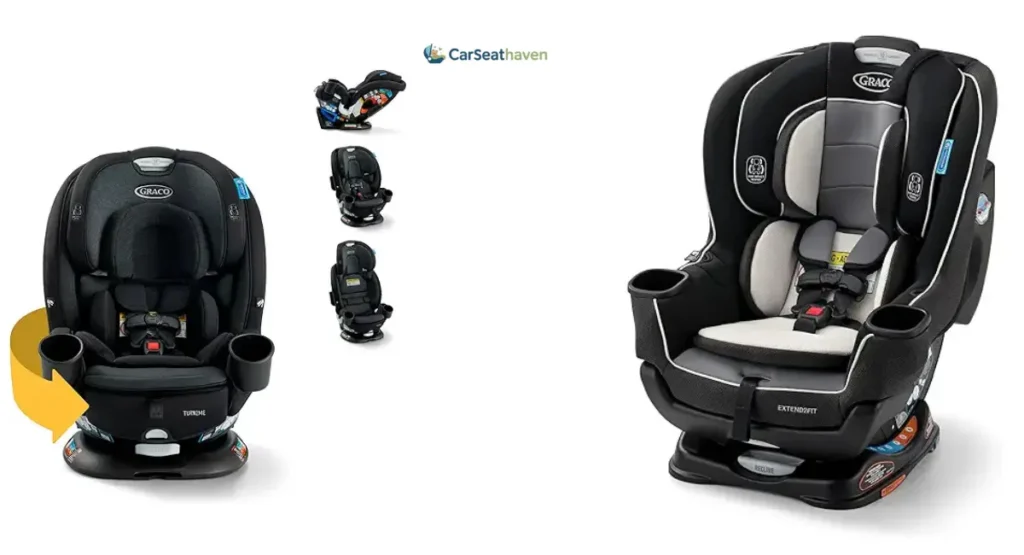
The Sirona S 360 is the premium European-engineered option, and its headline feature is not really the rotation, it is the installation system. The EasyLock bar reduces the force needed to get a tight vehicle belt install by up to four times, the load leg braces against the vehicle floor to reduce crash rotation, and the one-time vehicle belt installation covers both rear-facing and forward-facing modes. It rotates a full 360 degrees with one hand in both modes, supports rear-facing from 4 to 50 pounds and forward-facing from 22 to 65 pounds, and includes Linear Side-impact Protection, an anti-rebound base, a 12-position no-rethread headrest, magnetic buckle holders, and the SensorSafe smart chest clip.
What holds it back: the price, usually in the mid $500s, puts it at the top of this list. It is also a complex seat to install the first time, so budget extra time and read the manual carefully, especially the load leg setup. Like most CYBEX seats, the LATCH limits are conservative, with no LATCH use above 30 pounds of child weight rear-facing or 35 pounds forward-facing, so most families will install with the vehicle belt. And while the fabrics feel premium, the seat does not convert to a booster, so its usable life ends at 65 pounds.
Baby Jogger City Turn: Best for Easy Install and Hot Climates
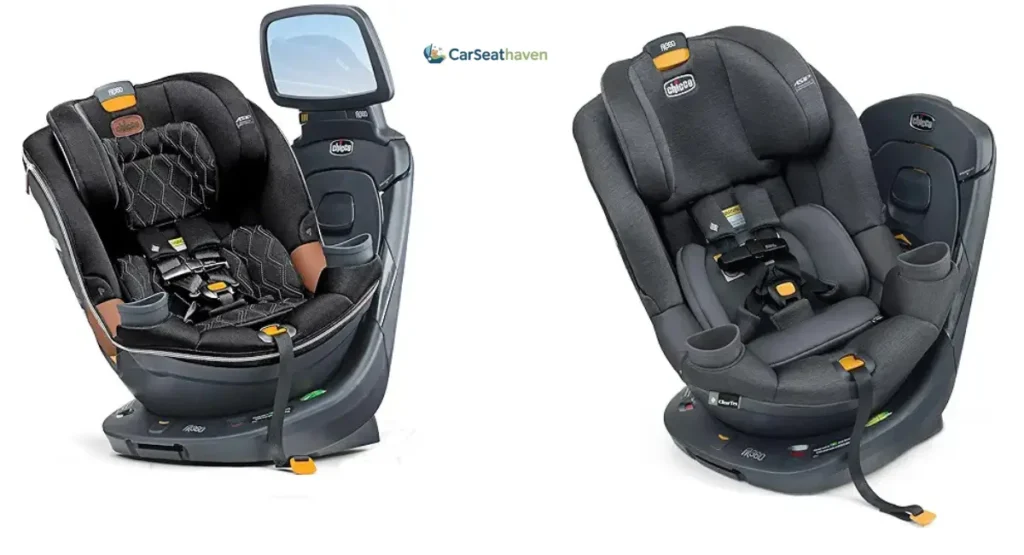
The Baby Jogger City Turn is the outlier in this group because it only rotates in rear-facing mode. The patented 180-degree mechanism brings your child about ten inches closer to you as it turns, which is genuinely easier on your back than a pure spin, and it locks with an audible click. It is a convertible, not an all-in-one: rear-facing from 4 to 50 pounds and forward-facing from 22 to 65 pounds, with no booster mode. The 50-pound rear-facing limit matches the best in class, which is impressive for a seat at this price point.
Its two real strengths are installation and fabrics. The RAPIDLOCK base belt-tensioning system is one of the easiest installs in any category, and because the seat rotates toward you, you get clear access to the belt path during installation. The COOLMAX moisture-wicking fabrics genuinely help in hot climates, and the seat meets Baby Jogger’s TRUE Test Plus standards for rollover, side, front, and rear impacts, with a steel-reinforced frame and EPP foam. It weighs about 28 pounds and measures about 19 inches wide.
The drawbacks are the rotation limit and the reinstall. Once you turn the seat forward-facing, it does not rotate at all, and switching modes requires a full reinstall. At around $550 to $630 it costs more than the Revolve360 Extend while offering less rotation, so the value case rests entirely on the easier install, the cooling fabrics, and the 50-pound rear-facing limit. If you live somewhere hot and install seats with dread, that trade can make sense.
Honorable Mentions Worth Knowing About
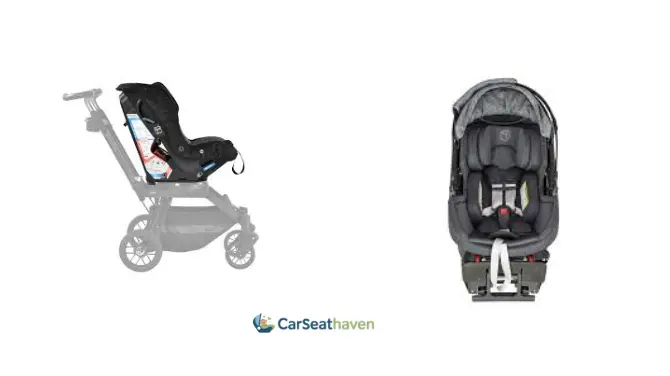
Two more seats come up in almost every rotating seat conversation. The Graco Turn2Me is a budget-friendly swivel option with about 190 degrees of rotation and a rear-facing limit of 4 to 40 pounds. It is a simpler, cheaper way into rotation, but the 40-pound rear-facing cap and partial rotation make it a compromise. The Nuna REVV is the luxury 360-degree option, with premium fabrics and a true 360 spin, but rear-facing only to 40 pounds and a price well above the Evenflo seats. Neither one displaces the picks above for most families, but they are worth a look if you are loyal to Graco or Nuna.
Rotating Seats vs Standard Convertibles: Which Is Better
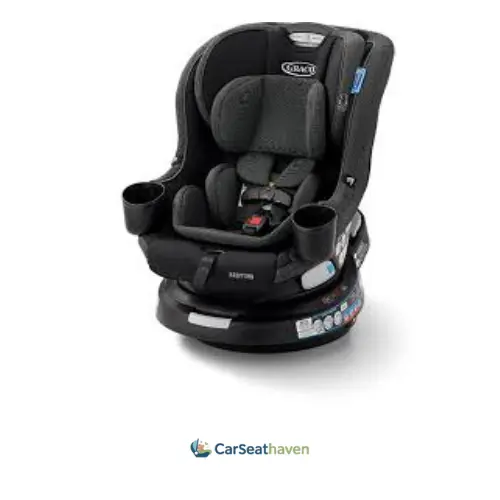
A rotating seat and a standard convertible do the same safety job. The difference is entirely about your daily experience and your vehicle. Rotation shines during the rear-facing years, when you are lifting a heavy baby into a seat several times a day. It matters less as your child grows, and it stops mattering the day your child can climb in and buckle up alone.
Standard convertibles win on several fronts. They are usually lighter, narrower, and cheaper than their rotating counterparts. They fit better in small cars and in three-across setups. They have fewer moving parts, which means fewer things to misunderstand in the manual. And many of the best standard convertibles, like the Britax One4Life or the Graco Extend2Fit, also offer 50-pound rear-facing limits at lower prices than any rotating seat. If your budget is tight or your car is small, a great standard convertible used rear-facing to its limits is a better safety value than a budget rotating seat with a 40-pound rear-facing cap.
Rotating seats win on one thing, but it is a big thing: the twice-a-day loading ritual gets dramatically easier. For parents with back injuries, C-section recoveries, twins, or tight parking situations, that convenience is not a luxury, it is the difference between a manageable routine and a miserable one. Buy the rotation for the years you will actually use it, and weigh the rear-facing limit just as heavily as the spin.
Installation Notes and Common Mistakes
Rotating seats are more complex than standard seats, and complexity creates mistakes. These are the ones that show up most often, and all of them are avoidable.
- Driving with the seat rotated. The seat must be locked in the rear-facing or forward-facing travel position before the car moves. Rotation is for loading only. Every seat in this guide locks with an audible click or visual confirmation, and you should check it every single time.
- A loose install. The base should move less than one inch side to side at the belt path. Rotating seats are heavy, and a heavy seat on a loose base is a bad combination. Use the tensioning system your seat provides, whether that is Evenflo’s LockStrong, Baby Jogger’s RAPIDLOCK, Safety 1st’s SecureTech indicators, or CYBEX’s EasyLock bar, and recheck tightness monthly.
- Exceeding LATCH weight limits. Lower anchors have child weight limits that vary by seat, often 30 to 40 pounds depending on the model and mode. Once your child passes the limit in the manual, switch to a vehicle belt install. This catches families by surprise on almost every seat in this category.
- Wrong recline angle. Rear-facing seats need the correct recline for the child’s age, and rotating seats have level indicators for a reason. Newborns need a more reclined angle to keep the airway open, while older toddlers can sit more upright. Check the indicator after every reinstall.
- Reinstalling when you do not need to. On the Revolve360 seats, the Turn & Go, and the Sirona S, the base installs once and the seat changes modes on the base. Reinstalling from scratch each time invites errors. On the Baby Jogger City Turn, you do need to reinstall when switching modes, so follow that manual exactly.
- Skipping the top tether forward-facing. The top tether reduces forward head movement in a crash, and every forward-facing harnessed seat in this guide should be tethered. The visual tether indicator on the Turn & Go exists because parents forget this step.
- Leaving the load leg or anti-rebound bar unused. If your seat comes with a load leg (Sirona S, optional on the Revolve180) or an anti-rebound bar (Revolve360 seats), use it. These features only help when they are actually deployed.
Safety Notes: Rear-Facing Longer, Top Tethers, and Aftermarket Gear
The single most important safety decision you will make has nothing to do with which brand you buy. Both the American Academy of Pediatrics and the National Highway Traffic Safety Administration advise keeping children rear-facing as long as possible, until they reach the maximum height or weight limit of their seat. The AAP recommends rear-facing until at least age two and longer if the seat allows, and NHTSA’s guidance is to keep children in each restraint type for as long as they fit within the manufacturer’s limits before moving up. Rear-facing spreads crash forces across the child’s back and dramatically reduces stress on the neck and spine. This is exactly why a 50-pound rear-facing limit matters so much in this category: it is the difference between turning forward at age two and staying rear-facing until age three or four.
A few more non-negotiables. Use the top tether for every forward-facing harnessed ride. Never place a rear-facing seat in front of an active airbag. Skip aftermarket inserts, strap covers, head supports, and seat protectors that did not come with your seat or are not explicitly approved by the manufacturer, because they can compress in a crash and introduce slack, and they void the seat’s testing. Dress your child in thin layers and put the coat on backwards over the harness rather than buckling over a puffy jacket. Register your seat with the manufacturer so recall notices reach you, and check the NHTSA recall database if you buy secondhand, though buying a used seat with unknown history is something safety experts recommend against.
Price and Value Tiers
Rotating seats cost more than standard convertibles, and the price spread within the category is wide. Here is how the value breaks down at typical 2026 street prices, with the reminder that sales move these numbers and you should always check the current price.
- Budget, around $300 to $350: the Safety 1st Turn & Go 360 DLX. You get full 360 rotation and an all-in-one lifespan for the lowest price in the category, but you accept a 40-pound rear-facing limit and a wide, heavy body.
- Mid-range, mid $300s to low $400s: the Evenflo Revolve360 Slim and Extend. This is the sweet spot. The Extend adds a booster mode and the Slim adds a narrow footprint, and both give you 50-pound rear-facing with full rotation.
- Premium, mid $500s to low $600s: the CYBEX Sirona S 360 and Baby Jogger City Turn. You are paying for installation engineering, premium materials, and brand-specific features like the load leg or COOLMAX fabrics, not for fundamentally more safety.
The honest value math: a mid-range rotating seat with a 50-pound rear-facing limit usually beats a premium seat with a 40-pound limit on the metric that matters most, which is how long your child can stay rear-facing. Spend extra for features you will feel every day, like an easier install or cooling fabrics, not for a fancier box.
Vehicle Fit, Travel, and Cleaning Notes
A rotating seat that does not fit your car is an expensive mistake, and these seats are some of the widest and deepest on the market. Before you buy, measure your backseat width and check how much room the seat will need front-to-back when rear-facing at the correct recline angle. The Revolve360 Extend and the Turn & Go are the bulkiest of the group, and in a compact sedan they can force the front passenger seat uncomfortably far forward. The Revolve360 Slim is the clear winner for tight cars at 16.7 inches wide.
Three-across is the hardest fit of all. Most rotating seats are simply too wide, and rotation needs clearance on the door side to spin. If three-across is your goal, the Slim is the only rotating seat with a realistic chance, and even then you should test the actual combination before committing. If it does not work, a slim non-rotating convertible is usually the practical answer: seats like the Graco SlimFit3 LX were designed specifically for narrow spaces. For a clear-eyed look at what three-across actually requires, and what does not, see our myth-busting guide to 3-across car seats.
For air travel, the Revolve360 Extend and Slim are FAA approved for use in harness mode, which is a genuine plus if you fly with a toddler. But at nearly 30 pounds, neither is fun to carry through an airport, and rotation mechanisms add weight you will feel on your shoulder. Lighter standard convertibles or a dedicated travel seat are usually better flying companions. Always confirm FAA approval in your specific seat’s manual and check your airline’s policy before you fly.
Cleaning is a daily reality with car seats, so it deserves a mention. The Revolve360 Gold trims and the Turn & Go DLX have machine-washable covers, and several seats in this group have dishwasher-safe cup holders, which is a small feature you will appreciate more than you expect. As a rule, harness straps should only be wiped clean, never machine washed or soaked, because harsh cleaning can weaken the webbing. When in doubt, the care label on your seat outranks any general advice.
Who Should Buy a Rotating Seat, and Who Should Skip It
Buy a rotating seat if: you lift a baby into the car multiple times a day and your back, shoulders, or recovery are feeling it; you park in tight spots where the door barely opens; you have a tall vehicle with a high lift-over; you are a grandparent or caregiver who finds the twisting motion difficult; or you simply value a smoother daily routine enough to pay the premium. In these cases the feature earns its price every single day.
Skip it if: your budget is tight, because a great standard convertible with a 50-pound rear-facing limit protects your child just as well for less money; your car is small and the seat you want will not fit without crushing the front passenger; you move the seat between vehicles often, since rotating seats are heavy and happiest installed once; your child is already forward-facing and buckling independently, because rotation’s best years are behind you; or you need three-across and the rotating options will not fit. There is no shame in a standard seat. The safest seat is the one that is installed correctly and used rear-facing to its limits.
Rotating Car Seat FAQs
Are rotating car seats as safe as regular car seats?
Yes. Every car seat sold in the United States must meet the same federal crash test standards, rotating or not. Safety comes from correct installation, correct fit, and keeping your child rear-facing to the seat’s limits, not from the rotation mechanism. A rotating seat does not make a child safer by itself, and a standard seat is not safer by default. What matters is how you use it.
What is the best rotating car seat for a newborn?
For a newborn, you have two good paths. The Evenflo Revolve180 LiteMax NXT is a rear-facing-only infant seat with 180-degree rotation, rated from 3 to 30 pounds, and it works like a traditional bucket seat for easy carrying. Alternatively, the Revolve360 Extend or Slim can be used from 4 pounds and will last for years, including a 50-pound rear-facing limit, so you skip the infant seat stage entirely. The convertible route saves money long term; the infant seat route is easier for carrying a sleeping baby.
Can you rotate the seat while driving?
Never. Rotation is for loading and unloading only, with the vehicle parked. The seat must be locked into the rear-facing or forward-facing travel position before the car moves. Every seat in this guide has a locking mechanism with an audible click or visual indicator, and you should verify it every time you spin the seat back.
Do rotating car seats work in small cars?
Some do. The Evenflo Revolve360 Slim, at about 16.7 inches wide, is the best rotating option for compact cars and tight backseats. The Extend, the Turn & Go, and the Sirona S are wider and deeper, and rear-facing they can eat into front passenger legroom in a small sedan. Measure your backseat and test the fit if you possibly can before buying.
Can I use a rotating car seat on an airplane?
Some of them, in harness mode. The Revolve360 Extend and Slim are FAA approved for aircraft use, which means you can install them on the plane seat with the lap belt. Always confirm approval in your specific seat’s manual, because approval can vary by mode, and check your airline’s policy before you fly. Be warned that rotating seats are heavy, so they are not the most pleasant travel companions.
How long can my child stay rear-facing in a rotating seat?
It depends on the seat’s limits, which is why the limit matters so much. Seats like the Revolve360 Extend, Revolve360 Slim, Sirona S, and Baby Jogger City Turn allow rear-facing to 50 pounds, which typically keeps an average-sized child rear-facing until age three or four. Seats with 40-pound rear-facing limits, like the Turn & Go and the Revolve180’s infant range, will turn a tall toddler forward sooner. Both the AAP and NHTSA advise keeping children rear-facing as long as possible within the seat’s limits.
What happened with the Graco SnugRide Turn & Slide recall?
In April 2026 Graco voluntarily recalled about 5,126 SnugRide Turn & Slide rotating infant seats after post-production lab testing found a structural issue: the carrier could detach from the base in a crash. Affected seats were manufactured between December 2025 and March 2026. Graco offered free replacements, and the seat could be used safely without the base, installed with the vehicle seat belt. No other Graco rotating seats, including the Turn2Me and EasyTurn, were affected. If you own one, check your model and serial numbers against Graco’s recall page.
Should I get the Revolve360 Slim or the Revolve360 Extend?
Get the Slim if space is tight: it is 16.7 inches wide versus the Extend’s 19.5, which makes it the better choice for small cars and possible three-across setups. Get the Extend if you want maximum lifespan: it adds a high-back booster mode (40 to 120 pounds) that the Slim lacks. Both rotate fully in both modes and both rear-face to 50 pounds, so you are not sacrificing the important specs either way.
Do rotating car seats have a booster mode?
Some do. The Revolve360 Extend converts to a high-back booster from 40 to 120 pounds, and the Safety 1st Turn & Go 360 DLX becomes a belt-positioning booster from 40 to 100 pounds. The Revolve360 Slim, Sirona S, City Turn, and Revolve180 do not have booster modes, so you will need a separate booster when your child outgrows the harness. If you want one seat to truly do it all, check for the booster mode before you buy.
Are swivel car seats worth the extra money?
They are worth it if you will use the rotation daily during the rear-facing years and the seat fits your car and budget. For parents with back pain, tight parking, or a recovery to heal from, the convenience is transformative. They are not worth it if the premium forces you into a seat with a lower rear-facing limit than a cheaper standard convertible, or if the seat will not fit your vehicle. Spend for the rotation and the rear-facing limit together, not for one at the expense of the other.
Choosing the best rotating car seat comes down to an honest look at your car, your child, and your daily routine. Prioritize the rear-facing limit first, the rotation mechanism second, and the install quality third, and you will end up with a seat that makes the next few years genuinely easier. Whichever seat you choose, install it carefully, keep your child rear-facing as long as the seat allows, and register it with the manufacturer so you never miss a recall notice.

Aiden is the founder and editor of CarSeatHaven. He researches NHTSA safety standards, AAP guidance, manufacturer manuals, and recall notices, and turns them into plain-language car seat guides for parents.
