


The Graco SlimFit3 LX is a narrow all-in-one car seat that carries one child from newborn to booster age in a shell just 16.7 inches wide. If you need to fit three car seats across one row, or you drive a smaller car and still want a seat that lasts from rear-facing to a highback booster, it is one of the strongest value picks on the market. This guide covers the real specs, how it installs, how it stacks up against the wider Graco SlimFit 3-in-1 and rivals like the Chicco Fit3x, Clek Fllo, and Diono Radian 3R, and answers the questions parents ask most before buying.
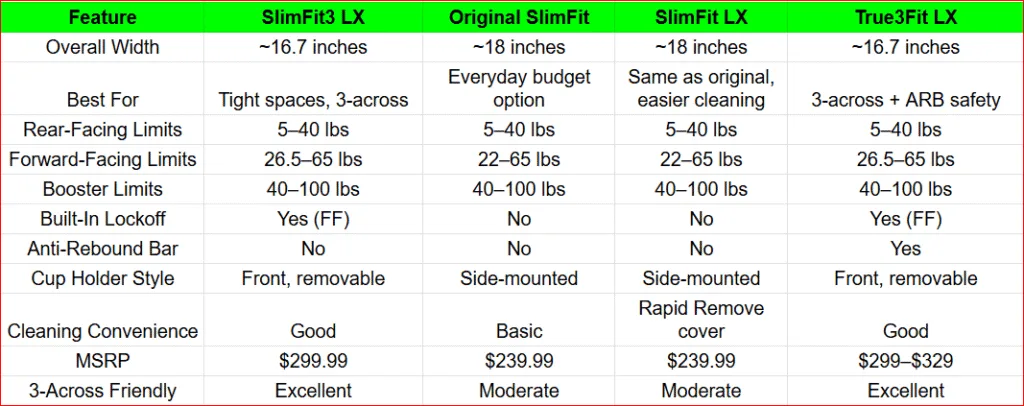
Before you buy, one naming warning: Graco sells several seats with almost identical names. The SlimFit3 LX (this seat, the narrow one) is not the same as the original Graco SlimFit 3-in-1 or the SlimFit LX, both of which are about 19 inches wide. The similar names confuse a lot of shoppers, and buying the wrong one can completely change whether your three-across setup works. Double check the product page says SlimFit3 LX before you check out.

What Is the Graco SlimFit3 LX and Who Is It For?
The SlimFit3 LX is a 3-in-1 convertible car seat from Graco, which means it works in three modes: rear-facing with a harness, forward-facing with a harness, and finally as a highback booster using the vehicle seat belt. It covers kids from 5 to 100 pounds, so for most families it can be the only seat you ever buy after the infant bucket seat.
Its defining feature is the slim shell. At 16.7 inches wide, it is among the narrowest full-featured all-in-one seats sold in the United States. Graco designed it specifically to help families fit three car seats side by side in one row, something that matters the moment a third child arrives, when you regularly carpool, or when twins are on the way and an older sibling already rides in the back.
The seat is best for:
- Families who need 3-across seating. This is the core reason the seat exists. If three seats in one row is your goal, the 16.7-inch shell plus removable cup holders gives you the best odds of making it work.
- Small and mid-size cars. A compact sedan or crossover back row feels much roomier with a slim seat, and you keep usable space for an adult passenger riding next to the seat.
- Budget-minded buyers who want a long-lasting seat. With a list price around $300 and frequent sales below that, it undercuts most other narrow all-in-ones while still covering every stage from birth to booster.
- Vehicles with non-removable headrests. Child passenger safety technicians report that this seat tends to fit well even in vehicles whose headrests cannot be removed, which trips up some competing narrow seats.
It is not the best pick for everyone. If rear-facing to the absolute maximum is your priority, seats like the Clek Fllo or Diono Radian 3R rear-face to 45 or 50 pounds versus 40 here. And if you never need a narrow seat, the wider original SlimFit 3-in-1 installs a little more easily and costs less. The sections below break down exactly where the SlimFit3 LX wins and where it does not.
Graco SlimFit3 LX Key Specs at a Glance
Every number below comes from Graco’s own product specifications, so you can shop with confidence that nothing here is guessed at.
| Width | 16.7 inches |
| Height | 24.5 inches |
| Depth | 20.7 inches |
| Seat weight | 19.2 pounds |
| Rear-facing harness | 5 to 40 lb, child’s head at least 1 inch below the handle |
| Forward-facing harness | 26.5 to 65 lb, up to 49 inches tall |
| Highback booster | 40 to 100 lb, 43 to 57 inches, at least 4 years old |
| Headrest | 10-position, no-rethread Simply Safe Adjust harness |
| Installation | InRight LATCH push-button connectors, open belt paths, integrated forward-facing belt lock-off |
| Safety engineering | Graco ProtectPlus Engineered (tested for frontal, side, rear, and rollover crashes), steel-reinforced frame, energy-absorbing foam |
| Cup holders | Two, removable, shaped for 3-across fit |
| Cover | Rapid Remove, comes off in about 60 seconds without uninstalling the seat |
| Expiration | 10 years from date of manufacture |
| Typical price | Around $300 list; regularly discounted (prices vary by retailer and season) |
A quick note on the forward-facing minimum: Graco updated the 2025 models so the forward-facing minimum is 26.5 pounds instead of the older 22-pound figure you may see on old listings. If you are buying secondhand, check the manual for your specific manufacture date, though buying car seats used is generally not recommended since you cannot verify the crash history.

SlimFit3 LX vs. the Wider Graco SlimFit 3-in-1
This is the comparison that causes the most confusion, so let us settle it with a side-by-side table.
| Feature | SlimFit3 LX | Original SlimFit 3-in-1 |
| Width | 16.7 inches | 19.9 inches |
| Weight limits (all modes) | Same: 5-40 RF, 26.5-65 FF, 40-100 booster | Same: 5-40 RF, 22-65 FF (older models), 40-100 booster |
| Cup holders | Two removable, shaped for 3-across | Two rotating/retractable |
| Forward-facing lock-off | Yes, integrated | No |
| Seat weight | 19.2 lb | 21.5 lb |
| Highest harness position | 16.75 inches | 17.5 inches |
| Price tier | Higher (around $300 list) | Lower (often under $250) |
Both seats are 3-in-1 designs with the same weight limits in every mode, the same 10-position no-rethread headrest, the same push-button InRight LATCH connectors, and the same Graco ProtectPlus safety engineering. The differences come down to width, cup holders, and the lock-off.
The SlimFit3 LX is about 2 inches narrower, which is the whole point of the seat. Its cup holders are removable and shaped to sit close to the shell so they do not eat into the space beside a neighboring seat. The original SlimFit has rotating cup holders that swing inward, which is convenient for everyday use but less ideal when you are trying to wedge seats together.
The SlimFit3 LX also includes an integrated belt lock-off on the forward-facing belt path. That is a real installation advantage: when you install forward-facing with the vehicle seat belt, the lock-off clamps the belt tight for you instead of making you fight the belt or switch the retractor into locking mode. The original SlimFit has no lock-off at all, so seat belt installs take more technique.
Which one should you buy? If you need 3-across seating, get the SlimFit3 LX. Full stop. If you have one or two kids and plenty of back seat, the original SlimFit 3-in-1 saves you money and installs a bit more easily, and the extra width is not a problem for you.
How the SlimFit3 LX Compares to Rivals
The narrow-seat market has grown fast, and the SlimFit3 LX now faces serious competition. Here is how the main rivals line up on the numbers that matter most for 3-across families.
| Seat | Width | Rear-facing | Forward-facing | Booster | Price tier |
| Graco SlimFit3 LX | 16.7 in | 5-40 lb | 26.5-65 lb | 40-100 lb | ~$300 list, often on sale |
| Chicco Fit3x | 16.7 in | 5-40 lb, 43 in | 26.5-65 lb, 54 in | 40-100 lb, 57 in | Similar ballpark, often slightly more |
| Clek Fllo | ~17 in | 14-50 lb | 22-65 lb | No booster mode | Premium, usually $400+ |
| Diono Radian 3R | 17 in | 5-45 lb | 22-65 lb | 40-100 lb | Roughly $240-300 depending on trim |
| Evenflo Revolve360 Slim | ~17-18 in | 4-50 lb | 22-65 lb | No booster mode | Higher, usually around $400 |
Prices move constantly, so treat the price tier column as a snapshot, not a quote. Check current pricing at your retailer of choice.
SlimFit3 LX vs. Chicco Fit3x
This is the closest head-to-head fight. The Chicco Fit3x is also 16.7 inches wide, covers the same three modes with matching weight limits, and even adds belt lock-offs for both rear-facing and forward-facing installs (the Graco only has a forward-facing lock-off). Chicco’s ClearTex fabric is made without added flame-retardant chemicals, and the seat carries GREENGUARD Gold certification for low chemical emissions, which matters to parents who prioritize low-chemical materials.
So why would you still pick the Graco? Two reasons: price and track record. The SlimFit3 LX is typically the cheaper of the two, and Graco’s version has been on the market longer with a huge base of real-world 3-across installs behind it. Child passenger safety technicians consistently report that the SlimFit3 LX fits in a wide range of vehicles, including ones with non-removable headrests. If low-chemical fabric is a top priority, the Chicco is worth the premium. If value and proven fit are, the Graco wins.
SlimFit3 LX vs. Clek Fllo
The Clek Fllo is the premium play in the narrow category. It rear-faces to 50 pounds instead of 40, which can buy an extra year or more of rear-facing for a big toddler. It has an anti-rebound bar, advanced energy management technology, and flame-retardant-free fabrics, all in a 17-inch-wide shell with clean, straight sides that puzzle well next to other seats.
The trade-offs are price and longevity of modes. The Fllo costs roughly twice what the SlimFit3 LX often sells for, and it has no booster mode at all, so you will buy another seat later anyway. For a family that wants maximum rear-facing time in a narrow shell and can afford it, the Fllo is excellent. For a family that wants one seat from birth to booster without breaking the budget, the Graco covers more ground for less money.
SlimFit3 LX vs. Diono Radian 3R
The Diono Radian 3R is the other long-running 3-across favorite, at 17 inches wide with a steel alloy frame and a signature party trick: it folds flat for travel and storage, and it can even be worn as a backpack with included straps. It rear-faces to 45 pounds, five more than the Graco, and its booster mode runs to 100 pounds.
Where the Graco pulls ahead is everyday usability. The Radian is heavy (nearly 28 pounds versus the Graco’s 19.2), tall, and famously fiddly to install in some vehicles. The SlimFit3 LX is lighter, installs with push-button LATCH and a forward-facing lock-off, and has a much more forgiving learning curve. If you travel by plane regularly or need a fold-flat seat, look at the Diono. For daily driving with three across, most parents find the Graco easier to live with.
SlimFit3 LX vs. Evenflo Revolve360 Slim
The Evenflo Revolve360 Slim plays a different game: it rotates. The whole seat swivels toward the door so you can buckle a rear-facing or forward-facing child without leaning deep into the car, which is a genuine back-saver. The Slim version trims the original Revolve360’s bulk down to a footprint that works in 3-across setups.
The catch is price and complexity. Rotating seats cost more, usually around $400, and the rotation mechanism adds moving parts and a steeper learning curve. The SlimFit3 LX is the simpler, cheaper, lighter answer to the same space problem. If you struggle with buckling because of back pain or a tall SUV, read our best rotating car seat comparison to see whether rotation is worth the premium for your family. If you just need a narrow seat that fits and stays put, the Graco does the job for less.
Fitting 3 Across: What to Know Before You Buy
The SlimFit3 LX was built for 3-across seating, and Graco confirms it is designed to help fit three across in most vehicles. But “most vehicles” is doing a lot of work in that sentence, so set your expectations correctly.
Three-across fit depends on more than seat width. Your vehicle’s back seat width, the shape of the seat cushions, the position of the seat belt buckles, and the other seats or boosters in the mix all matter. Two SlimFit3 LX seats plus a slim booster is an easier puzzle than three of the same seat, and mixing seat directions (for example, one rear-facing between two forward-facing) often fits better than three identical installs.
A few practical tips from how these installs actually go:
- Remove the cup holders. They pop off easily, and you instantly reclaim the inches they were taking up. Put them back on once the kids are older and space is less tight.
- Install the center seat first. Get the middle seat rock solid, then install the outboard seats, which can slightly overlap the center seat’s edges if needed.
- Try both LATCH and seat belt. LATCH has weight limits and fixed anchor positions; the seat belt often gives you more lateral wiggle room to nudge a seat toward the door. Use whichever gives the tighter install with less than one inch of movement at the belt path.
- Consider a narrow booster for the oldest. A backless or slim highback booster for the oldest child is usually the easiest third piece of the puzzle.
For a deeper look at the myths and realities of squeezing seats together, including which combinations tend to work and which do not, see our guide on myth-busting 3-across adjacent car seats.
Installation Guide: Rear-Facing, Forward-Facing, and Booster
You can install the SlimFit3 LX with either the InRight LATCH connectors or the vehicle seat belt. Open belt paths and dual level indicators help you get the angle and tightness right. Always read your specific manual before installing, because these steps summarize the process rather than replacing it.

Rear-Facing Installation
Use the rear-facing belt path with the seat in one of the two rear-facing recline positions. Attach the push-button InRight LATCH connectors to your vehicle’s lower anchors (listen for the audible click that confirms each one is attached), or route the vehicle seat belt through the rear-facing belt path. Press down firmly on the seat near the belt path while tightening to remove slack. Check the dual level indicators to confirm the recline angle is correct for your child’s weight, and verify the seat moves less than one inch side to side or front to back when you tug at the belt path.
Thread the harness through the rear-facing belt path, and keep the harness straps at or below your child’s shoulders. The removable infant head and body inserts help position smaller babies; remove them as your child grows, following the manual’s guidance on when each insert comes out.
Forward-Facing Installation
Switch the seat to one of the two forward-facing recline positions and route your installation method through the forward-facing belt path. This is where the SlimFit3 LX’s integrated belt lock-off earns its keep: when installing with the vehicle seat belt, close the lock-off over the belt and it clamps the belt tight, giving you a secure install without having to lock the retractor yourself.
Always attach the top tether when forward-facing. The tether is a critical safety feature that reduces how far your child’s head moves forward in a crash, and it is required by the manual. Tighten until the seat moves less than one inch at the belt path, and set the harness straps at or above your child’s shoulders using the no-rethread headrest adjustment.
Booster Mode
When your child outgrows the forward-facing harness by weight or height, convert the seat to highback booster mode by storing the harness in the built-in harness storage compartment (the manual shows exactly where it goes). Your child must be at least 4 years old, at least 40 pounds, and between 43 and 57 inches tall.
In booster mode the vehicle seat belt does the restraining. Route the lap belt low across your child’s upper thighs (not the belly) and the shoulder belt across the middle of the shoulder and chest (not the neck or face), using the seat’s belt guides to position it. The seat itself is not attached with LATCH in booster mode on most installs, so teach your child to buckle the empty booster when they get out; an unbuckled booster becomes a projectile in a crash.
How Long Each Mode Actually Lasts
Weight limits tell you the legal range, but height usually ends the party first. Here is what to realistically expect.
Rear-facing (5 to 40 lb): Most children reach 40 pounds somewhere around age 4, but torso height matters more than the calendar. Your child outgrows rear-facing when their head comes within one inch of the handle at the top of the shell, even if they are under 40 pounds. Tall-torso kids may max out the height before the weight. For an average-size child, expect rear-facing to last until roughly age 3 to 4.
Forward-facing harness (26.5 to 65 lb, up to 49 inches): The 49-inch standing height limit or the harness height (about 16.75 inches at the top slot) will usually end this stage. Most kids outgrow the harness around age 5 to 7. Keep the harness straps at or above the shoulders, and move up only when the shoulders go above the top harness position or the ears reach the top of the headrest.
Highback booster (40 to 100 lb, 43 to 57 inches): Be realistic here: very few children will actually fit this seat at 100 pounds or 57 inches. The highest belt guide sits only about an inch above the top harness position, so booster mode typically lasts about a year after the harness is outgrown. Plan on buying a dedicated booster later; this mode is a bridge, not a final destination.
Safety Features Explained
The SlimFit3 LX is Graco ProtectPlus Engineered, which means Graco tests it for frontal, side, rear, and rollover crashes, beyond just the federal FMVSS 213 standard. The shell uses a steel-reinforced frame with energy-absorbing EPS foam to manage crash forces around your child.
Day-to-day safety comes from the details. The 10-position no-rethread headrest lets you raise the harness and headrest together in one motion, so the harness stays correctly positioned as your child grows with no rethreading mistakes. The five-point harness spreads crash forces across the strongest parts of your child’s body. Dual level indicators take the guesswork out of rear-facing recline angle, which matters because a newborn’s airway needs the right recline to stay open.
One honest note: this seat does not include an anti-rebound bar in the standard US version (some retailer-exclusive variants, like the Walmart True3Fit LX version of this same seat, have included one). If an anti-rebound bar is a must-have for you, that is a point in favor of the Clek Fllo or certain Diono models. For most families, correct installation and correct harnessing matter far more than any single add-on feature.
Cleaning and Care
Car seats get disgusting. This is a fact of parenting, and Graco designed the SlimFit3 LX with that in mind.
The Rapid Remove cover comes off in about 60 seconds without uninstalling the seat or removing the harness, which is a standout feature when you have three seats wedged across a back row and the thought of reinstalling all of them makes you want to cry. Machine wash the pad in cold water with gentle soap on the delicate cycle, then drip dry. Do not use bleach.
For the rest of the seat, follow these rules:
- Buckle: Rinse in warm water only. No soap, no detergents, no lubricants. Press the red button several times while it soaks to flush out crumbs.
- Harness straps: Surface clean only with mild soap and a damp cloth. Never soak the harness or put it in the washing machine; that can weaken the webbing.
- Shell and plastic parts: Wipe down with mild soap and cool water.
Let everything dry completely before reassembling, and double check that the harness lies flat with no twists once the cover is back on.
Expiration and Warranty Notes
Graco says to stop using the SlimFit3 LX and dispose of it 10 years after the date of manufacture. You will find the manufacture date on a label on the seat itself; the expiration is 10 years from that date, not from the day you bought it. This matters if you buy a seat that has been sitting in a warehouse or if you plan to hand it down to a younger sibling years later. A seat manufactured in 2024 expires in 2034, and the clock runs whether the seat is in use or in storage.
Ten years is a generous lifespan that easily covers one child from birth to booster with years to spare, and it can stretch across two siblings if the timing works. Just remember that materials degrade over time and safety standards evolve, so “expires in 10 years” is a hard limit, not a suggestion.
On warranty, Graco covers its car seats against manufacturing defects; keep your receipt and register the seat with Graco after purchase so recall notices reach you directly. You can also register any car seat with the NHTSA to get recall alerts. Registration takes a few minutes and it is the single most useful thing you can do after bringing the seat home, because it is how you find out if your specific seat is ever recalled.
Pros and Cons
Pros
- Genuinely narrow at 16.7 inches wide, purpose-built for 3-across seating
- True 3-in-1: rear-facing, forward-facing, and highback booster in one purchase
- Integrated forward-facing belt lock-off makes seat belt installs much easier
- Push-button InRight LATCH connectors with an audible click for confident attachment
- 10-position no-rethread headrest, so harness height is always easy to get right
- Rapid Remove cover comes off in about a minute without uninstalling the seat
- Removable cup holders free up space when seats are wedged together
- Light for its class at 19.2 pounds, easier to move between cars than most rivals
- Strong value: around $300 list and frequently discounted, well under premium narrow seats
- 10-year expiration covers one child fully and can stretch across two
Cons
- Rear-facing limit of 40 pounds is lower than the Clek Fllo (50 lb) and Diono Radian 3R (45 lb)
- Booster mode is short-lived; the belt guide sits barely above the top harness slot, so plan on a dedicated booster later
- No anti-rebound bar on the standard US version
- Belt-path install ease scores lower than some competitors in independent testing; it takes a little technique
- Confusingly similar names (SlimFit 3-in-1, SlimFit LX) make it easy to buy the wrong, wider seat
- Highest harness slot (16.75 inches) is slightly lower than the original SlimFit, so tall-torso kids may outgrow the harness a bit sooner
Frequently Asked Questions
Is the Graco SlimFit3 LX good for 3 across?
Yes. That is exactly what it was designed for. At 16.7 inches wide with removable cup holders, it is one of the narrowest full-featured all-in-one seats available, and Graco explicitly markets it for fitting three across in most vehicles. Real-world installs back that up across a wide range of cars, including vehicles with non-removable headrests. Just remember that your specific vehicle’s back seat width and the other seats in the mix still matter.
What is the difference between the SlimFit3 LX and the regular SlimFit?
The SlimFit3 LX is about 2 inches narrower (16.7 inches versus 19.9 inches), has removable cup holders shaped for 3-across fit instead of rotating ones, and includes an integrated forward-facing belt lock-off that the original SlimFit lacks. Weight limits are the same across all three modes. If you need 3-across, buy the SlimFit3 LX; if you have plenty of space, the original SlimFit costs less.
Is the SlimFit3 LX the same as the True3Fit LX?
Yes. The True3Fit LX is the same seat sold under a different name, originally as a Walmart exclusive with different fabric fashions. Dimensions, weight limits, and safety features are identical. Some True3Fit LX versions included an anti-rebound bar, so check the specific listing if that feature matters to you.
How long can my child rear-face in the SlimFit3 LX?
The seat rear-faces from 5 to 40 pounds, with the child’s head at least one inch below the top handle. For an average-size child that means rear-facing until roughly age 3 to 4. Height often ends rear-facing before weight does, so watch head position relative to the shell, not just the scale.
Can I use the SlimFit3 LX from birth?
Technically yes, since it is rated from 5 pounds with infant head and body inserts included. In practice, child passenger safety technicians often recommend waiting until a newborn can sit with good support before moving to a convertible, because the SlimFit3 LX sits a bit more upright than a dedicated infant bucket seat even at full recline. Many families start with an infant seat and switch to the SlimFit3 LX around 6 to 12 months.
Does the SlimFit3 LX fit in small cars?
It is one of the better all-in-one choices for small cars. The narrow shell leaves more room for front-seat passengers, and the seat is reported to install well in compact sedans and crossovers. Rear-facing it still takes up front-to-back space like any convertible, so very small cars with tall drivers should test the fit, but width is rarely the problem with this seat.
How do you clean the SlimFit3 LX cover?
Use the Rapid Remove system to take the cover off in about a minute without uninstalling the seat. Machine wash the pad in cold water with gentle soap on the delicate cycle and drip dry. Never use bleach. Clean the buckle in warm water only with no soap, and surface-clean the harness straps with mild soap and a damp cloth; never soak or machine-wash the harness.
When does the SlimFit3 LX expire?
Ten years after the date of manufacture, which is printed on a label on the seat. Do not use the seat past that date, and factor the manufacture date (not the purchase date) into your plans if you intend to reuse it for a younger sibling.
Is the SlimFit3 LX worth it compared to cheaper Graco seats?
If you need a narrow seat, yes. Nothing else in Graco’s lineup under $300 fits 3 across like this one, and the forward-facing lock-off is a genuine upgrade over the cheaper original SlimFit. If you do not need the narrow width, the original SlimFit 3-in-1 gives you the same weight limits for less money and slightly easier installs, so save your cash.
Can the SlimFit3 LX be used on an airplane?
Graco certifies this seat for aircraft use in its harnessed modes (rear-facing and forward-facing), as is standard for US convertible seats with a five-point harness. It cannot be used as a booster on a plane since boosters require a lap-and-shoulder belt. At 19.2 pounds and 16.7 inches wide, it is also one of the more manageable all-in-ones to carry through an airport, though a lightweight travel seat is still easier.
Final Verdict: Should You Buy the Graco SlimFit3 LX?
The Graco SlimFit3 LX is the narrow all-in-one seat to beat on value. It does the one thing it promises, fitting three across, as well as seats costing far more, while covering every stage from 5 pounds to booster age and installing with genuinely parent-friendly features like the forward-facing lock-off and push-button LATCH. Its weaknesses are real but narrow: a 40-pound rear-facing cap that trails the premium competition, a booster mode that will not last long, and a name that Graco really should have thought through better.
Buy it if you need 3-across seating, drive a smaller car, or want one affordable seat that covers birth to booster. Skip it if extended rear-facing past 40 pounds is your top priority (look at the Clek Fllo or Diono Radian 3R), if you want a rotating seat for easier buckling (see our rotating car seat comparison), or if you
have plenty of back seat space and would rather save money with the wider original SlimFit. For the families it was built for, though, the SlimFit3 LX is an easy recommendation.
If narrow seats are your priority, also see our roundup of the best skinny car seats for 2026.

Aiden is the founder and editor of CarSeatHaven. He researches NHTSA safety standards, AAP guidance, manufacturer manuals, and recall notices, and turns them into plain-language car seat guides for parents.
