

Table of Contents
Table of Contents
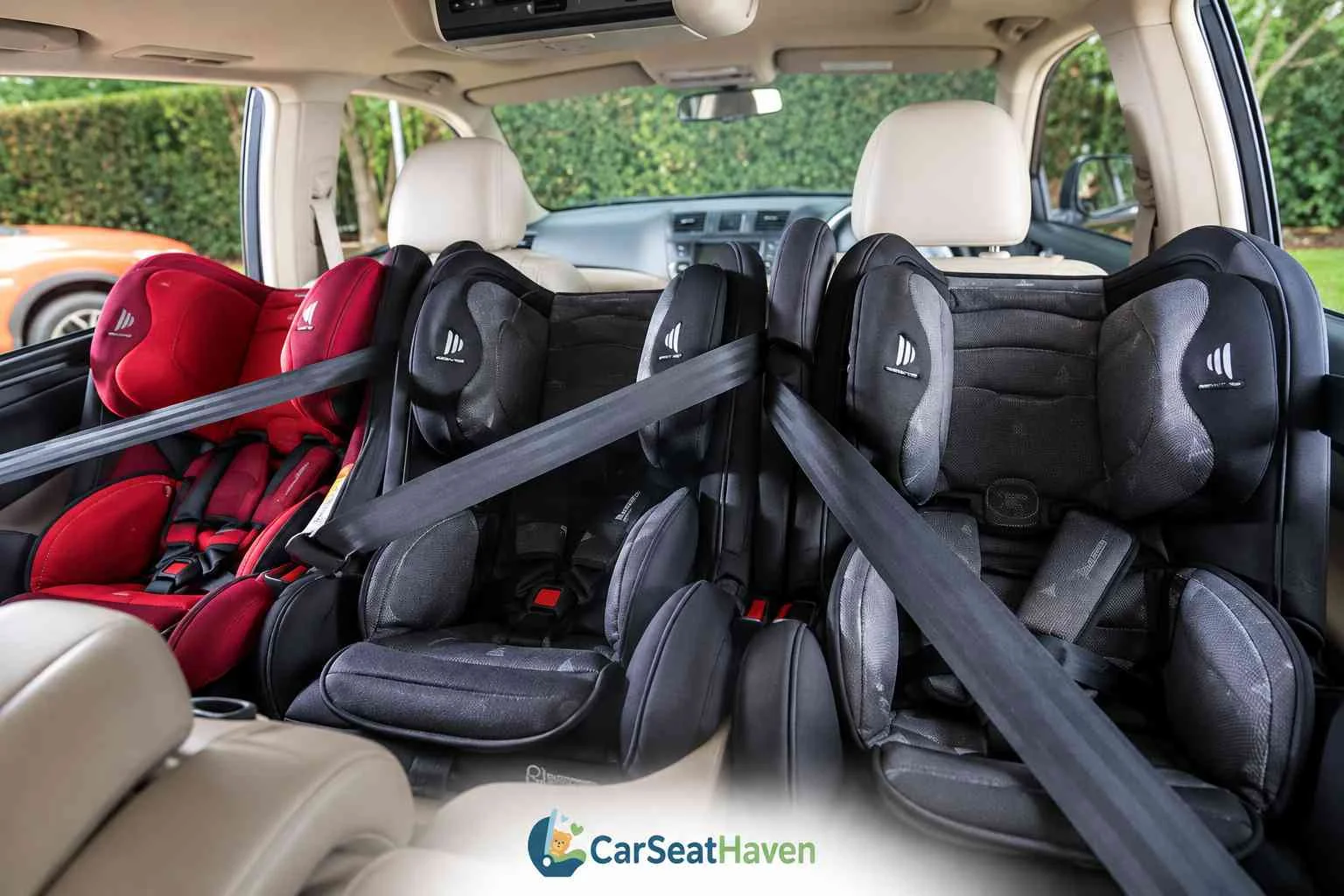
Fitting 3 across car seats in one row of your vehicle is possible far more often than parents expect. Yes, three car seats can fit across a single back seat, including in many midsize sedans, as long as you pick seats that are about 16.7 to 17 inches wide, install the center seat first (usually with the vehicle seat belt), and confirm that each seat moves less than one inch when tested on its own. This guide busts the most common myths about 3-across installs, compares the narrow seats that make it work, and walks you through the installation method child passenger safety technicians actually teach.
What Does “3 Across” Actually Mean?
“3 across” means installing three child restraints side by side in a single row of vehicle seats, usually the second row. The three seats can be any mix of infant seats, rear-facing convertibles, forward-facing convertibles, all-in-one seats, or boosters. The critical detail that many parents miss is that each seat must be independently installed. That means every one of the three seats has to be tight and correct even if you removed the other two. If one seat is only tight because it is wedged between its neighbors, it is not a safe install.
There is also a difference between “3 across” and “adjacent seats.” Adjacent simply means seats placed next to each other, which is normal in every two-seat setup too. “3 across car seats” is the specific challenge: three seats, one row, each one independently secure, with every seat belt or LATCH strap routed correctly and no overlap that changes how any single seat performs.
The Short Answer: Will Three Car Seats Fit in Your Vehicle?
In most cases, yes. Measure the usable width of your back seat from the inside of one door to the inside of the other. Most midsize sedans give you about 52 to 58 inches. Three seats that are each 17 inches wide add up to 51 inches, which fits a 52-inch back seat with an inch to spare. The math is why seat width matters so much, and why seats like the Graco SlimFit3 LX (16.7 inches), the Diono Radian 3QXT (17 inches), and the Clek Fllo (16.9 inches seating width) are built specifically for this job.
But raw width is not the whole story. Vehicle seats are sculpted, not flat. Bolsters on the sides, a raised center hump, seat contours, headrests that cannot be removed, and seat belt buckles that sit in stiff, short stalks can all make a 51-inch calculation fail in real life. Two seats of identical width can behave completely differently next to each other because of where their widest point sits. A seat that is narrow at the base but wide at the headrest may puzzle perfectly beside a seat that is the opposite shape. This is why technicians say “try it in your vehicle” instead of trusting specs alone.
12 Myths About 3-Across Car Seats, Busted
These are the claims parents repeat in parking lots, parenting groups, and comment sections. Some contain a grain of truth. None of them should decide your setup without checking the facts.
Myth 1: Any three car seats will fit across if you push hard enough
Fact: Width is only one variable. Three wide convertible seats, such as a Chicco NextFit at about 19 inches wide, would need 57 inches of back seat before you account for buckles, contours, and your hands. Even three 17-inch seats can fail if the widest points collide at the same height, if seat belt buckles are buried between the seats, or if a center hump tilts everything. “Pushing hard enough” is never the answer: force that bends a seat out of position or wedges seats together so they brace each other is not an install, it is a pile of seats.
Myth 2: Narrow car seats are less safe than wide ones
Fact: Every car seat sold in the United States must pass the same federal standard, FMVSS 213, before it can be sold. A narrower seat is not a weaker seat. The Diono Radian line uses a steel alloy frame. Clek seats use a metal substructure with aluminum honeycomb crumple technology. Graco tests its SlimFit3 LX to the newer FMVSS 213a side-impact standard. Width is a fit feature, not a safety rating. What makes a seat safe is a correct install, a snug harness, and using the seat within its weight and height limits.
Myth 3: You need a big SUV or a minivan for three kids
Fact: Many parents successfully run 3 across in a Honda Civic, Toyota Corolla, Mazda 3, or similar compact sedan. What you need is a back seat with roughly 52 or more usable inches and three narrow seats, not a three-row vehicle. Ironically, some large SUVs are worse for 3 across than sedans, because the second row may have only two captain’s chairs (meaning there is no center position at all), or a narrow third row with only two seating positions. Vehicle size helps with loading kids in and out, but it does not guarantee a 3-across fit.
Myth 4: LATCH is safer than a seat belt installation
Fact: LATCH (Lower Anchors and Tethers for Children) and the vehicle seat belt are equally safe when used correctly and within the LATCH weight limits. LATCH was designed to make installs easier, not safer. This myth matters for 3 across because the center position of most vehicles has no dedicated lower anchors. That means the center seat is almost always installed with the seat belt, and there is nothing second-rate about that. A correct seat belt install beats a sloppy LATCH install every time.
Myth 5: Seat belt installs do not work well for 3 across
Fact: Seat belt installs are often the better choice for 3 across. Lower anchor straps and connectors add hardware at the seat bight that eats precious inches, and many center positions cannot use LATCH at all. A seat belt install gives you more freedom to position each seat exactly where it fits, and built-in lock-offs (found on seats like the Clek Fllo and Foonf, and the Graco SlimFit3 LX’s forward-facing belt path) make seat belt installs as simple as LATCH. The only requirement is that the belt be locked, either by the retractor or by the seat’s lock-off.
Myth 6: You can use LATCH and the seat belt together for extra security
Fact: Never do this. Car seat manufacturers do not allow installing with both systems at once (the top tether, used with forward-facing installs, is the one exception and is always encouraged). Using two systems concentrates crash forces in ways the seat was never tested for and can change how it performs. More is not better here. Pick one system per seat, install it correctly, and add the tether for every forward-facing seat.
Myth 7: You can borrow the outboard LATCH anchors for a center install
Fact: Only if your vehicle’s owner’s manual explicitly allows it, and it rarely does. Lower anchors are spaced 11 inches apart in a standard LATCH position. Borrowing one anchor from each outboard position creates a non-standard, wider spacing that the system was not designed for. Two seats can never share a single anchor either. If the manual does not say borrowing is allowed, install the center seat with the seat belt. When in doubt, the seat belt is the answer.
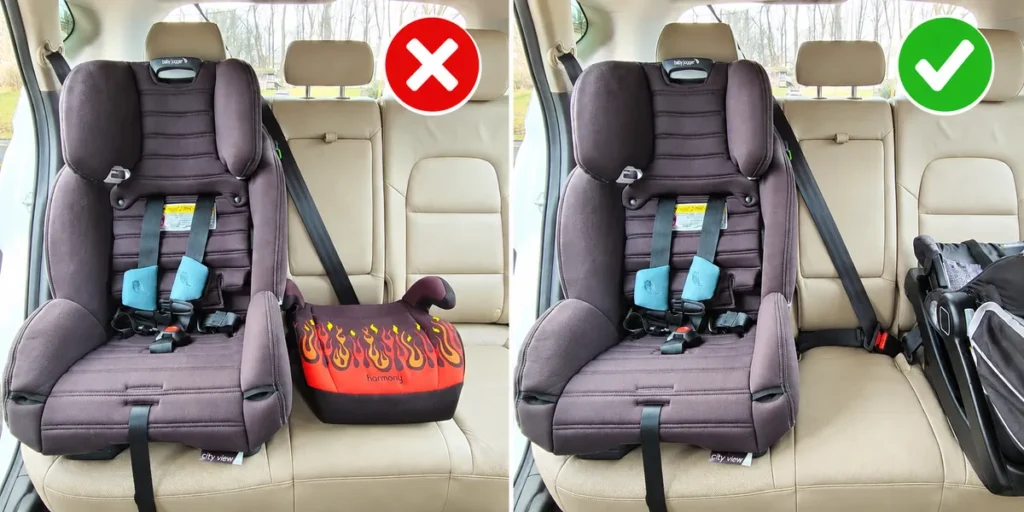
Myth 8: It is fine if the seats touch or overlap, they hold each other in
Fact: This is the most dangerous 3-across myth. Seats that depend on each other to stay tight are not installed. The standard test, taught by certified Child Passenger Safety Technicians (CPSTs): install the center seat first, then the two outboard seats, then remove the center seat and check whether the outboard seats still move less than one inch at the belt path. Put the center seat back in and check it the same way. If any seat fails without its neighbors, the setup is wrong. Seats may lightly touch, but none may be braced against another or against the front seat in a way either manual prohibits.
Myth 9: A rear-facing seat can brace against the front seat to save space
Fact: Bracing is only allowed when both the car seat manual and the vehicle manual allow it, which is uncommon. In a 3-across setup, a braced rear-facing seat can mask a loose install, because the seat feels tight only because it is jammed against the car. It can also interfere with advanced airbag sensors in the front passenger seat. If you need front-to-back room, look for seats with a compact footprint (the Diono Radian sits very low, and the Clek Fllo’s anti-rebound bar is designed to allow a more upright rear-facing angle) rather than pushing seats into the front row.
Myth 10: All three seats should face the same direction
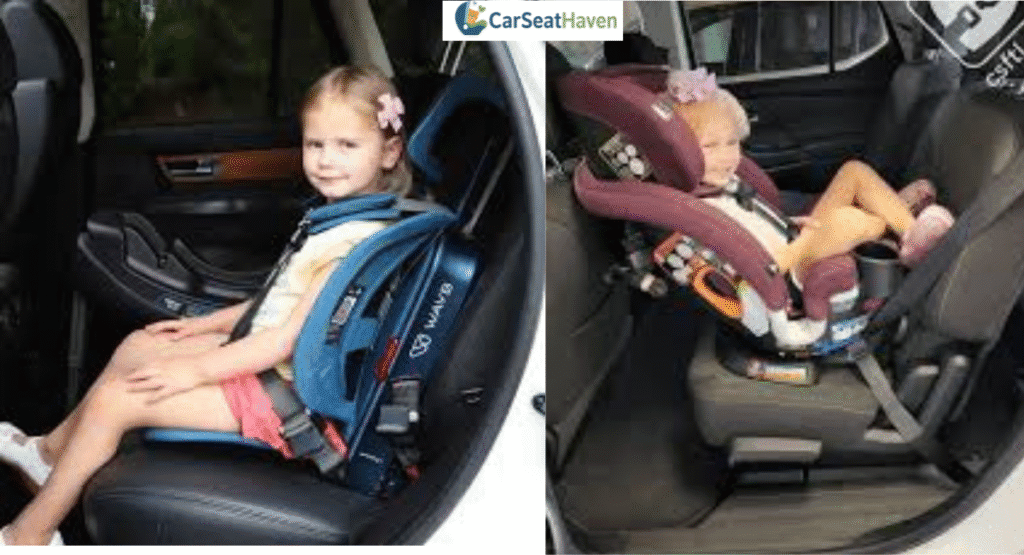
Fact: Mixed configurations usually fit better. A rear-facing seat and a forward-facing seat often puzzle together because their wide points are at different heights: the rear-facing seat is widest near the base, while the forward-facing seat is widest up at the headrest. Two identical seats in the same direction may collide where two different seats nest together. Plan the setup around each child’s age, weight, and rear-facing limits, then let the shapes do the work.
Myth 11: The youngest child should always go in the center
Fact: The center is statistically the safest spot because it is farthest from side impact, but which child goes there is a judgment call. Many technicians recommend putting a forward-facing child in the center, since a forward-facing child has less side-impact protection than a rear-facing child cocooned in a seat shell. In 3-across setups, the center seat also tends to be the one installed with the seat belt and the one that is hardest to reach, so it often works best for the most independent child. Every seating position in the back is very safe with a correctly installed seat.
Myth 12: Three boosters across is just as easy as three harnessed seats
Fact: Boosters are the hardest part of 3 across. A harnessed seat stays buckled; a booster rider needs a hand and a buckle every single ride, and reaching the vehicle buckle between two narrow seats is genuinely difficult for many adults, let alone kids. There are narrow boosters (the Maxi-Cosi RodiFix and Peg Perego Flex 120 have no armrests, which makes buckling easier), but they are expensive. The practical CPST advice is to keep kids harnessed as long as the seat allows before moving to boosters in a 3-across setup.
Myth vs. Fact at a Glance
| Myth | Fact |
| Narrow seats are less safe | All seats pass FMVSS 213; width is a fit feature, not a safety rating |
| You need a big SUV or minivan | Many sedans fit three 17-inch seats in a 52-inch back seat |
| LATCH is safer than the seat belt | Equally safe within LATCH limits; the center usually uses the belt |
| Use LATCH and the seat belt together | Never; use one system per seat (plus the top tether when forward-facing) |
| Seats can lean on each other | Every seat must pass the 1-inch test independently of the others |
| Boosters are easy in a 3 across | Buckling between seats is hard; keep kids harnessed longer |
Narrow Car Seats Compared
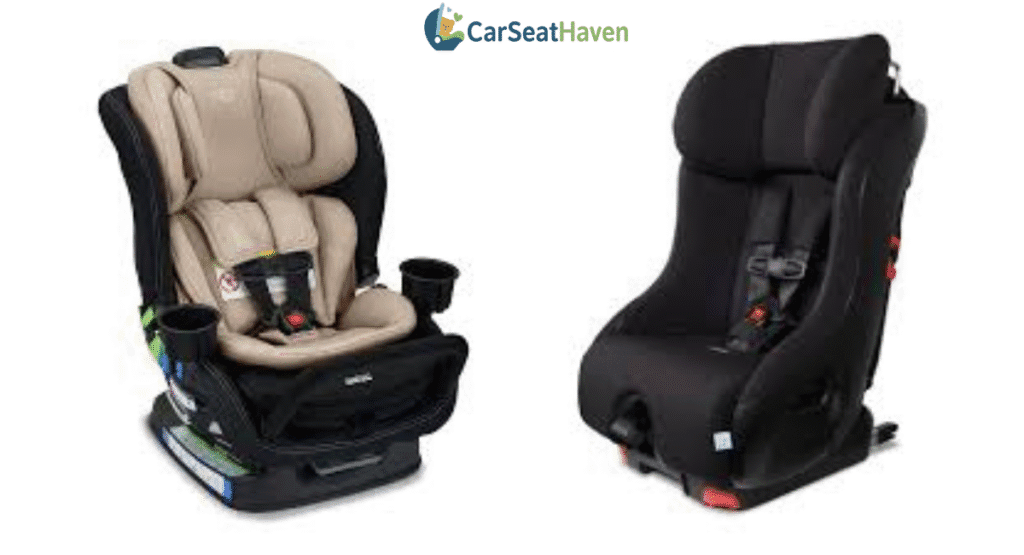
These are the seats CPSTs and parents reach for most often when planning 3 across car seats. Width is listed as published by each manufacturer; always confirm in the manual for your model year.
| Seat | Width | Modes | Weight ranges | Why it works for 3 across |
| Graco SlimFit3 LX | 16.7 in | Rear-facing, forward-facing, highback booster | RF 5-40 lb; FF 26.5-65 lb; booster 40-100 lb | Designed for 3 across; integrated belt lock-off; slim cup holders |
| Chicco Fit3x | 16.7 in | Rear-facing, forward-facing, highback booster | RF 5-40 lb; FF 26.5-65 lb; booster 40-100 lb | Built from the ground up for 3 across; lock-offs for RF and FF |
| Diono Radian 3QXT | 17 in | Rear-facing, forward-facing, booster | RF 4-50 lb; FF 22-65 lb; booster 40-120 lb | Steel frame; very low forward-facing profile; folds for travel |
| Diono Radian 3R | 17 in | Rear-facing, forward-facing, booster | RF 5-45 lb; FF 22-65 lb; booster 40-120 lb | Same narrow shell at a lower price point |
| Clek Fllo | 16.9 in seating width (13 in base) | Rear-facing, forward-facing | RF 14-50 lb; FF 22-65 lb | 13-inch base puzzles beautifully; steel anti-rebound bar; 9-year lifespan |
| Clek Foonf | 16.9 in | Rear-facing, forward-facing | RF 14-50 lb; FF 22-65 lb | Rigid-LATCH (REACT) system; anti-rebound bar; 9-year lifespan |
| Evenflo Revolve360 Slim | 16.7 in | Rear-facing, forward-facing (check manual for booster mode on your version) | RF 4-50 lb; FF 22-65 lb | Only rotating seat narrow enough for many 3-across setups |
| Cosco Scenera Next | 17 in | Rear-facing, forward-facing | RF 5-40 lb; FF 22-40 lb | Budget pick; lightweight; good for the rear-facing years |
A few notes on these picks. The Graco SlimFit3 LX is the most direct answer to “which seat fits 3 across”: Graco’s own FAQ confirms the 16.7-inch design is made for three across in most vehicles, and it is a true all-in-one that takes a child from 5 pounds to booster age. You can read a dedicated breakdown in the Graco SlimFit3 LX guide.
The Diono Radian seats are the classic 3-across answer and their forward-facing profile is exceptionally low, which helps with puzzle fits. They are heavy, at over 30 pounds, and can be tricky to install, so budget time for the first install.
The Clek seats are premium in price but their narrow base and built-in lock-offs make them technician favorites. The Evenflo Revolve360 Slim is worth a look if you want rotation: it is one of the only rotating seats slim enough for 3 across, though the seat may not be able to swivel once neighboring seats are installed, so treat rotation as a bonus, not a promise. The Cosco Scenera Next is the budget answer for the rear-facing years, though its 40-pound forward-facing limit means you will need another seat later.
One seat to treat with caution for 3 across: the Chicco NextFit, at about 19 inches wide, is a fine seat but three of them need 57 inches of back seat, which rules out most sedans. Width matters more than brand loyalty here.
How to Install 3 Car Seats Across, Step by Step
Step 1: Read both manuals first
Before anything else, read your vehicle’s owner’s manual (the child safety section) and each car seat manual. You need to know: which seating positions allow car seats, whether center LATCH borrowing is allowed (it usually is not), where the top tether anchors are, whether headrests can be removed, and whether bracing is permitted. Ten minutes here prevents an hour of frustration.
Step 2: Install the center seat first
Start with the center position because it is the most constrained. Use the vehicle seat belt for the center seat unless your manual explicitly allows center LATCH. Route the belt through the correct belt path (rear-facing and forward-facing paths are different), buckle it, lock the belt or use the seat’s lock-off, then press down firmly at the belt path while pulling the slack out. Check the recline angle for a rear-facing seat with the seat’s level indicator.
Step 3: Install the two outboard seats
Install one outboard seat, then the other, working around the center seat. Outboard positions usually have dedicated lower anchors, and you can use LATCH here as long as the combined weight of the child and the seat is within the LATCH limit (65 pounds total is the standard cutoff, and most seat manuals print a specific child-weight limit on a label). If LATCH straps and connectors are eating space between seats, switch an outboard seat to the seat belt instead. Tighten each seat at its own belt path.
Step 4: The independence test
This is the step that makes or breaks a 3 across car seats install. Remove the center seat completely, then test each outboard seat: grab it at the belt path and pull side to side and front to back. It should move less than one inch. Put the center seat back in, then test the center seat the same way. If any seat only feels tight because its neighbors are holding it, reinstall until every seat passes on its own. Seats may lightly touch, but none may rely on another.
Step 5: Tether every forward-facing seat
The top tether reduces forward head movement in a crash and should be used for every forward-facing installation, whether the seat was installed with LATCH or the seat belt. Find the tether anchors in your vehicle manual: they are often on the rear shelf, the back of the vehicle seat, or the ceiling in SUVs. Route the tether over the top of the vehicle seat (never under), hook it to the correct anchor, and remove the slack. Never attach a tether to a cargo hook or anything that is not a designated tether anchor.
Step 6: Check tightness the right way
Test movement with your non-dominant hand at the belt path, with a firm handshake-level pull, not with all your strength. Movement at the top of a rear-facing seat is normal; the belt path is what matters. Technicians also warn against over-tightening: cranking a seat so hard that you move the whole vehicle can damage the seat at the belt path or break a lock-off. Tight means less than one inch, not “cannot be moved by a strong adult.”
Puzzle-Fit Techniques That Actually Work
When three seats will not fit in the obvious arrangement, rearrange before you give up. The puzzle approach is standard technician practice for fitting 3 across car seats.
- Mix directions. A rear-facing seat beside a forward-facing seat often fits where two seats facing the same way will not, because the widest points sit at different heights.
- Mix brands and shapes. A seat that is narrow at the base (like the Clek Fllo’s 13-inch base) can sit beside a seat that is narrow at the top. Two identical seats can collide where two different seats nest.
- Alternate high and low profiles. The Diono Radian sits very low when forward-facing. Placing a low-profile seat next to a taller one lets the taller seat’s wide upper section pass over the low seat.
- Try different mode combinations. A highback booster is wide at the shoulders; the same seat in harnessed mode with the headrest lower may be narrower. An infant seat without its base takes less width than with it.
- Swap which seat goes in the center. The center position is often the narrowest because of the hump and contours. The seat with the narrowest base usually belongs there.
- Remove what the manuals allow. Cup holders that stick out, infant inserts a child has outgrown, and removable headrests can each free up a useful inch. Only remove what the seat manual permits.
Center Seat Rules: LATCH, Humps, and Contours
The center position deserves its own section because most 3 across car seats problems start here. First, do not invent a LATCH position: if the center has no dedicated lower anchors, and the manual does not explicitly permit borrowing the inner anchors from the outboard positions, the center seat goes in with the seat belt. One lower anchor can never serve two seats.
Second, check the center for a raised hump or a deep contour. A seat installed on a hump can rock side to side or sit at the wrong recline angle; sometimes a different seat with a flatter base solves it, and sometimes the center simply will not work with a particular seat.
Third, confirm the center has a usable top tether anchor for a forward-facing seat. Most vehicles have three tether anchors across the back, but some do not. A forward-facing seat in a position with no tether anchor may need to move to a position that has one.
Fourth, look at the center headrest: if it pushes the car seat forward and cannot be removed or folded, it may rule out certain seats. Fifth, check the center seat belt. Some centers have a belt that comes from the ceiling or a buckle on a long, floppy stalk, which can make a tight install difficult. A locking clip or a seat with a good lock-off usually fixes this, but it is something to test before you buy.
What About Boosters in a 3-Across Setup?
Boosters change the 3-across equation because the vehicle seat belt, not the car seat’s harness, does the restraining, which means an adult hand must reach the buckle on every ride. In a tight 3 across, that buckle is often buried between two seats.
Practical strategies: keep children in a 5-point harness as long as the seat’s limits allow (many narrow seats harness to 65 pounds), choose backless or narrow highback boosters with no armrests so hands can reach the buckle, and put the booster rider in the outboard position where the buckle is most accessible. If a child cannot buckle independently and you cannot reach the buckle either, that setup does not work, no matter how good it looks parked in the driveway. Test the real morning routine, not just the install.
When 3 Across Is Simply Not Possible
Sometimes the answer is that it does not fit, and recognizing that is part of good child passenger safety. Signs you have hit a real wall: any seat moves more than one inch when its neighbors are removed; a seat overlaps another so the harness or belt path is covered; you cannot route a seat belt or tether without crossing it over another seat; a buckle is inaccessible; or a child old enough for a booster cannot buckle and you cannot reach in to help.
If you hit that wall, your options are: try a different combination of seats (renting or borrowing seats to test-fit before buying can save hundreds of dollars); consult a certified CPST, who may see a puzzle solution you missed (find one through Safe Kids Worldwide or your local health department); use the third row if your vehicle has one; or accept that a different vehicle is the answer.
There is no shame in that last one. A setup that technically fits but that you dread using every day will eventually be used incorrectly, and a correctly used setup in a bigger vehicle beats a resented, sloppy one in a small car.
Quick Troubleshooting Checklist
- Each seat moves less than one inch at the belt path, tested with neighbors removed.
- No seat depends on another seat to stay tight; light touching is fine, bracing is not.
- Center seat is installed with the seat belt unless the manual allows center LATCH.
- No two seats share a lower anchor, and no borrowed anchors unless the manual permits.
- Every forward-facing seat has its top tether attached to a designated tether anchor.
- No seat belt or LATCH strap crosses over another seat.
- Each harness is snug (no pinchable slack at the shoulder) with the chest clip at armpit level.
- Rear-facing recline angles are correct per each seat’s level indicator.
- Buckles for booster riders are reachable in the real daily routine.
- Nothing is braced against the front seat unless both manuals allow it.
Frequently Asked Questions
Can you fit 3 car seats across in a sedan?
Yes, in many sedans. Most midsize sedans have about 52 to 58 inches of usable back-seat width, and three 17-inch seats total 51 inches. The constraints are usually seat contours, buckle placement, and the center hump rather than total width, so test-fit in your specific car.
What is the narrowest car seat for 3 across?
Among the most recommended 3 across car seats, the Graco SlimFit3 LX, Chicco Fit3x, and Evenflo Revolve360 Slim are each 16.7 inches wide. The Clek Fllo has a 13-inch base with a 16.9-inch seating width, which often puzzles better than its headline number suggests. Published width is a starting point; shape matters as much as inches.
Is it safe for car seats to touch each other?
Light touching is fine. What is not fine is seats that lean on, brace against, or overlap each other in a way that changes the install. Every seat must move less than one inch at the belt path when tested with the other seats removed.
Should the center seat use LATCH or the seat belt?
The seat belt, in most vehicles. Most cars have no dedicated lower anchors in the center, and borrowing anchors from the outboard positions is only allowed when the vehicle manual explicitly permits it. A seat belt install is equally safe when done correctly.
Can you use LATCH and the seat belt at the same time?
No. Use one installation system per seat, not both. The top tether is the exception: always use it for forward-facing installs regardless of whether the seat is installed with LATCH or the seat belt.
When do you have to stop using LATCH?
When the combined weight of the child and the car seat reaches the LATCH limit, which is 65 pounds under the federal standard, though your seat or vehicle manual may specify a lower child-weight cutoff. The seat’s label usually does the math for you. After that, switch to a seat belt install.
Can three rear-facing seats fit across?
Often yes, with narrow seats and puzzle fitting. Rear-facing seats are widest near the base, so alternating with a forward-facing seat or mixing brands usually works better than three identical seats. Check front-to-back room too: a rear-facing seat must not brace against the front seat unless both manuals allow it.
Are rotating car seats good for 3 across?
The Evenflo Revolve360 Slim, at 16.7 inches wide, is one of the only rotating seats that can work in a 3 across. The catch is that the seat may not be able to swivel once neighboring seats are installed, so consider rotation a bonus. Compare rotating options in the best rotating car seat comparison.
What do you do if 3 across will not fit?
Try different seat combinations first, since shape matters as much as width, and get a certified CPST to check your work. If it truly does not fit, options include using a third row, keeping kids harnessed longer instead of switching to hard-to-buckle boosters, or choosing a vehicle with a wider back seat.
The bottom line on 3 across car seats: it is a solvable puzzle, not a reason to panic-buy a minivan. Start with narrow seats around 17 inches wide, install the center seat first with the seat belt, puzzle the shapes together, and verify that every seat is independently tight. When each seat passes the one-inch test on its own, you have a setup you can trust every day.

Aiden is the founder and editor of CarSeatHaven. He researches NHTSA safety standards, AAP guidance, manufacturer manuals, and recall notices, and turns them into plain-language car seat guides for parents.
