

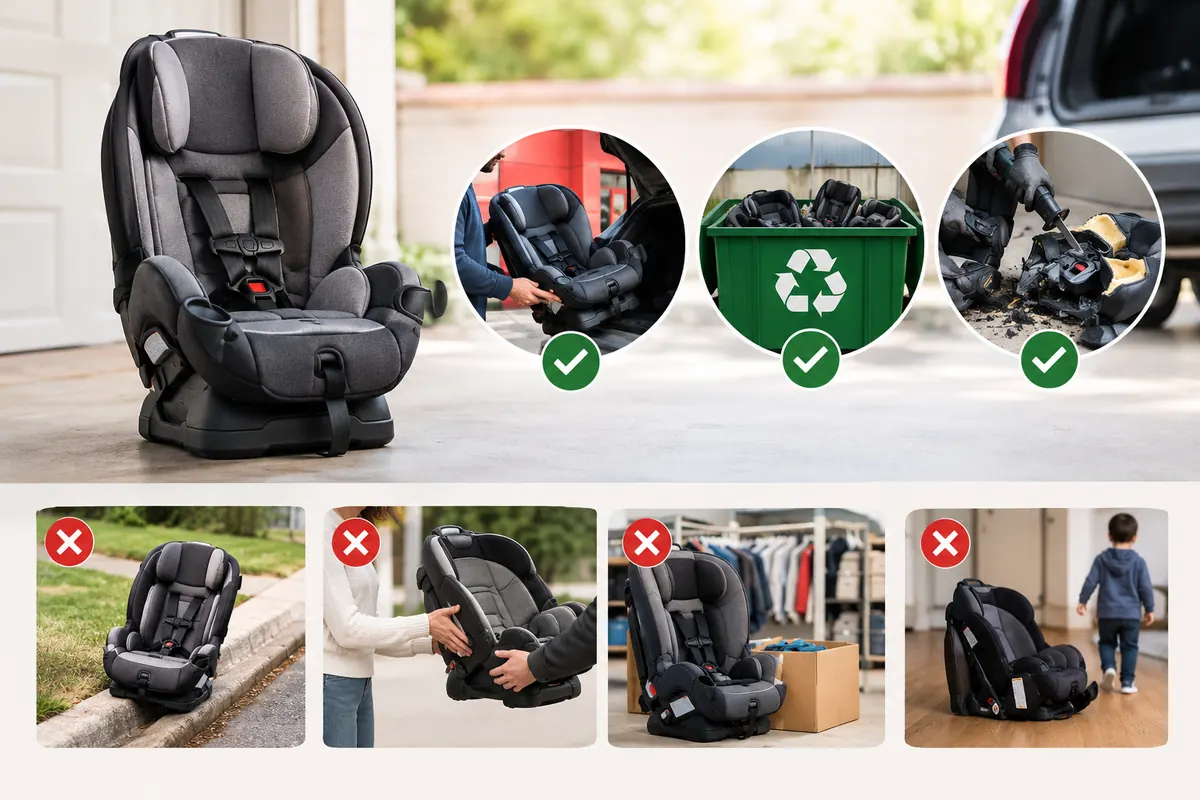
When your car seat expires, you have three safe choices: trade it in for a discount on a new seat, recycle it through a dedicated program, or destroy it so thoroughly that nobody can ever use it again. What you must never do is leave it intact on the curb, sell it, donate it, or hand it down to a friend. An expired seat looks perfectly fine, which is exactly why someone will grab it and put a child in it, not knowing the plastic has weakened from years of heat and cold. Retailers like Target run trade-in events, typically in spring and fall, where your old seat earns you a discount and gets recycled responsibly. If no event is running, recycling programs and a careful destruction routine finish the job. This guide walks you through every option, step by step.
Key Takeaways
- You have three safe options for an expired car seat: trade it in, recycle it, or destroy it so nobody can reuse it.
- Never sell, donate, give away, or leave an expired seat intact on the curb. Someone will pick it up and put a child in it.
- Target runs trade-in events, typically in spring and fall, with 20 percent off a new seat. Check Target’s site for current dates.
- If no event is running, cut all the straps right away and store the seat out of reach until you can trade it in or recycle it.
- If money is tight, the trade-in discount plus free or low-cost seats from Safe Kids coalitions can bridge the gap.
The Golden Rule: Never Let an Intact Expired Seat Leave Your Hands
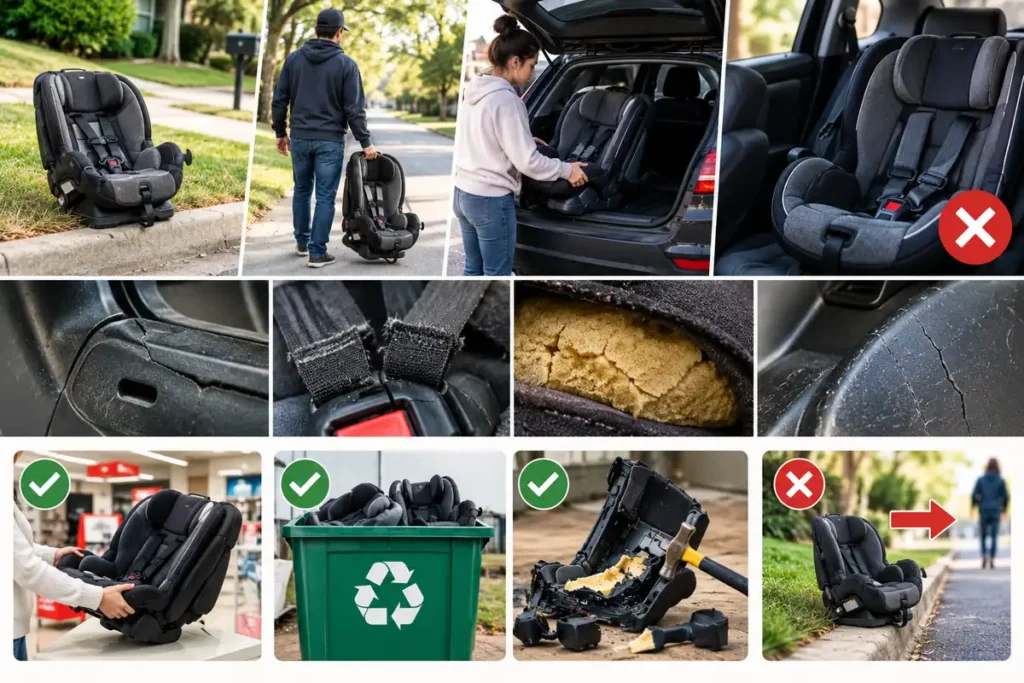
Picture it. You drag the old seat to the curb the night before trash day. By morning it’s gone, but not because the garbage truck came. A neighbor spotted it. A bargain hunter grabbed it. A young parent who’s stretched thin saw a free car seat and loaded it into the trunk. This happens all the time. Curbside free piles, thrift store shelves, and buy-nothing groups are full of seats that expired years ago, and the people taking them home have no idea.
Here’s what that person doesn’t know. Your seat might look perfect, but its plastic shell has spent years baking in summer heat and freezing on winter nights. That constant heating and cooling slowly makes plastic brittle. The harness webbing has been tightened and loosened thousands of times. The energy-absorbing foam inside has compressed a little with every pothole and sudden stop. None of that shows on the outside. The family who picks up your old seat gets a product that can’t protect a child the way it was designed to, and they won’t find out until the moment it matters most.
This is why every safety authority lands in the same place. NHTSA’s used car seat safety checklist says a secondhand seat is only acceptable when its history, labels, and condition can be fully verified. An expired seat fails that test on its face. So the rule is simple and absolute: an expired seat never leaves your hands in usable condition. Trade it in, recycle it, or destroy it. Those are the only three exits, and everything below shows you exactly how.
Option 1: Trade It In for a Discount: The Best Choice
If you can only do one thing with your expired seat, make it a trade-in. You hand over the old seat, it gets recycled responsibly instead of ending up in a landfill, and you get a meaningful discount on the replacement. It’s one of those rare cases where doing the right thing also saves you real money.
Target runs the biggest program in the country. Their car seat trade-in events, typically held in spring and fall, accept any car seat in any condition, from any brand, expired or not. Bring the seat to a participating store and you get 20 percent off a new car seat, stroller or select baby gear. Since the program began, Target has collected more than 3.8 million car seats, diverting over 63.7 million pounds of material from landfills. The collected seats are broken down, and the materials are recycled into new products.
A few tips to get the most out of it. Check Target’s website for current event dates before you go, because the timing shifts a little from year to year. You don’t need a receipt, and it doesn’t matter where you originally bought the seat. For a full walkthrough of how the event works, what counts, and what the bonus covers, read our guide to the Target car seat trade-in event.
Walmart has run similar trade-in events in the past, and some local baby stores run their own versions, so a quick search for car seat trade-in programs near you is worth two minutes. If no event is running right now, don’t throw the seat away. Cut the straps right away so nobody can use it in the meantime, stash it in the garage or a closet, and wait for the next one. The seat isn’t going anywhere, and the discount is worth the wait. If you’re not sure the seat is actually expired before you haul it to the store, our free car seat expiration checker settles it in about 30 seconds.
Option 2: Recycle It
A car seat is mostly plastic and metal, which sounds recyclable, and technically it is. The catch is that curbside recycling programs almost never accept car seats. The mix of hard plastic, metal, fabric, foam, and straps can’t go through standard recycling trucks and sorting lines. Tossing a seat in the blue bin just means it ends up in the landfill anyway, or worse, jams the machinery at the sorting facility.
Dedicated car seat recycling is the real solution. TerraCycle has offered car seat recycling programs in the past, and some cities and counties run special car seat drop-off events, often timed around Earth Day or trade-in season. A few local waste authorities will accept a seat if you strip it down to clean plastic and metal yourself: pop off the fabric cover, cut away the straps and foam, pull out any mixed-material bits, and bring in just the hard shell and metal parts. It’s real work, so call your local program first and ask exactly what they accept and how they want it prepared. Showing up with a fully assembled seat when they only take stripped shells wastes everyone’s afternoon.
The fastest way to find current options is to search for car seat recycling near me plus your city or county name. Call before you drive over, because these programs come and go with funding and seasons. And if recycling turns out to be a dead end where you live, the destruction routine in the next section always works, no program required.
Option 3: Destroy It So Nobody Can Ever Use It
This is the last resort, and it’s also the most important skill on this page, because every parent eventually faces a seat with no trade-in event and no recycling program in sight. Think of it this way: destruction isn’t wasteful, it’s protective. An intact expired seat in the trash is a hazard waiting for the next family. A destroyed seat is just plastic. Here’s the routine, in order.
Cut every strap. This is the single most important step. Cut the harness straps, the LATCH straps, and the tether strap. Cut them short and in several places so there’s no way to knot them back together. A seat with no straps is visibly, obviously unusable, and that’s exactly the point.
Remove the cover and padding. Pull off the fabric cover, the infant insert, the harness pads, and any comfort padding. This does two things: it makes the seat look broken instead of free, and it removes the pieces a scavenger would need to make the seat look complete again.
Write EXPIRED DO NOT USE on the shell. Grab a thick permanent marker and write it big, on both sides of the plastic shell if you can reach them. Make it impossible to miss. This is your warning to anyone who finds the pieces.
Bag everything in a dark trash bag. Put the shell and all the pieces into a dark or black trash bag and tie it shut. An exposed seat on the curb advertises itself as a freebie. A tied bag is just trash, which is all it should be.
Put it out on trash day, not before. Don’t leave the bag sitting on the curb for days where someone might open it out of curiosity. Time it so the bag goes out shortly before pickup and disappears with the truck.
It will feel wrong the first time you take scissors to a seat that looks perfectly fine. Do it anyway. You’re not destroying a good car seat. You’re retiring a seat whose safety promise has expired, and you’re making sure no other child ever rides in it.
What About the Metal Parts?
If you’re already stripping the seat, the metal pieces are worth separating. LATCH connectors, metal buckle tongues, and steel reinforcement bars can usually go in with scrap metal recycling in most areas. It’s a small bonus on top of the main job, not a requirement. The straps are the part that matters most, so if you only have five minutes, spend all five on the straps.
What NOT to Do With an Expired Car Seat
Parents ask about these options constantly, usually with genuinely good intentions. The answer to every one of them is the same: don’t do it.
Do Not Sell It
Not on Facebook Marketplace, not at a consignment sale, not at a yard sale. A buyer can’t see expiration the way they can see a stain or a tear, and most buyers don’t even know car seats expire. Selling an expired seat passes a hidden danger to another family’s child, and if that child is hurt, it can come back on you. No as-is disclaimer fixes this. Once a seat is expired, it isn’t a product anymore. It’s waste, and it should be treated like waste.
Do Not Donate It
Goodwill, Salvation Army, and most charities won’t accept car seats at all, precisely because they can’t verify crash history or expiration dates. The rare shop that does take them is doing parents no favors. Don’t drop an expired seat at a donation bin hoping it finds a good home. The home it finds is a car carrying someone’s baby, and that baby deserves a seat with life left in it.
Do Not Give It to a Friend or Family Member
This one is the hardest, because it feels generous and the seat looks fine. Your sister, your neighbor, your cousin who’s expecting. They’ll trust your judgment, which makes it worse, not better. If the seat is expired for your child, it’s expired for theirs. If you truly want to help, help them find a trade-in event or a low-cost seat program instead. That’s real generosity, and it doesn’t put their kid at risk.
Do Not Leave It Intact on the Curb
We covered this above, but it bears repeating because it’s the single most common mistake. A seat on the curb is a seat in someone else’s car by sunset. If it has to go in the trash, it goes in destroyed, bagged, and timed to pickup day. No exceptions, not even just this once.
Do Not Keep It Around Just in Case
The garage seat. The attic seat. The backup for grandma’s car. Every family has one, and it’s exactly how expired seats sneak back into use. The good seat is in the other car, a toddler needs a ride right now, and suddenly the expired backup is buckled in just this once. If a seat is expired, it has no backup role. Destroy it or trade it in today, while you’re thinking about it, before a rushed morning makes the decision for you.
An expired seat sitting in your garage is not a backup plan. It’s a temptation waiting for the most rushed morning of your year.
First, Make Sure It Is Really Expired
Before you destroy a seat, take 30 seconds to confirm the date. Find the white manufacture sticker on the seat, usually on the bottom, the back, or tucked under the cover, and compare it against your brand’s stated lifespan. Some seats print a Do Not Use After date right on the sticker, which settles it instantly. Our full guide on do car seats expire walks through every major brand’s lifespan and exactly where to look for the date. If the sticker is missing or unreadable and you can’t verify the age with the manufacturer, treat the seat as expired. A seat of unknown age is not a seat you keep.
What If You Cannot Afford a New Seat?
Let’s be honest about the part most guides skip. New car seats cost real money, and the expiration date doesn’t check your bank account first. Telling a struggling parent to just buy a new one isn’t advice. So here’s what actually helps.
First, the trade-in discount is real money. Twenty percent off turns a 200 dollar seat into a 160 dollar seat, and the old seat disappears responsibly at the same time. Time your purchase to an event and the math gets much friendlier.
Second, help exists, and there’s nothing embarrassing about using it. Safe Kids coalitions across the country run programs that provide free or low-cost car seats to families who need them. Start at safekids.org and look up your local coalition. Many hospitals also provide seats at discharge when there’s a demonstrated need, so ask the social worker before you leave the hospital, not after.
What doesn’t help is stretching the expired seat a little longer. Every month past the date means weaker plastic and more worn webbing. If the choice is between an expired seat and asking for help, ask for help. That’s what these programs are for.
Special Situations Worth Thinking About
The Grandparents Seat
The most common expired seat in America lives at grandma’s house. It was bought for the cousins a decade ago, it’s sat in a clean garage ever since, and it looks brand new. Bring it up with love, not a lecture. Try this: I just learned car seats expire, so I checked ours. Can we check yours together? Offer to split the cost of a replacement or time it to a trade-in event. Most grandparents have no idea the date exists, and once they know, they want to fix it.
Daycare and Babysitter Seats
You’re allowed to ask about the seats other people use with your child. A simple Can you tell me the manufacture dates on the car seats you use is a reasonable parent question, not an insult. Licensed programs should be able to answer it. If a babysitter or family daycare is using an expired seat, send them this guide and offer to help them trade it in. Framing it as a team effort works far better than an accusation.
Moving, Traveling, and Rental Seats
Don’t leave your expired seat behind in a move, a storage unit, or a rental property for the next family. That’s just the curb problem with extra steps. Destroy it before the movers arrive. And flip the script when you travel: never accept a rental or borrowed seat without checking its date as carefully as you’d check your own. Rental seats live hard lives, and you know nothing about their history.
Frequently Asked Questions
Q.1 Can I just throw an expired car seat in the regular trash?
You can, but only after destroying it first. Cut every strap, remove the cover and padding, write EXPIRED DO NOT USE on the shell in permanent marker, and bag the pieces in a dark trash bag. An intact seat in the trash will get picked up by someone who thinks they scored a free car seat. A destroyed seat in a bag is just trash, which is all it should be.
Q.2 Will Target take any car seat for the trade-in event?
Yes. The event accepts any car seat in any condition, from any brand, expired or damaged. You don’t need a receipt, and you don’t need to have bought the original seat at Target. Since 2016 the program has collected more than 3.8 million seats, keeping over 63.7 million pounds of material out of landfills. Target typically runs these events in spring and fall, so check Target’s site for current dates, and see our Target car seat trade-in event guide for the full walkthrough.
Q.3 Can I put a car seat in my curbside recycling bin?
No. Curbside programs don’t accept car seats. The mix of hard plastic, metal, fabric, and foam can’t be processed by standard recycling trucks and sorting lines, so the seat ends up in the landfill anyway. Use a dedicated car seat recycling program or drop-off instead, and if none exists near you, destroy the seat and dispose of it as household trash.
Q.4 Is it illegal to sell an expired car seat?
No federal law specifically bans selling an expired car seat, but that doesn’t make it okay. If you sell a seat knowing it’s expired and a child is hurt in it, you could face serious legal consequences, and no as-is note in a Marketplace listing protects the child who ends up riding in it. Beyond the law, it’s simply wrong: the buyer can’t see the danger. Destroy the seat instead.
Q.5 The trade-in event just ended. What should I do with the seat now?
Cut the straps today so nobody can use the seat, then store it somewhere out of reach until the next event. Trade-ins typically run in spring and fall, so the wait is usually a few months rather than forever. Check Target’s site for the next dates as they’re announced. If you need a replacement seat right now and can’t wait, look into the low-cost programs covered earlier in this guide.
Q.6 Can I keep using the expired seat until I can afford a new one?
Every safety authority says no, and the materials science backs them up. The plastic keeps weakening and the webbing keeps wearing whether or not the budget is ready. If money is the barrier, use the resources above: the 20 percent trade-in discount, Safe Kids coalitions for free or low-cost seats, and hospital discharge programs. An expired seat isn’t a bridge to better times. It’s a risk you can see coming, so replace it before you ever need it in a crash.

Aiden is the founder and editor of CarSeatHaven. He researches NHTSA safety standards, AAP guidance, manufacturer manuals, and recall notices, and turns them into plain-language car seat guides for parents.
