

Table of Contents
For people who own one or two dogs, the best cars for pets are midsize crossovers that have a low flat cargo floor, a wide and square tailgate opening and surfaces that wipe clean. The Subaru Outback and Honda CR‑V appear on every list and the numbers that have been published explain why. If you have large dogs or a couple of big crates you need more space and that points to a three‑row SUV such as the Kia Telluride or a minivan such as the Chrysler Pacifica. If you have dogs and cats you need far less space so almost any compact SUV or hatchback will work for pets.
The name of the car is not enough. Every day three things decide whether a vehicle is good, for a pet: how easily the pet gets in and out how the pet rides and how the space handles heat, hair and mud.
The sections below cover those three things first. Then they compare body styles, walk through specific models with manufacturer figures, and finish with a test-drive routine you can run with your own animal. The specs are based on the 2026 and 2027 model-year data released by manufacturers and dealers. Trim levels, engines and regional markets can affect the numbers, always double-check the details for the specific vehicle you are looking at.
Quick picks by situation
Nobody needs the same vehicle. Here’s how the common situations sort out, with the reasoning developed in the rest of the article.
| Your situation | Body style to start with | Models worth checking | Why it fits |
| One or two medium or large dogs, everyday use | Midsize or compact crossover | Subaru Outback, Honda CR-V | Wide cargo area, easy access, standard or available AWD |
| Senior dog or dog with joint trouble | Low-riding crossover, wagon, or minivan | Outback, Volvo V60 wagon | Lower entry; pair with a ramp |
| Three or more dogs, or several crates | Minivan or three-row SUV | Chrysler Pacifica, Kia Telluride | Large, flat load space when seats are folded |
| Small dog, cat, or other small pet | Compact SUV or hatchback | Toyota RAV4, Mazda CX-5 | Right-sized, and the back seat can anchor a carrier |
| Muddy trails, lakes, snow | Raised crossover or 4-door truck | Outback Wilderness, four-door Jeep Wrangler, Honda Ridgeline | Clearance and durable surfaces |
| Kids and dogs together | Three-row SUV or minivan | Honda Pilot, Telluride, Sienna | Separate seats and a dedicated cargo zone |
| Frequent errands where the pet stays with you | EV with a pet-comfort mode | Rivian R1S/R1T, Tesla models | Climate control keeps running |
The table is an editorial starting point, not a ranking. A vehicle that suits a 20-pound terrier on paved roads can be a poor choice for two Great Danes, and no list can see your dog.
What actually makes a car good for pets
Marketing copy loves the phrase pet-friendly. The useful version comes down to six practical features.
Load height and floor shape
Start with the lift. A dog that has to jump or be hoisted into the back is a dog whose joints and whose owner’s back take a hit on every trip. One dealer buyer’s guide suggests a load height under about 30 inches lets most dogs step or hop in without a ramp. Treat that as a rule of thumb. A Labrador in its prime clears it easily, a ten-year-old with sore hips may not, and a dachshund never will.
Published lift-over heights are worth looking up, but confirm them in person. The Outback shows why. Listings say the 2026 model has a low lift height of 28.4 inches but one dealer research page claims Subaru widened the load floor and raised it slightly in the redesign. Those two statements don’t match up. A quick measurement with a tape measure clears things up in just thirty seconds.
The shape of the floor is just as important as its height. Fold down the seats and check for steps, slopes or gaps. Even a small tilt in the floor can cause a crate to shift during turns. If there’s a lip at the seat hinge that makes it even harder to keep cargo stable.
Opening shape beats cubic feet
Cargo volume is the number everyone quotes and the least useful one for crate owners. Two vehicles can list identical cubic feet and swallow very different kennels, because the opening, the wheel wells and the roofline decide what actually slides in.
The Outback makes a good example. For the 2026 model, one spec compilation lists a cargo floor about 42.8 inches long behind the rear seats, 75.9 inches with the seats folded, 43.3 inches between the wheel housings, and a cargo-area height of 34.1 inches. Crates are sold by interior length, and the outer dimensions usually run a bit longer. A 42-inch crate, common for large breeds, is therefore a tight or impossible fit behind the upright seats, and you’d fold the seats to make it work. Folded, there’s plenty of length, but the wheel-well width limits how wide a crate can be.
Measure your crate’s outside length, width and height. Then measure the vehicle’s opening at its narrowest point, and check the height under the cargo cover or roller blind. The cover usually has to come out for a tall crate.
Surfaces you can clean
Dogs shed, drool and track things in. Cloth upholstery holds hair and odor, while leatherette, rubberized liners and rubber floor mats let go of both. One dealer guide lists leather or synthetic leather seating that wipes down quickly and rubber floor mats that catch fur, mud and dirt as basics, and that matches what most owners report.
Nothing is free, though. Claws mark leather and leatherette, so a seat cover or hammock is still wise. Some manufacturers offer water-resistant upholstery on select trims. A reviewer who travels with dogs notes that the Outback’s Onyx and Wilderness models can be had with StarTex upholstery, which repels water without feeling stiff. Trim availability changes by year and market, so verify it for the model you’re looking at.
Carpeted cargo areas are the weak spot in many vehicles. A custom-fit liner solves most of it, so check that one exists for your model before you buy the vehicle.
Anchor points and places to attach things
Secure travel needs something solid to attach to. Look for cargo tie-down hooks that can hold a strap seat-belt geometry that works with a harness and rear-seat tether anchors if you use a carrier or seat that needs them. A dealer guide says that cargo tie-downs and rear-seat LATCH anchors help you hold a crash-tested harness, crate or barrier in place. Follow the pet-product maker’s instructions on which attachment points to use. Not every harness or crate is designed for every anchor, and child-seat hardware wasn’t specified for animal loads.
Rear airflow and climate
Animals in the cargo area or back seat depend on rear vents. Their absence is a real drawback on long summer drives, because the front cabin can feel comfortable while the back stays stuffy. Some vehicles list this as a feature. One review says all Honda Ridgeline models have air vents. Another review says the Volvo XC40 and XC60 both have A/C vents in the rear. Check the trim you are buying because equipment lists can change between model years.
In a hatchback or SUV air must reach the cargo area where a crate might be placed. Vents in the row help with airflow. A panoramic roof or dark glass can make the back warmer. Side window mesh shades cost little and cut sun without blocking the view.
Ride, visibility and noise
A smooth ride matters more than owners expect, especially for dogs that get carsick. A stiff-riding vehicle, a high-riding seat with a poor view and heavy engine noise can all make things worse. Many dogs settle better facing forward with a view of the road. If yours gets queasy, a lower seating position and a calmer ride are worth prioritizing over extra cargo volume. Electric vehicles get credit here: one reviewer notes that EVs spare pets the loud noises and engine vibration that can rattle a nervous dog.
Body styles compared
Each body style trades convenience against space and cost, and the winner depends on your animals.
| Body style | Strengths for pet owners | Trade-offs |
| Compact crossover | Easy to park, low running costs, and a cargo area big enough for one large crate | Tight for several dogs or a giant breed |
| Midsize crossover/SUV | Best all-round balance: room, access, clearance | Costs more than compacts; some have a higher load floor |
| Wagon or hatchback | Low load floor, easy for older dogs; U.S. News found that wagons and small SUVs are among the most versatile choices for dogs and their families | Few wagons are sold new in some markets |
| Three-row SUV | Space for kids plus dogs; folding the rows creates a big load floor | Behind the third row, cargo space is modest; the Telluride offers only 22.3 cu ft there |
| Minivan | Sliding doors, low floor, huge fold-flat space in some models | Not every minivan folds flat; plug-in versions may lose floor storage |
| Crew-cab pickup | Roomy rear bench and tough surfaces | High step-in without running boards; the bed is not a safe place for a dog |
| Sedan | Cheap and efficient | Dogs ride on the back seat and can’t use the trunk; large crates rarely fit |
| EV | Quiet cabin; pet-comfort modes on some models | Pet mode depends on battery and software; range drops when climate runs |
Two of these deserve more explanation.
Sedans are workable for a small dog in a carrier or harness on the back seat, but they leave you with no crate space and awkward access. An SUV, wagon or minivan brings the entry point closer to hip height. One reviewer explains that a better “hip point” makes loading and unloading a dog easier, whatever its size.
Pickups are more complicated. A crew cab gives a big rear bench and often a wide floor, and one reviewer suggests a four-door version with running boards for medium or large dogs who struggle to get in on their own. The open bed is another matter. Several U.S. states restrict how dogs are carried in open truck beds, and loose animals can be thrown or can jump out. The cab is the right place for a pet.
Vehicles that meet the criteria and what to look for on each
The selections listed below are based on information that has been published and the comments from reviewers. When sources don’t agree or the information is limited the text mentions that clearly.
No vehicle here was tested by the author, and that limit applies to everything that follows.
Subaru Outback: low floor, standard AWD
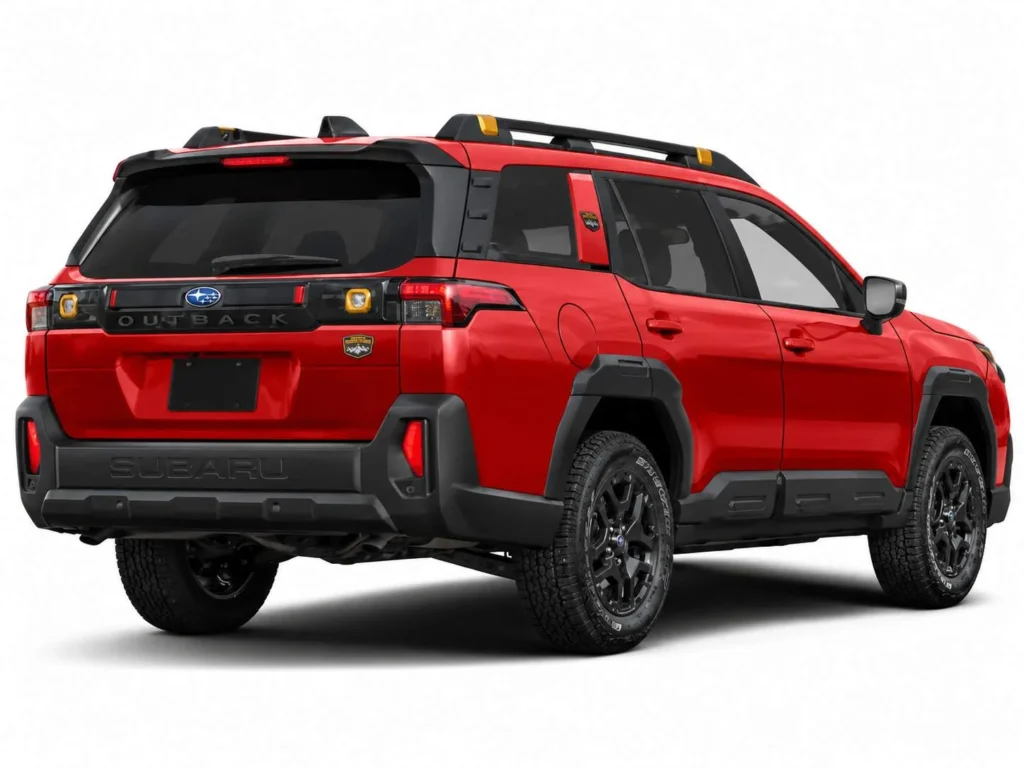
The Outback is the reference point in this category and the Outback earns the spot. For 2026 the redesigned Outback has a boxier body and a roomier interior than the outgoing Outback. The Outback offers 34.6 feet of cargo space behind the rear seats and 80.5 cubic feet when the seats are lowered up from about 32.6 and 75.6 in the previous-generation Outback. The Outback’s ground clearance is 8.7 inches. The Wilderness Outback has 9.5 inches. Every model comes with standard Symmetrical All-Wheel Drive.
For dog owners, that combination is useful: low enough to load, high enough for a gravel pull-off, and easy to accessorize. Nalley Automotive calls it the best all-around car for pet owners, a judgment that fits one to two medium or large dogs best.
Watch for two limits. The Outback’s behind-seat volume trails the CR-V’s on paper, and the floor length behind the upright seats won’t take the longest crates. Owners of giant breeds should measure before committing.
Honda CR-V: the widest compact
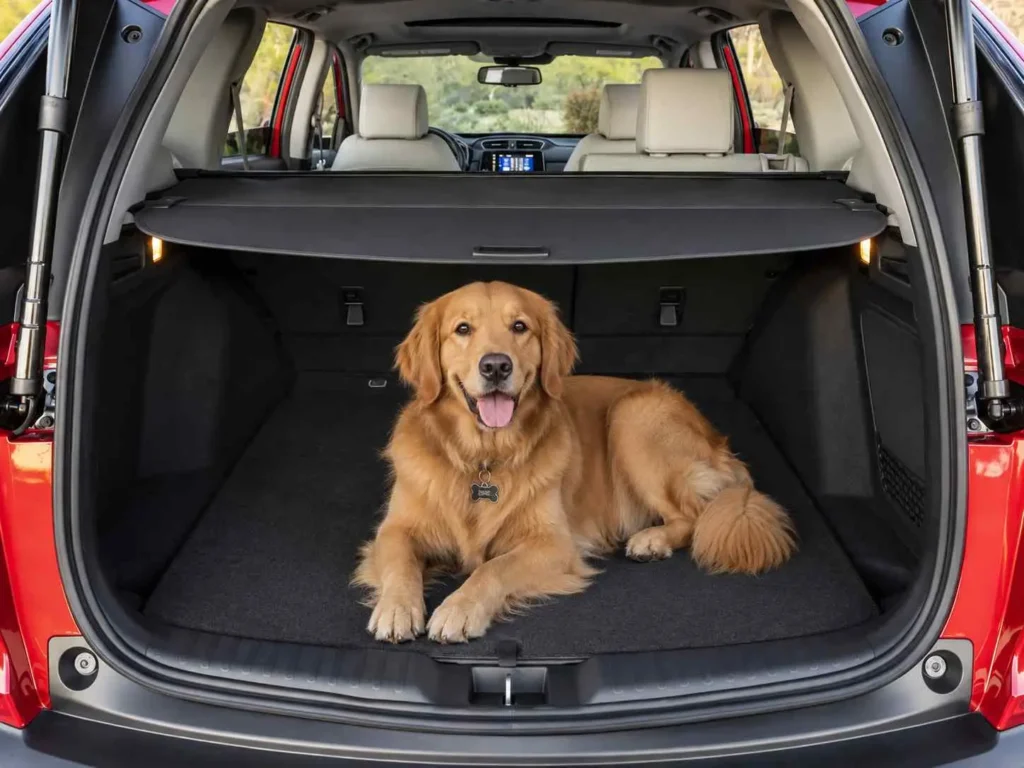
The CR-V’s strength is shape. For 2026 the gas models have 39.3 feet behind the second row and up to 76.5 cubic feet with the seats folded. The hybrids have 36.3 and 71.8. The Sport Touring hybrid drops more to 34.7 cubic feet behind the seats. The hybrids battery pack also removes the tire and reduces cargo space.
If you want a CR-V for crate duty the gas version provides room. If you want fuel costs the hybrid still has usable space but make sure to measure your crate against that trim specifically. It sits below the Outback for clearance, so muddy trailheads are less of a strength.
Subaru Forester: boxy and trail-ready
The Forester’s tall, boxy cargo area appeals to owners of tall crates or dogs that like to stand. Nalley recommends it as the pick for the active, outdoorsy pet household. One comparison guide lists its behind-seat volume as 28.9 cubic feet, well below the CR-V’s 39.3. The shape may still work for a specific crate, but check the figures before assuming.
Toyota RAV4 and Mazda CX-5: right-sized for smaller pets
Not every animal needs a cavern. For a small dog, a cat or a single medium dog, a compact SUV is enough. The current RAV4 lists about 37.5 cubic feet behind the rear seats and 69.8 with them folded. The Mazda CX-5 draws praise from one reviewer for large windows for dogs to see out of, moderate ground clearance, and a rear seat with enough space for loading, unloading and securing dogs. Both suit a carrier or harness on the back seat and a small crate in the cargo area.
Kia Telluride: room for big crates and big families
When a small or midsize crossover runs out of room, a three-row SUV steps in to help. The 2027 Telluride has 22.3 feet behind the third row, 48.7 cubic feet with the second row up and the third row folded and 89.3 cubic feet when everything is open. Hybrid versions lose one foot in each number: 21.3, 47.7 and 88.3. The new model is also longer than before which gives space for things. The number to remember is 22.3. With all three rows in place the space, behind them is not very big so a large box can only fit in the cargo area once the third row is folded. Then you get 48.7 cubic feet. For multiple large dogs or an oversized kennel, a folded third row is the normal setup. Nalley picks the Telluride for multiple large dogs or oversized crates.
Honda Pilot: the family option
The Pilot appeals to households where people and pets travel together. One reviewer suggests that with the third row down there’s room for a crate, or a car seat and tether attached to the tether anchors on the second-row seatbacks. If you regularly carry a friend’s dog too, the layout gives you options. As with any three-row SUV, confirm dimensions against your own crate.
Minivans: Sienna versus Pacifica
Minivans get overlooked, and they shouldn’t. Sliding doors help in tight parking spaces, the floor is low, and the cabin is huge. But the two leading vans differ in ways that matter for pets.
The Toyota Sienna offers 33.5 cubic feet behind the third row and 75.2 with the third row folded. Its weakness is that the second row can’t be removed or folded into the floor, so the maximum is 101 cubic feet, well under the Pacifica’s. Efficiency is the payoff, since every Sienna delivers 36 mpg with front-wheel drive or 35 with all-wheel drive.
The Chrysler Pacifica goes the other way. Its Stow ‘n Go system folds both rows into the floor, and the vehicle lists 32.3 cubic feet behind the third row, and 140.5 cubic feet at maximum when the second and third rows are stowed. That flat, uninterrupted floor is the sort of space multiple crates need. Note the exceptions: the plug-in hybrid doesn’t offer second-row Stow ‘n Go because of the battery, and the Pinnacle trim’s second row doesn’t fold into the floor. If a big flat floor is the reason you’re buying, confirm your exact trim has it.
Two smaller Pacifica details are worth knowing. One reviewer found that captain’s chairs stop a small dog from jumping to the middle of a bench seat. And on certain trims the available Stow ‘n Vac onboard vacuum, standard on the top Pinnacle trim, lets you remove fur away from home. Trim availability changes, so check the current lineup.
Trucks and Jeeps: for the outdoorsy
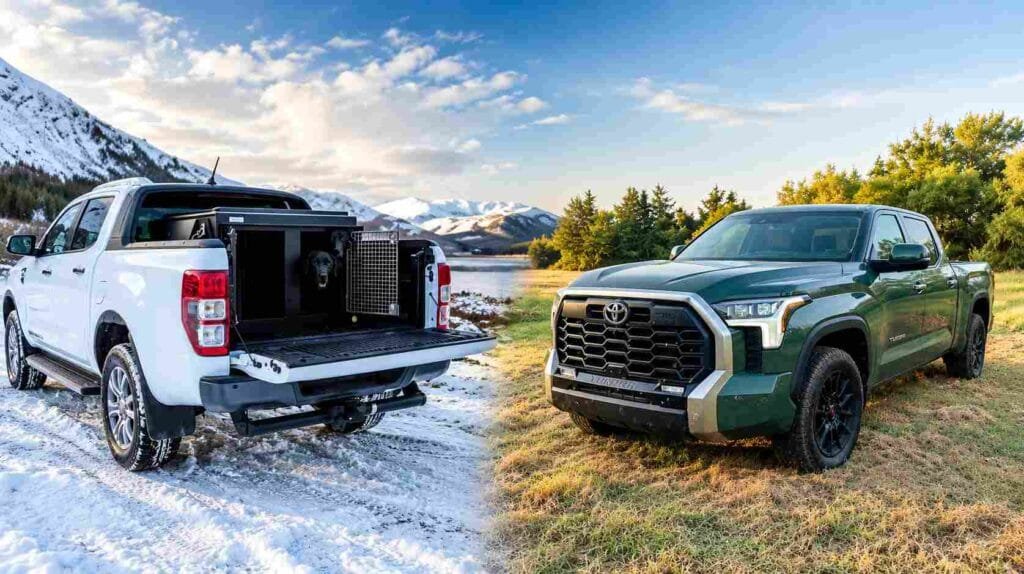
The four-door Jeep Wrangler suits owners who value off-road ability. A reviewer who travels with two toy-breed dogs describes car seats that fit in the back, mesh door pockets for water bottles, and floor space for a kennel and cushion. The trade-offs for larger dogs are a high step-in and a smaller cargo area than most SUVs offer.
The Honda Ridgeline is a truck built on a car-like platform. One review lists low sill heights for a truck, rear vents on every model, and a 60/40 rear bench that flips up against the rear bulkhead to free floor space for a pet or its carrier. A full-size crew cab like the Tundra gives a huge rear seat, though as noted above, running boards help medium and large dogs climb in.
Luxury and safety-first picks
If safety features and rear-seat comfort matter more than price, Volvo is the brand that comes up. One reviewer says the XC40 and XC60 offer easy-to-clean seat materials, a manageable entry height, and a rear-seat radar system that alerts you if something is left on the rear seats. That last feature is a useful safeguard against forgetting a pet in the back on a hot day, though it’s no substitute for checking. The V60 wagon also earns a place on lists because only a handful of wagons remain on sale, and they suit families with pets well.
Electric vehicles: Pet modes with caveats
EVs bring a few distinct advantages. The cabin is quiet, and some models have a dedicated feature for leaving an animal in a parked vehicle. The Rivian R1T and R1S have a Pet Mode that keeps the climate running and displays a message telling passers-by that the pet is safe. Tesla has a “dog mode” that keeps the air conditioning on and shows the interior temperature on the large screen.
These modes can help on short stops. They’re not a reason to leave animals for long periods. They rely on battery charge and software working as intended, and a system fault or a dead battery removes the protection. If you use one, stay close, keep the stop brief, and know the manufacturer’s stated limits.
Match the vehicle to the animal
Vehicle guides often skip the animal, and that’s a problem, because a 12-pound cat and a 110-pound mastiff have almost nothing in common.
Large and giant dogs
Large dogs need a crate that fits or a cargo area they can lie down in, and easy access is critical. Start with the opening and floor length, not the cargo volume. A dog that grows too big for the back of a car is a common surprise because a puppy that seemed tiny in the store can weigh 90 pounds in just one year.
For dogs a minivan or a three-row SUV with the seats down is usually the best choice. A ramp is part of the car: lifting a dog over and over is tough, on your back and its joints.
Two or more dogs
Multiple dogs raise the stakes on the layout.Some options include two crates side by side in a minivan or three-row SUV with a folded seat row or one dog in the cargo area and another belted on the back seat. Think about how the dogs act. If they fight or argue, it’s best to keep them in crates. That way each dog has its space and stays calm.
If you often take a friend’s dog along a three-row layout or a minivan gives you the most flexibility. You can fit dogs comfortably and adjust seating as needed. It makes trips easier when you’re traveling with, than one dog. The fold-flat floor of the gas Pacifica suits this best.
Small dogs and cats
Small animals travel best in something that contains them. I have found that a hard‑sided carrier or a crash‑tested small‑dog seat, which is secured to the vehicle is safer than a lap or a loose seat. On the seat a carrier can be secured with the seat belt or a carrier can be wedged on the floor behind a front seat if the manufacturer’s instructions allow.
Size opens up a lot of options. A compact SUV, a hatchback or even a sedan works. I always look for a spot for the carrier good airflow, for the carrier and a way to keep the sun off the animal.
Cats deserve a note of their own. Most cats do best in a solid carrier with a towel or blanket over the sides to reduce visual stress, and they shouldn’t roam the cabin. Never let a cat ride loose, because a frightened cat can hide under the pedals.
Puppies and senior dogs
Puppies need stops to go potty. They need protection to stay dry. They also need a spot to feel safe. They grow really fast. A liner or hammock that covers the whole back seat makes accidents easier to manage. Seniors have the opposite problem: they need a low entry and a stable surface. A low-riding wagon or crossover plus a ramp lets an older dog board without a jump. A ramp is much easier on joints than a lift.
Muddy, wet and shedding dogs
Some dogs come out of every walk soaked. For them waterproof liners, rubber mats and washable seat covers are more important than a vent. Raised clearance and AWD are helpful when reaching the trailhead. Nothing compares to a washable floor. They want a vehicle where the cargo area can be hosed out or wiped clean without taking out the carpet.
Anxious or carsick dogs
Motion sickness and anxiety are common. A smooth ride, a quiet cabin and a secure crate with a familiar blanket often help. Some dogs travel better facing forward with a sightline out the windshield. If yours doesn’t settle, talk to a vet before long trips.
Securing your pet
Choosing the right car is half the job. An animal that is not controlled in a crash or sudden stop can be dangerous for itself and for everyone inside the vehicle. A loose animal can also take the driver’s attention away. The tools you use are important. So is the way you put them in place.
Crates and carriers
A crate is only as safe as its construction and its tie-downs. The Center for Pet Safety (CPS), a nonprofit, has run crash tests on pet products for years. An investigative report says CPS has tested close to 400 pet car-restraint products since 2011, including harnesses, carriers and crates. Its tests use simulated animals, and CPS states that no live dogs or cats are used.
The findings should temper any blind trust in labels. In an early study, a wire crate held down with rubber straps failed the test, and the crate was severely deformed. A second wire crate held in place, but the test dog hit the back of the crate so hard that it broke through and hit the seatback. Anchor strength is a common theme. CPS’s founder has said that anchor points are critically important because a crate must not release in an accident, and that there are no federal testing or performance standards for these products.
Certification helps, but it has limits. One explainer notes that CPS certification indicates a crate didn’t fail catastrophically under test conditions, and doesn’t certify suitability for all vehicles or untested sizes. Certification can depend on crate size, orientation and tie-down use, so buy the tested size and set it up as tested.
A crate in a hatchback or SUV should sit against the seatbacks, tied down through the cargo anchors, with no room to slide. In a minivan, use the floor tie-downs.
Harnesses
For dogs riding on the back seat, a crash-tested harness clipped to the seat belt is the usual choice. CPS explains that regular walking harnesses aren’t designed to withstand crash forces, while certified harnesses spread the impact across the dog’s body. Fit is critical. A harness that’s too loose lets the dog slide, and one that’s too tight is uncomfortable.
Keep the dog in the back seat. Front-seat riding puts animals in the path of airbags.
Barriers
A cargo barrier keeps a dog out of the passenger cabin and the driver’s space, which cuts distraction. It does not turn the cargo area into a safe zone. CPS has drawn a distinction between a distraction-prevention crate and a crash-protection crate. A barrier belongs in the first category. If your dog rides loose behind one, understand that it’s protected from being a distraction, not from the crash.
Small pets and cats
Small animals should ride in a hard carrier secured on the seat with the belt or on the floor of the second row. The CPS distinction between the two setups is this: a crate is restrained in the back of a van or SUV, and a carrier sits on the back seat, attached by a seat belt. A carrier that slides around is a hazard.
Where pets should not ride
Not on the driver’s lap. Not in the front passenger seat. Not in the open bed of a pickup. Not with their heads out the window, since debris and sudden stops cause injuries.
A word on the law
Rules vary. Some states require dog restraints explicitly while other states rely on distracted‑driving or animal‑cruelty laws. Several states also limit dogs in truck beds. Sources differ on which state has which rule and laws change. One summary says that in states distracted‑driving laws can be used against a driver whose dog creates a distraction even if there is no law that mentions pets. Check your rules and remember that the law is only a minimum requirement, not a full safety plan.
Heat, cold and airflow
Heat is the most dangerous everyday risk. The American Veterinary Medical Association says that the temperature inside a vehicle can rise 20 degrees Fahrenheit in ten minutes and almost 30 degrees in twenty minutes and after one hour the temperature inside a vehicle can be more than 40 degrees higher than outside. On a seventy‑degree day the temperature inside a vehicle can be, over one hundred ten degrees. The AVMA’s table lists rises of 19°F at 10 minutes, 29°F at 20, 34°F at 30, and 43°F at 60.
Cracking the windows doesn’t fix this. The American Kennel Club, citing AVMA, says a parked car with cracked windows heats at almost the same rate as one with the windows rolled up. Leaving the engine idling with the air conditioning on is not reliable either. An AVMA representative notes that many modern vehicles shut off automatically after 10 to 15 minutes of idling.
Cold can be a risk too. The AVMA page addresses both hot and cold vehicles. In winter, the cabin loses heat quickly once the engine is off, and small or short-haired animals are most vulnerable. The practical answer: if the animal can’t come with you, leave it at home. For the rest of the trip, use rear vents, sunshades, water, and regular stops. Plan breaks about every couple of hours on a long drive for water, a short walk and a bathroom stop.
Accessories worth the money
The right accessories make an ordinary car a good pet vehicle, and a few are worth prioritizing.
- Cargo liner: A custom-fit rubberized liner protects the floor and cleans easily. Check availability for your model.
- Rear seat cover or hammock: Keeps hair, mud and claws off the upholstery and blocks a dog from stepping into the footwell.
- Ramp or step: Saves joints for older or heavy dogs. Test that it fits your vehicle’s opening.
- Crash-tested harness or crate: Buy tested sizes and follow the installation instructions.
- Cargo barrier: Useful for keeping a dog out of the cabin, with the limits noted above.
- Side-window shades: Reduce sun and heat in the rear.
- Travel kit: A collapsible bowl, water, waste bags, a leash, cleanup supplies and a towel.
How to test-drive a car with your pet
The most reliable way to judge a vehicle is to try it with your animal. Some retailers offer return windows that make this easier, and many dealers will let you load a crate on a test drive if you ask. Here’s a routine that works:
- Bring your crate or carrier. Load it into the cargo area and see whether it fits with the cover in place and the tailgate closing.
- Measure the opening and floor. Check width at the narrowest point, height under the cover, and floor length with seats up and down.
- Check the lift. Measure the load height, or watch your dog get in. A dog that hesitates at a showroom sill will struggle every day.
- Fold the seats. Look for steps, slopes and gaps. The floor should be flat enough to keep a crate stable.
- Find the anchors. Locate the tie-down points, seat-belt geometry and any rear-seat tether hardware. Confirm they match your restraint.
- Test the rear climate. Sit in the back with the air conditioning on. Feel for airflow.
- Sniff and wipe. Look at the upholstery and carpet. Ask what cleaning products are safe.
- Check the doors and windows. Make sure you can lock the rear windows and child locks, and note how wide the doors open.
- Drive a rough patch. Take a route with turns and bumps. Watch the crate and listen for rattles.
- Ask about accessories. Confirm liners, barriers and covers exist for this exact model and year.
New or used?
A used vehicle is often the smarter choice. Pet ownership wears interiors regardless of age, and letting the first owner absorb the steepest depreciation leaves more budget for liners, barriers and restraints. Nalley suggests that a certified pre-owned SUV lets the first owner absorb the steepest depreciation and leaves money for accessories.
When you inspect a used vehicle that carried animals, check for chewed trim, scratched door panels, stained carpet and lingering odor. Pull up the cargo liner and look at the floor beneath. A deep clean removes most smells, but fabric damage is permanent. And if a return window exists, use it to try your actual crate.
Common mistakes to avoid
- Buying on cubic feet alone. Opening shape, wheel wells and roof height decide whether a crate fits.
- Ignoring load height. A dog that can’t get in unaided means lifting every day.
- Trusting “crash-tested” labels blindly. Look for independent testing and buy the tested size.
- Assuming a barrier equals safety. It stops distraction, not crash forces.
- Leaving the pet “just for a minute.” Interior temperatures climb quickly.
- Skipping the fit test. Carry your crate and your dog before you sign.
- Forgetting your dog will grow. Buy for the adult size.
Where this leaves you
The best car for your pets is the one that fits your animal, your crate and your routine. That lets you restrain them properly. For people that means a midsize or compact crossover like the Outback or CR-V. If you have animals or more, than one pet go for a three-row SUV or a minivan. Choose the Pacifica if you need a flat floor. For pets nearly any compact vehicle works. Whatever you pick measure your crate watch your dog board and set up the restraint before the road trip.
FAQs
Q.1 What is the best SUV for a large dog?
A midsize or three-row SUV with a wide, square cargo opening and a flat floor suits large dogs best. The CR-V’s roughly 39 cubic feet behind the seats suits one big dog, and the Telluride’s larger space helps with two or with oversized crates. Measure your crate against the opening before deciding.
Q.2 Do I need an SUV to travel with a dog?
No. Wagons, hatchbacks and even sedans work for small and medium dogs, especially with a harness or carrier on the back seat. An SUV or minivan makes loading easier and gives space for crates, which matters more as dogs get bigger.
Q.3 Is it safe for a dog to ride in the cargo area?
It can be, if the dog is in a secured crate. A loose dog in the cargo area is at risk in a crash and can be thrown forward. A barrier stops it from entering the cabin but doesn’t protect it in an impact, so a tied-down crate is the safer setup.
Q.4 Are leather seats better for pets than cloth?
Leather and leatherette wipe clean and don’t hold hair the way cloth does, though claws can mark them. A seat cover or hammock protects either material. Some manufacturers offer water-resistant upholstery on certain trims, so ask about it.
Q.5 Can I leave my dog in the car with the air conditioning on?
Not safely. Idling is unreliable, since many modern vehicles shut off after 10 to 15 minutes, and interior temperatures can rise quickly. Some EVs offer pet-comfort modes, but they depend on battery and software and shouldn’t be used for long stops.
Q.6 Which is better for pets: a minivan or a three-row SUV?
A minivan usually offers a lower floor, sliding doors and more fold-flat space, particularly the gas Chrysler Pacifica with Stow ‘n Go. A three-row SUV like the Telluride offers AWD and a more rugged look but less room behind the third row. Choose based on how much cargo space you need with the seats up.
Q.7 How do I know if a crate will fit my car?
Measure the crate’s outside length, width and height. Then measure the vehicle’s cargo opening at its narrowest point, the floor length with the seats up or folded, and the height under the cargo cover. Better yet, load the crate into the vehicle before you buy.
Protect the seats on the way: see our premium dog car seat covers.

Aiden is the founder and editor of CarSeatHaven. He researches NHTSA safety standards, AAP guidance, manufacturer manuals, and recall notices, and turns them into plain-language car seat guides for parents.
